
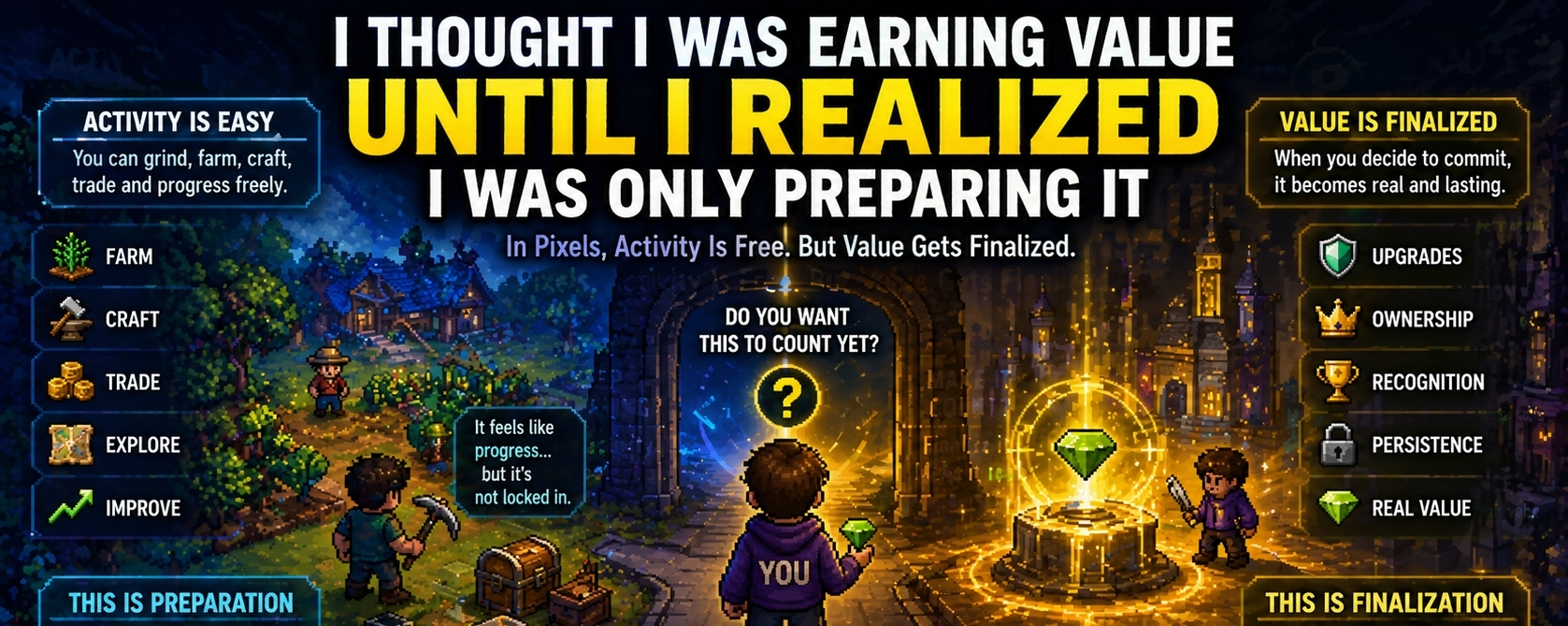
I used to believe that if a game lets me grind, trade, and progress freely, then whatever I build is already mine in a meaningful way. It felt obvious to me that effort goes in and value comes out. That’s the loop I trusted, especially in systems that talk about ownership and open economies. But the longer I stayed inside Pixels, the more I started feeling a quiet disconnect between what I was doing and what actually stayed.
At first, I ignored it because everything looked active and rewarding. I was constantly moving, producing, and improving my routines. Nothing was stopping me and the system felt smooth. But over time, I began to notice that not everything I touched carried the same weight. Some actions felt temporary, almost like they were waiting for something. Not blocked, not lost, just unfinished in a way I couldn’t fully explain at the beginning. #pixel
That’s when I started questioning my own assumption. I realized I wasn’t always creating value. A lot of the time, I was just preparing it. There is a real difference between doing something and having that thing recognized in a lasting way. It is a small gap, but once I noticed it, it changed how I saw everything. I could spend hours farming, optimizing paths, and stacking resources, and still feel like none of it had fully crossed into something final.
What surprised me most was not the system itself, but my own behavior inside it. I started hesitating in moments where I normally wouldn’t. Not because I was confused, but because I was thinking more carefully. I would reach a point where I could upgrade or commit to something meaningful, and instead of doing it instantly, I paused. I started asking myself if this was the right time. That question had nothing to do with difficulty and everything to do with timing.
That shift changed how the game felt to me. In most games, timing is about speed and efficiency. Here, timing started to feel like weight. Acting too early felt like locking in something before it had reached its full potential, while waiting longer felt more strategic but also carried its own risks. It introduced a layer that was never clearly explained, yet it quietly shaped the way I approached every important decision.
I began to see the system less as a place where value flows freely and more as a place where value forms in stages. First comes activity, which is flexible and continuous. Then comes a second layer where that activity either becomes something lasting or stays in a kind of in between state. That second step is not forced immediately. I can delay it, ignore it, or approach it carefully, but at some point, if I want what I have done to truly matter, I have to make a decision.
What makes this even more interesting is that not every player handles that moment the same way. Some players finalize everything quickly, turning progress into something concrete as soon as possible. Others hold back, stacking potential and waiting for what they believe is the right moment. I find myself moving between both approaches, sometimes committing early and sometimes waiting longer, depending on how I read the situation.
This creates a different kind of pressure that does not come from the game directly, but from the choices I make inside it. It forces me to think about value not as something automatic, but as something that requires intention. And intention changes everything, because once a decision is made, it carries more weight than the action that led to it. $PIXEL
At the same time, I can see how delicate this balance is. If committing value becomes too difficult or too costly, I might start avoiding it altogether and remain in a loop of endless activity without ever finalizing anything meaningful. On the other hand, if everything becomes too easy to lock in, then the distinction disappears and the system risks falling back into the same problems of overproduction and low value that many other games have faced.
What stays with me the most is not any single feature, but the realization that the game does not just respond to what I do. It responds to when I decide it matters. That creates a very different relationship between me and the system. I am not just playing and progressing, I am choosing moments that define whether my actions become something lasting. $PIXEL
I do not think most players will describe it this way, but they will feel it in small decisions and brief pauses. That is enough for a system like this to work. It does not need to explain itself fully. It only needs to guide behavior in subtle ways.
Now when I play, I no longer see progress as something instant or guaranteed. It feels more staged and more intentional. Every time I reach a meaningful point, it feels like the system is quietly asking me a simple question. Do you want this to count yet. @Pixels