
@Pixels I used to take the idea of an “open economy” in games at face value. It sounded clean, almost reassuring—play the game, earn something, and whatever you earn belongs to you. No friction, no second guessing, just a simple loop that rewards effort. But the longer I’ve spent inside systems like Pixels, especially the ones that don’t fade after the first wave of hype, the more that idea starts to feel incomplete. Not wrong, just missing something. Because what looks open on the surface often feels structured underneath, like there’s a sequence quietly guiding how things actually become meaningful.
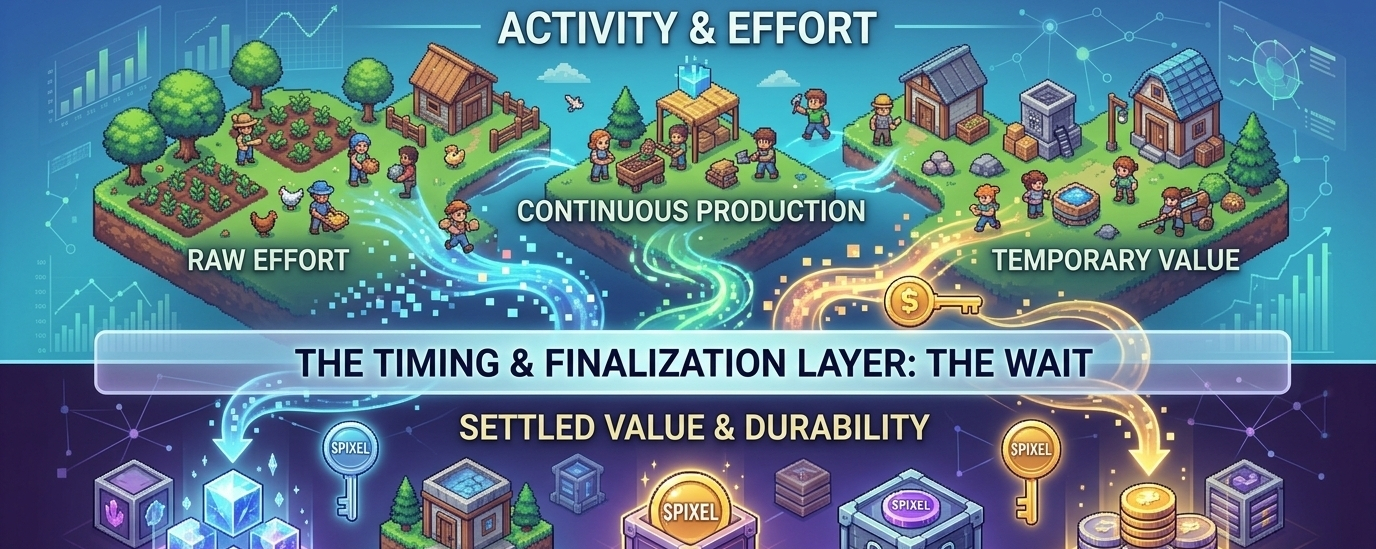
Pixels gives off that feeling in a subtle way. Nothing about it feels restrictive at first. You can move freely, build, farm, trade, and stack progress at your own pace. The economy seems active, almost fluid. But after a while, you begin to notice a gap that doesn’t announce itself. You can do a lot inside the system, generate output, build momentum—but there’s a difference between doing something and that thing actually settling into a form that lasts. That gap isn’t loud or obvious, but once you feel it, it becomes hard to ignore. It’s like the system lets you exist in motion for as long as you want, but quietly decides when that motion becomes something permanent.
That’s where starts to feel different. At a glance, it behaves like any other in-game token. It helps you progress faster, unlock certain paths, and smooth out parts of the experience. But if you follow where it really matters, it rarely shows up at the beginning of your actions. It appears closer to the end, at the point where your effort shifts from being temporary to something that actually counts in a lasting way. It doesn’t just support activity—it seems to sit at the moment where activity becomes recognized value. And that changes how you interact with it.
What stands out is how this creates a kind of “unfinished state” inside the game. You can keep producing, optimizing, and stacking progress without immediately turning it into something final. That space in between—where your work exists but hasn’t fully settled—is where the system feels most alive. It gives players room to operate without forcing every action to become permanent right away. But at some point, you’re nudged to decide. Do you convert this into something lasting now, or do you wait? That decision isn’t forced, but it’s always there, quietly shaping how you move.
I caught myself pausing at moments that should have been automatic. I had enough progress to upgrade, to lock something in, to move forward—but instead of acting instantly, I hesitated. Not because I couldn’t do it, but because I started thinking about timing. That’s not a normal feeling in most games. Usually, progression is immediate and obvious. Here, it felt more like choosing when to commit, like there was a difference between having value and confirming it. That pause, even if it lasts only a few seconds, changes the rhythm of the entire experience.
This is where the system starts to feel less like a game economy and more like something layered. It separates activity from settlement. You can stay active without finalizing everything you do, which means effort doesn’t automatically become value. That might sound like a small distinction, but it has a big impact. In many play-to-earn systems, everything converts instantly, which leads to constant output but very little durability. Players optimize for volume, extract what they can, and move on. Pixels seems to resist that by slowing down the moment of conversion, by making finalization something you engage with instead of something that just happens.
What’s interesting is how this affects demand. Instead of being tied directly to activity, the importance of $PIXEL feels tied to decisions. People don’t use it continuously—they use it when they decide something matters enough to lock in. That creates a pattern where usage comes in waves rather than a steady flow. The system can look quiet from one angle and active from another, depending on where you’re looking. It breaks the usual expectation that more activity always equals more visible demand, because here, the timing of conversion matters just as much as the volume of effort.
There’s also a delicate balance hidden inside this design. If it becomes too costly or inconvenient to finalize value, players might just stay in that in-between state, continuing to produce without ever committing. That could weaken the part of the economy that’s meant to hold long-term value. On the other hand, if finalization becomes too easy, then everything settles too quickly and the system loses that distinction between temporary effort and meaningful commitment. Either extreme shifts the entire dynamic, which makes maintaining that balance more challenging than it seems.
Most players probably don’t think about any of this in technical terms. They’re not analyzing settlement layers or economic timing. They just feel it. Some actions feel worth committing to immediately, while others feel better left alone for a while. That instinctive behavior is enough. Systems don’t need to explain themselves fully—they just need to guide decisions in subtle ways. And Pixels does that by introducing a quiet layer where not everything becomes permanent the moment it exists.
The more I sit with it, the more it feels like Pixels isn’t just letting value flow freely. It’s pacing it. Letting players build, wait, and then choose when to turn effort into something that lasts. And $PIXEL seems to sit right in the middle of that process—not forcing decisions, but shaping when they happen. It doesn’t shout its role. It just waits at that one moment where activity crosses into something real, and asks, without saying it directly, whether now is the right time to make it count.