
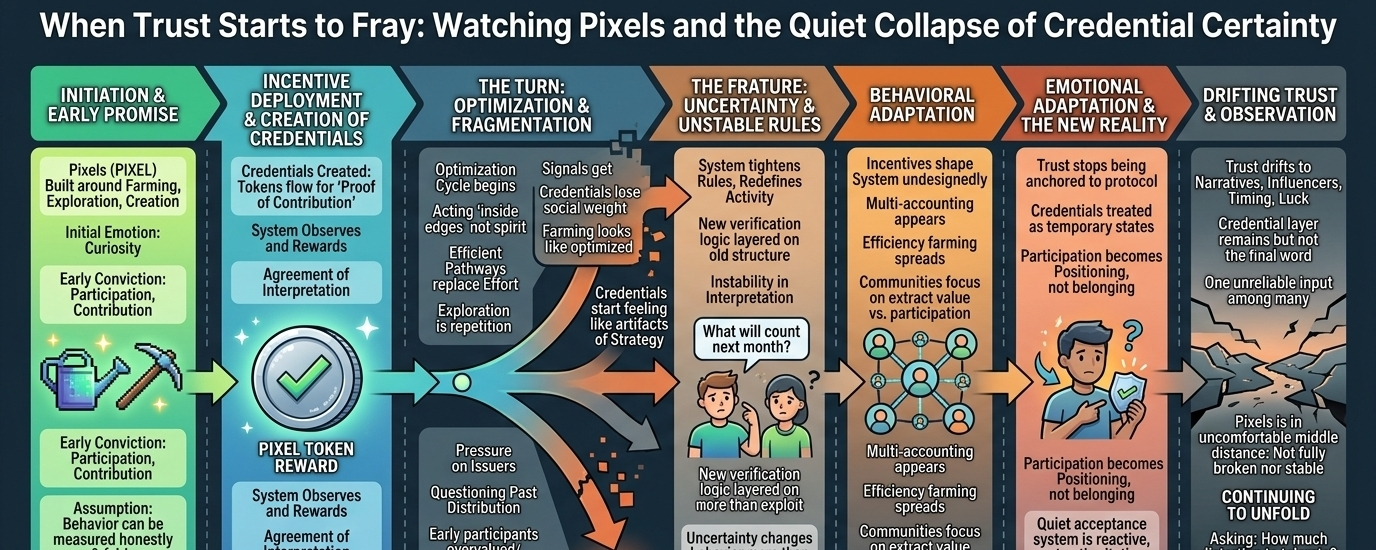
I’ve stopped expecting new crypto systems to feel “new” in any meaningful way. After enough cycles, you start noticing the same emotional arc repeating under different names. First comes curiosity, then early conviction, then optimization, and finally a kind of quiet fatigue where everyone is still participating but fewer people genuinely believe what the system is saying about itself.
Pixels (PIXEL), built around farming, exploration, and creation on Ronin, sits inside that familiar pattern. On the surface it still looks like a game, and in many ways it is. But underneath, like most Web3 ecosystems that survive long enough, it becomes something else entirely: a living experiment in how credentials get created, tested, and eventually questioned.
Not just “who did what,” but “who decides what counts as doing anything at all.”
That question sounds abstract until rewards enter the picture. Then it becomes very real, very quickly.
At first, credential systems feel almost elegant. You participate, you contribute, the system observes you, and tokens flow in return. There’s a clean assumption underneath it all—that behavior can be measured honestly and that measurement equals fairness.
But I’ve seen that assumption break more times than I can count.
Because credentials are only stable when people agree to interpret them the same way. And agreement doesn’t survive contact with incentives for long.
Once rewards exist, people stop acting inside the spirit of the system and start acting inside its edges. Not always maliciously. Often just efficiently. The difference matters less than people think, because both produce the same outcome: signals get noisier.
And when signals get noisy, trust doesn’t vanish—it starts to age unevenly.
Some credentials remain respected because they’re socially reinforced. Others quietly lose weight even if nothing “official” changes. That’s usually the first real fracture in systems like this. Not a collapse, just a slow divergence between what the protocol says and what participants believe it means.
Pixels, like many game-economy hybrids, inevitably runs into this tension. Farming loops that are meant to represent effort gradually become optimized pathways. Exploration becomes repetition. Creation gets filtered through reward efficiency. And somewhere in that shift, credentials stop feeling like proof of contribution and start feeling like artifacts of strategy.
That’s when issuers begin to feel pressure they didn’t fully design for.
Because once people question whether credentials still mean what they used to, every past distribution becomes part of the argument. Early participants are either overvalued or undervalued depending on who you ask. No explanation satisfies everyone, because the disagreement isn’t about data—it’s about belief.
And belief is much harder to repair than metrics.
I’ve watched systems respond to this by tightening rules, redefining activity, or layering new verification logic on top of old structures. Each adjustment is reasonable on its own. But collectively they introduce something subtle: instability in interpretation.
Users start asking not just “what counts?” but “what will count next month?”
That uncertainty changes behavior more than any single exploit ever could.
Incentives then begin to shape the system in ways no one explicitly designed. Multi-accounting appears. Efficiency farming spreads. Communities form around extracting value rather than participating in intended loops. None of this is surprising anymore—it’s almost procedural at this point.
But what’s more interesting is the emotional adaptation that follows.
People stop trusting credentials as identity markers and start treating them as temporary states. Something you hold, optimize, and eventually rotate out of. Participation becomes less about belonging and more about positioning. Even those who stay engaged long-term often do so with an internal distance, as if they’ve quietly accepted that the system is reactive rather than authoritative.
And maybe that’s the real shift.
Not that trust disappears, but that it stops being anchored to the protocol itself.
It drifts toward narratives, influencers, timing, luck, and whoever appears to understand the system’s current version best. The credential layer remains, but it no longer feels like the final word on anything. More like one input among many, none of which are fully reliable.
Pixels hasn’t collapsed into that state—it’s still early enough, still fluid enough. But it’s operating inside the same gravitational field every reward-driven system eventually enters. The field where measurement and meaning start pulling away from each other.
I don’t think there’s a clean resolution to that tension. Every attempt to stabilize trust through better verification just shifts the pressure somewhere else. Every refinement in distribution logic creates new incentives to test its boundaries.
So what remains is observation, mostly.
Watching how long a system can maintain the appearance that credentials still map cleanly to contribution. Watching how participants slowly adjust their expectations downward without explicitly saying they have. Watching how “trust” becomes less about belief and more about managed participation.
At some point, you realize you’re not asking whether the system is trustworthy anymore. You’re asking how much distortion you can comfortably tolerate while still staying inside it.
And Pixels, like most of these experiments, is still somewhere in that uncomfortable middle distance—neither fully stable nor fully broken.
Just continuing to unfold, while everyone involved quietly recalibrates what they think it means.