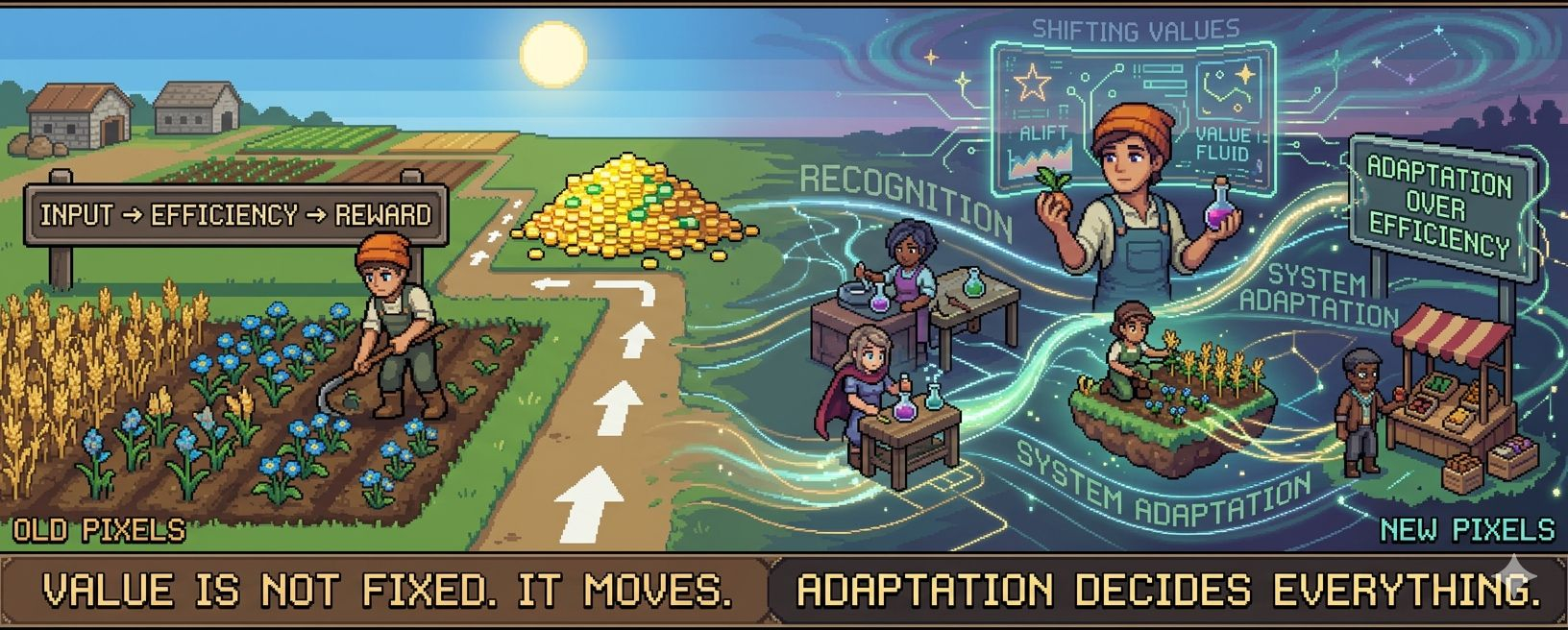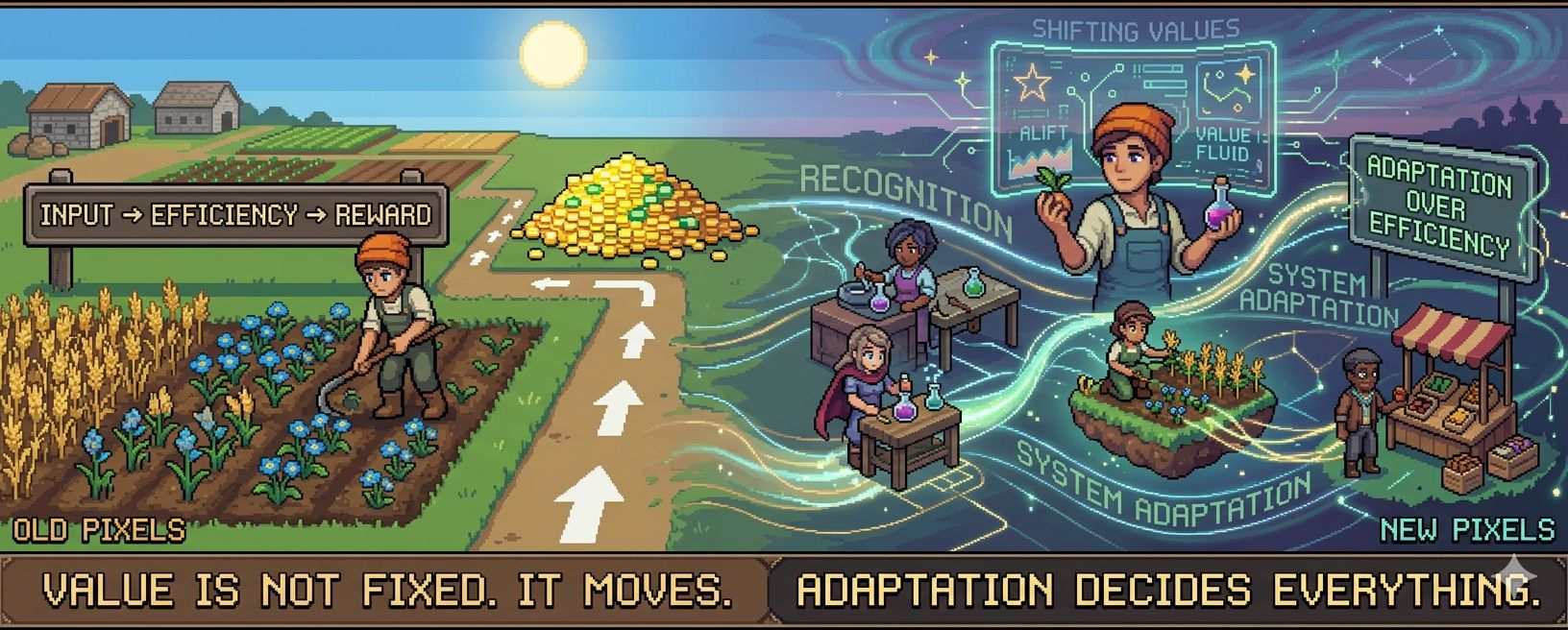
I didn’t log into Pixels expecting to question how value actually works. I just opened the game like I always do, ran the same loops, followed the same rhythm. For a while, everything made sense. You do something, you get something. Effort goes in, rewards come out. Clean, predictable, fair.
But lately, that relationship hasn’t felt stable.
Nothing is visibly broken. The mechanics are still there. Farming still works. Crafting still works. Trading still works. And yet, the outcome of doing those same things doesn’t feel as consistent anymore. Not in a chaotic way just… slightly off. Subtly uneven.
The more I paid attention, the more I realized what actually changed.
Pixels didn’t change what I can do.
It changed what counts.
Before, value felt like it lived inside the action itself. If I optimized my farming, I got better returns. If I improved efficiency, I saw the results. It was linear enough that you could trust the loop. The system didn’t feel like it had opinions. It just processed effort.
Now it feels different.
Two players can run the exact same loop same crops, same timing, same energy and still walk away with different outcomes. Not because of randomness. Not because one made a mistake. But because one of those behaviors aligned better with what the system is currently favoring.
That’s the shift most people don’t notice at first.
Value isn’t something you produce anymore.
It’s something the system chooses to recognize.
And once that clicks, the game changes.
I stopped thinking of Pixels as a fixed economy. It feels more like a layered system now. On the surface, nothing has changed. The same actions exist, the same loops are available, the same paths are open. But underneath that, there’s something quietly adjusting the weight of those actions. Not telling you what to do but influencing what matters more at any given moment.
It doesn’t force behavior.
It filters it.
And that’s a big difference.
Because now the real question isn’t “What’s the best thing to do?”
It’s “What does the system want to see right now?”
That realization hit harder when I noticed something else. It’s no longer enough to optimize a single task. A farming loop on its own can feel flat. But when I connect it with the right crafting decisions, or shift my timing slightly, the outcome changes. Not dramatically, but consistently enough that it can’t be ignored.
That’s when it became clear.
The system isn’t evaluating actions in isolation anymore.
It’s evaluating patterns.
Value isn’t tied to what you do.
It emerges from how your actions connect.
And that changes everything about how you play.
You’re not optimizing tasks anymore. You’re shaping behavior. You’re experimenting with sequences, trying to find alignment instead of just efficiency. The loop hasn’t disappeared but it’s no longer the full picture.
There’s also a deeper shift hiding underneath all of this, and it’s a bit uncomfortable once you see it.
Before, it felt like I was discovering strategies inside a neutral system. The game didn’t care what I chose .it just rewarded whatever worked best. That gave a strong sense of control.
Now it feels like the system already has preferences.
And I’m adapting to them.
That creates a quiet tension. Am I still freely optimizing, or am I aligning myself with an invisible logic I can’t fully see? Because when value depends on recognition, behavior starts drifting toward what the system favors not necessarily what I would naturally choose.
My agency is still there.
But it’s no longer untouched.
At the same time, I can’t ignore why this design works. Most game economies don’t fail because they’re broken. They fail because they become too clear. Players find the best loop, optimize it, and everyone follows. Over time, everything converges into one dominant strategy, and the system stops evolving.
That’s not happening here.
By constantly shifting which behaviors are weighted more heavily, the system avoids stagnation. It keeps players moving, adjusting, experimenting. No single loop stays dominant for too long. Efficiency becomes temporary. Strategy becomes fluid.
The system stays alive because nothing is allowed to settle.
But that comes with a trade off.
Clarity fades. Stability weakens. Effort no longer guarantees proportional results. And if you’re expecting a fixed relationship between input and output, it starts to feel inconsistent.
It isn’t inconsistent though.
It’s responsive.
The real shift for me wasn’t about the game. It was about how I understand incentives.
I used to think incentives followed behavior. You act, the system rewards. Simple.
Now it feels reversed.
Incentives don’t follow behavior.
They shape it.
They define which paths players explore, which strategies emerge, which habits form over time. Without forcing anything, they quietly guide everything.
And that leads to the one idea I can’t unsee anymore.
Value isn’t fixed.
It moves.
The same action can matter today, lose relevance tomorrow, and return later depending on how the system shifts its recognition. That turns Pixels into something very different from what it first appears to be.
It’s not a machine where repetition guarantees progress.
It’s an ecosystem where adaptation decides everything.
And once you understand that, the goal changes.
You don’t win by doing more.
You win by staying aligned before everyone else realizes what matters.