
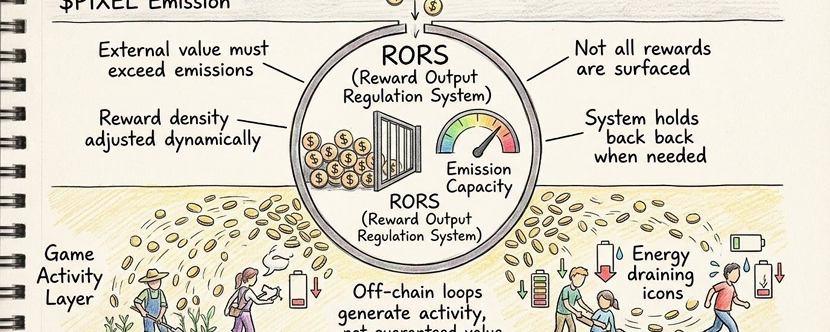
One thing I keep circling back to in @Pixels is something I used to ignore because it seemed impossible to measure, and because of that I assumed it probably did not matter. I mean the things players almost do, but don’t. The routes considered and abandoned before starting them. The upgrades delayed until later and then quietly forgotten. The loops entered halfway and exited before they ever became habit. At first all of that looks like absence, almost like empty space around the “real” activity that supposedly matters. If something never becomes action, it feels natural to assume it leaves no economic trace.
But lately I keep wondering whether those unrealized behaviors may be doing more work than they appear.
Because we usually think systems respond to what players do. Activity creates signals, signals shape incentives, incentives redirect behavior. That logic feels straightforward. But what if part of what shapes a system also comes from behavior that repeatedly approaches formation and then stops. Not failed participation exactly, but suppressed participation. Intentions that gather, hesitate, and dissolve before turning into stable behavior.
That feels different from the way game economies are normally discussed.
And it started bothering me because some friction in systems does not show up through visible breakdowns. It shows up through hesitation. Players do not always reject a loop by abandoning it outright. Sometimes they hover around it. Revisit it. Delay deeper involvement. Almost commit, then drift away. From the outside that can look like nothing happened.
But maybe something did.
Maybe repeated non-formation leaves traces too.
The thought sounds strange because economics usually likes positive events. Transactions, usage, throughput, volume — things that can be counted. But pressure in systems often appears before visible failure, and sometimes it appears exactly where something almost scales but repeatedly doesn’t. Not through collapse, but through unrealized momentu
And I keep wondering whether some of that exists inside Pixels.
Because if players repeatedly approach certain paths but stop short of deep engagement, that may be saying something long before participation metrics make it obvious. Not through activity itself, but through avoided activity. Through where intention keeps meeting friction.
That possibility changes how absence feels.
Absence may not always mean irrelevance
Sometimes it may hold diagnostic weight.
And maybe strong systems pay attention to that in ways players rarely notice.
I think that is partly why top creators’ articles often score well when they follow this kind of path. They do not take a visible mechanic and simply explain it. They take something usually treated as background — waiting, hesitation, timing, silence — and ask whether hidden economic logic may live there. The power is not in sounding abstract. It is in making something ordinary suddenly look structurally strange.
That is what I am trying to get at here.
Because unrealized intent is easy to dismiss precisely because it never reaches the reward surface. But suppose many players keep moving toward the same upgrade path and repeatedly pull away at similar stages. Or approach a loop over and over without fully adopting it. That pattern may not show up as participation, but it may still reveal where commitment is thinning
And thinning commitment is information.
Maybe not loud information.
But pressure information.
And pressure often shapes systems long before visible failures emerge.
That possibility makes me wonder whether some value in Pixels may partly depend on what never happens, not only what does. Because a loop players avoid deepening may influence how incentives around it evolve. A mechanic repeatedly approached but not embraced may quietly reveal where reward weight cannot be pushed indefinitely, even if nobody says so explicitly.
That starts making unrealized behavior feel less like empty possibility and more like negative-space evidence
And negative space can matter.
In art, what is omitted often helps define form. Maybe in economies, what fails to materialize can help define where value actually holds.
I know that sounds abstract, but the longer I sit with it, the less abstract it feels.
Because systems often look strongest when everyone focuses on visible growth. But sometimes deeper signals live in stalled growth. In what almost became behavior, but never fully did.
That may matter for sustainability.
Extraction often reveals itself through what gets overused.
Fragility may reveal itself through what repeatedly fails to become used enough.
Those are different warnings.
And maybe both belong inside how a system learns.
That is why this angle keeps unsettling me. It shifts attention away from rewarded activity toward unrealized participation pressure. And that is not where most people naturally look.
But maybe that is exactly why it is interesting.
Because value is usually discussed as what incentives produce.
Rarely as what incentives fail to fully attract.
And yet the second may tell us just as much.
Possibly more.
Because visible behavior can be strategic
Near-behavior may be harder to fake.
It often reveals where intention meets friction.
And that boundary is where systems quietly expose themselves.
I am not fully settled on it. Maybe abandoned intentions are just abandoned intentions. Maybe hesitation carries no structural significance at all.
But the thought keeps returning because it makes the economy feel less shaped only by completed loops and more shaped by pressures surrounding loops that almost form
And that feels like a very different lens.
Not what players commit to.
What commitment repeatedly approaches but does not cross into.
And maybe one of the stranger questions inside Pixels is whether some of the economy’s hidden signals live exactly there.
Not in what players do.
In what they keep nearly doing.