
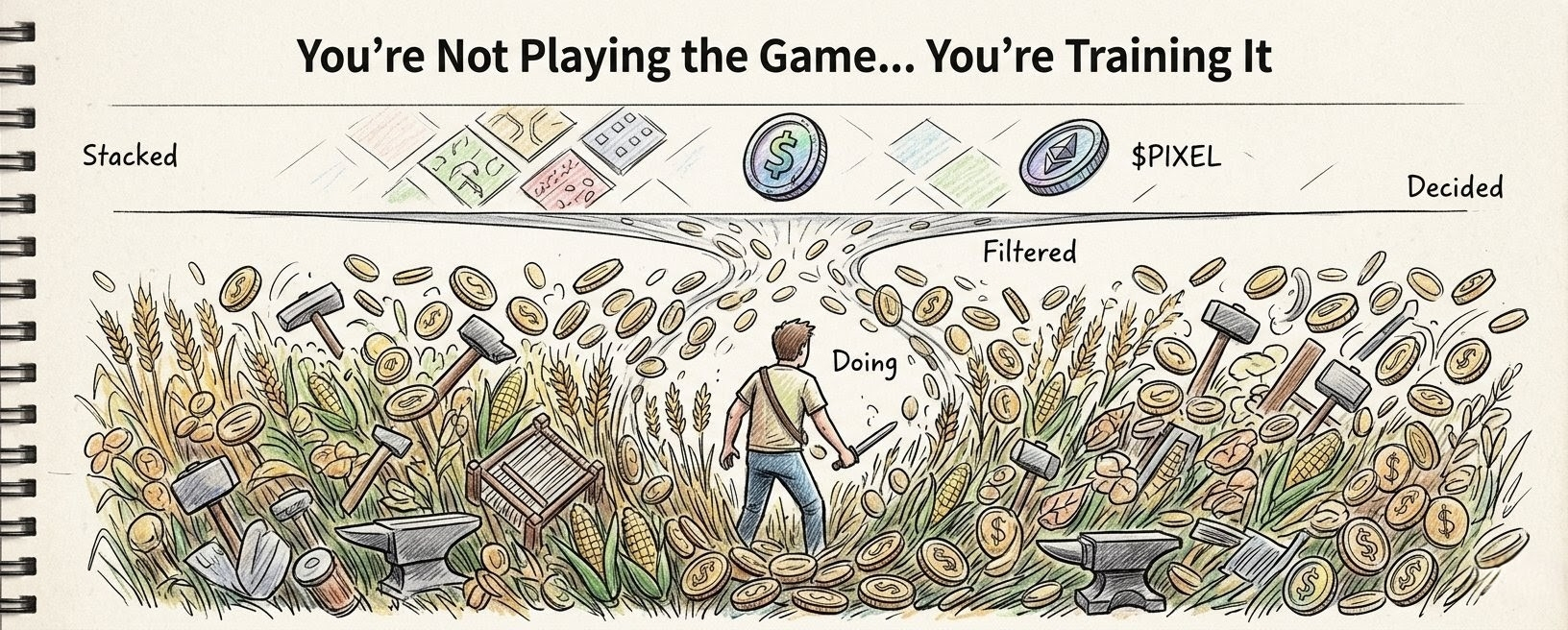

i keep thinking rewards inside Pixels are easy to misunderstand because they show up after activity.
so my brain does the lazy thing.
i farm, i craft, i move, i finish something, maybe the Task Board gives me a reason to care, maybe Pixels appears somewhere in the distance, and then i start connecting those things too cleanly… like the reward came because i did the action.
but i don’t think that’s the real shape anymore.
not inside Pixels.
because activity by itself is cheap here. that sounds harsh but it feels true. the game can absorb a lot of it because most of the Pixels loop is off-chain anyway… movement, farming, crafting, NPC interactions, Coins flowing around, daily repetition, all the little things that make the world feel alive without forcing Ronin to care about every click.
so if activity is easy to produce, why would the Pixels system reward all of it… why would every action deserve weight.
that question keeps making the loop feel different to me.
because old play-to-earn treated activity like proof. you played, so you earned. you repeated, so you extracted. you showed up long enough, so value had to come out somewhere. and that is exactly where so many of those economies started bleeding, because the game wasn’t really asking whether the activity helped anything survive.
it was just paying motion.
Pixels feels like it learned that lesson in a colder way.
because Stacked doesn’t sound like “reward app” to me anymore. not really. it sounds more like the layer asking which behavior is worth buying again. which player action actually improves something… retention, revenue, return patterns, maybe the small boring signals that decide whether a game is healthier tomorrow than it was today on Pixels.
and that is a different kind of reward.
not thank you for playing.
more like… we want this behavior to happen again.
that feels almost uncomfortable because Pixels turns rewards into something less friendly. from the player side, a reward feels like a prize. from the system side, it is closer to a purchase. Pixels is not just handing out value because the loop moved. it is spending only when the behavior looks useful enough to fund under RORS.
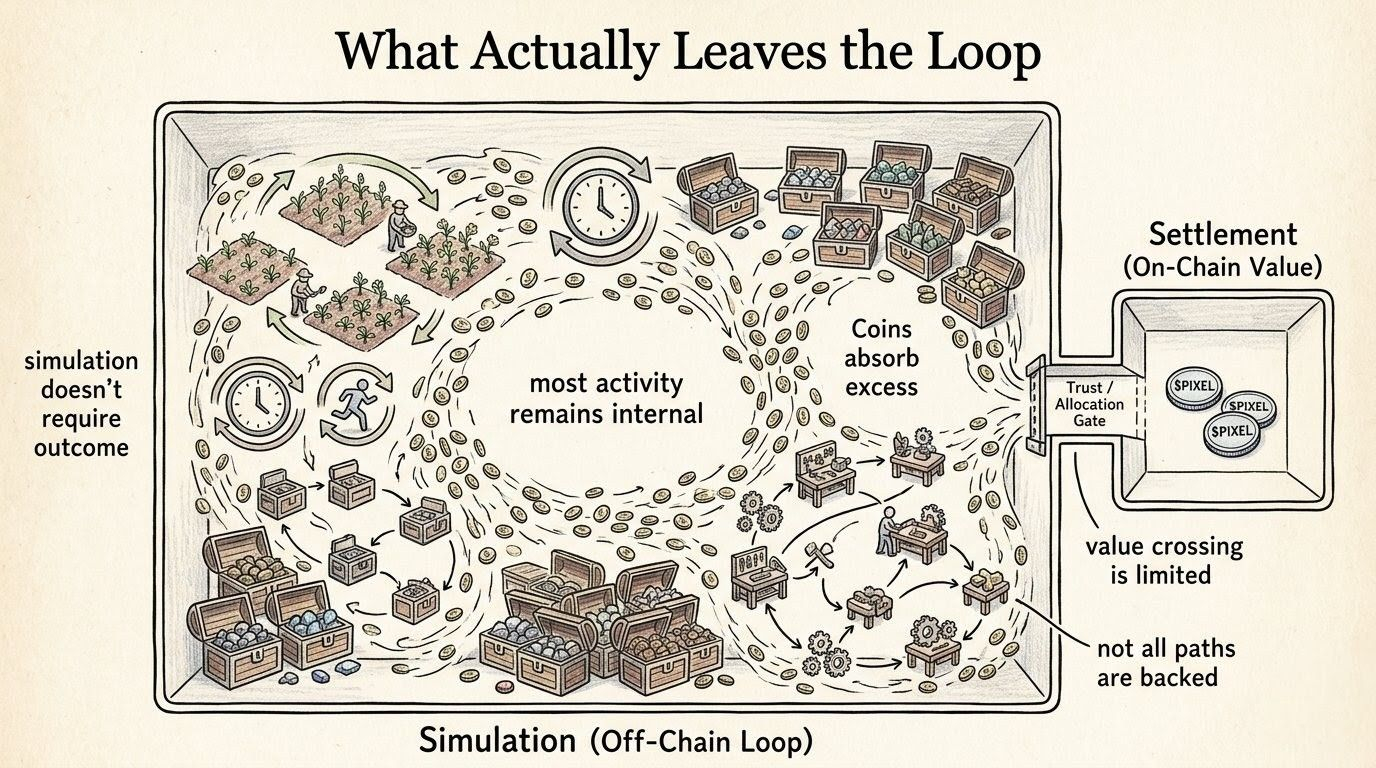
so then what am i actually doing when i chase a reward… am i earning, or am i becoming the kind of behavior the Pixels system wants to repeat.
that part gets stuck in my head because it explains why “activity” and “value” are not the same thing in Pixels. i can do a lot inside the game and most of it can stay inside Coins, soft, circulating, not needing any serious accounting. but the moment something starts moving toward Pixels, toward a reward that has real cost, it has to answer a harder question.
did this behavior pay back.
not morally, not emotionally, just economically.
did it help the system more than it cost.
and that is where Pixels RORS starts feeling like the quiet ceiling over everything. Return on Reward Spend is not just some metric sitting in a document. it changes the meaning of the reward itself. if $1 in rewards has to make more than $1 back, then a reward is not generosity. it is a test of whether a behavior is worth funding again.
that makes the Task Board feel different too.
because from inside the Pixels game, the Task Board looks like a list. do this, maybe get that. clean enough. but if Stacked is deciding which actions deserve to surface, then the board is not just offering tasks… it is the player-facing surface of behavior that already survived reward logic, like the UI of a reward experiment that passed one hidden filter before i even saw it.
some behavior made it through, some didn’t, and i don’t get to see the graveyard of things that were not worth funding.
that’s the part players probably don’t feel directly. the farm is still soft, still casual, still playable. nothing says “your behavior failed economic review.” Coins still move. crops still grow. machines still run. the world doesn’t insult you by stopping.
pixels just doesn’t pay everything.
and honestly that is the whole survival trick.
because if every player action became reward pressure, Pixels would fall into the same hole as the old P2E models. bots would farm motion. users would optimize for extraction. the loop would become a drain. the game would start working against itself. so instead, Pixels has to separate activity from fundable behavior.
that separation is the real Pixels system. not all play is equal, not all effort is valuable to the economy, and that sounds rude until i think about what the alternative is. if the game pretends all activity matters equally, it becomes easy to farm. if it refuses to reward anything, it loses the Web3 edge. so Pixels sits in the middle and tries to reward only the behavior that helps the machine stay alive.
Stacked is the tool for that middle.
the Pixels AI game economist idea makes more sense when i stop treating it like some fancy dashboard thing. it is not just there to look smart. it is there because a live game economy has too many signals for humans to price cleanly in real time. who is about to churn. which cohort is sticking. which reward improved retention. which campaign wasted budget. which users came back because the reward mattered and which users only came to drain it once.
that is not a simple quest Pixels system.
that is economic triage.
and if Stacked can ask those questions, then rewards inside Pixels become less like fixed prizes and more like experiments running through real players. Stacked is not just deciding reward size; it is deciding whether a behavior deserves another experiment after the result comes back. one reward tests whether a group returns. another tests whether a loop gets stronger. another tests whether some behavior creates revenue instead of only cost. and if it fails, it doesn’t keep getting funded.
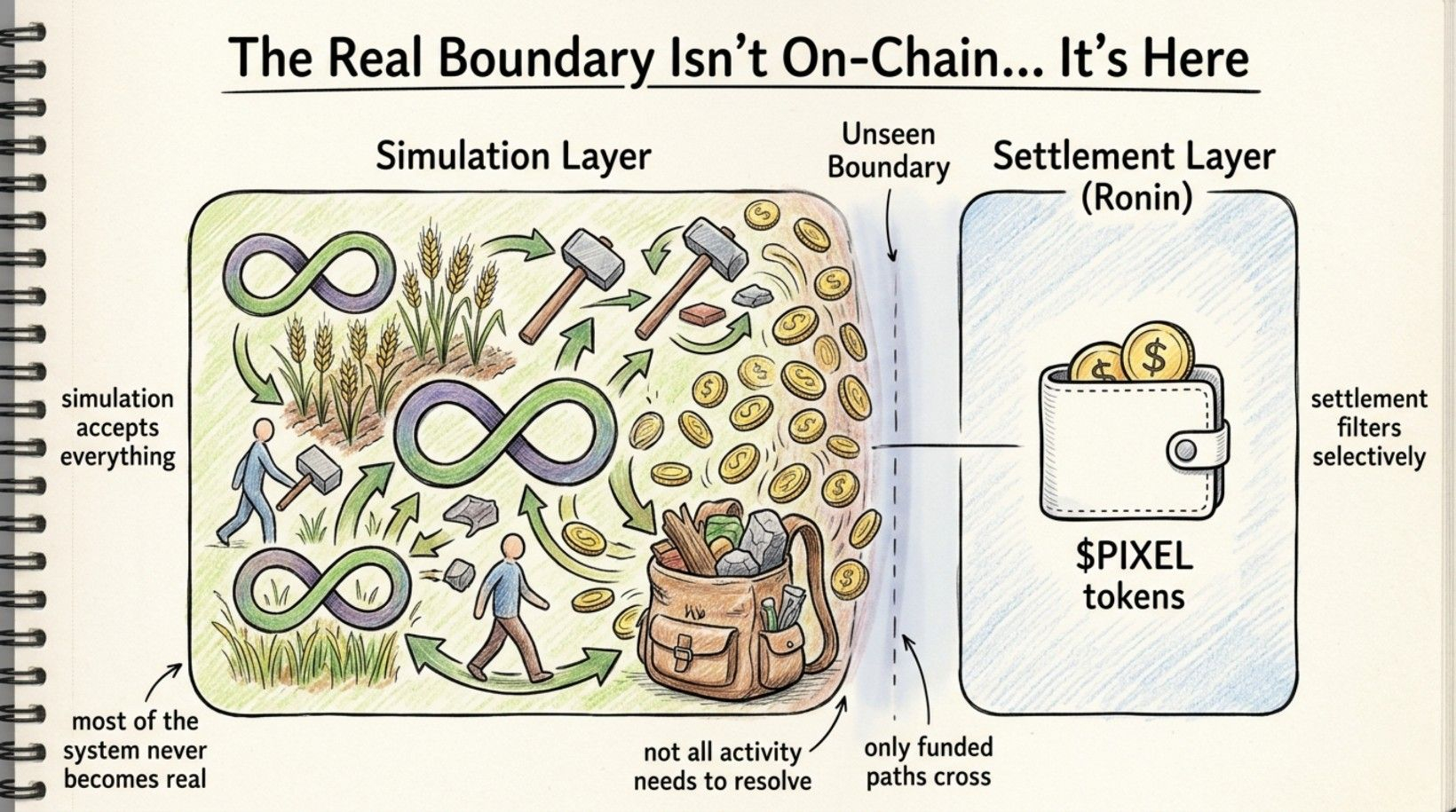
so when i see a reward on Pixels, maybe i’m not seeing kindness.
maybe i’m seeing a hypothesis.
that one feels strange because it makes the player part of the experiment without the game needing to say it loudly. i just play. i follow the path. i respond to the incentive. but behind that, the Pixels system is measuring whether paying me was worth it.
not in a villain way.
in a survival way.
because sustainable rewards need memory. they need feedback. old P2E paid out like the future didn’t exist. Pixels seems built around the opposite idea… every reward has to justify its next version. if it doesn’t produce enough value, it should shrink, move, disappear, or be replaced by something that does.
and that makes me look at “earning” differently.
earning used to feel like direct conversion from time to value. but inside Pixels, time is only one signal. activity is only one signal. the real signal is whether my behavior matches something the system wants more of at that moment.
did i come back after dropping off?
did i follow a path that improves retentio?
did i interact in a way that creates useful demand?
did i become part of a loop worth keeping alive?
these are uglier questions than “did i play”.
but they are more honest.
because if Pixels wants to be fun-first and not just another extraction machine, it can’t let rewards be blind. it has to treat reward spend like a resource with consequences. Stacked can redirect value to players, but RORS keeps asking whether that redirection is sane. that is the tension. players want rewards. the system wants behavior that pays back. somewhere between those two, the game survives or doesn’t.
and that also explains why the reward path can feel uneven.
not broken, just conditional.
one behavior might matter today because the Pixels system needs it. later it matters less. one group of players might be worth targeting because their retention curve is fragile. another group might not need the same push. one loop might get fuel because it creates value. another might stay mostly inside Coins because it keeps the world moving but does not deserve pixels pressure.
that is not random.
it is just not personal in the way players want it to be.
and that is the most uncomfortable part. i want to think the game is responding to me, but it is responding to patterns i am only one small part of. my pixels session, my actions, my returns, my spending, my silence, my timing… all of it becomes one little signal inside a wider pixels system trying to decide what behavior should be bought again.
so the reward is not the start of meaning.
it is the result of measurement.
and the more i think about that, the more Pixels starts feeling less like “play and earn” and more like “play and be priced.” not priced as a person, but priced as behavior. what is this action worth to the pixelysystem. what is this user path worth. what is this retention moment worth. what can be paid without breaking the reward economy.
that is a much harder design than just making a fun farm.
because the Pixels farm has to stay readable to players while the backend is doing something colder. the player sees crops and tasks. Stacked sees cohorts and lift. the player sees reward. RORS sees spend. the player sees progress. the Pixels system sees whether that progress deserves more budget.
two realities sitting inside the same cute world.
and that is why Pixels can look soft while being structurally strict.
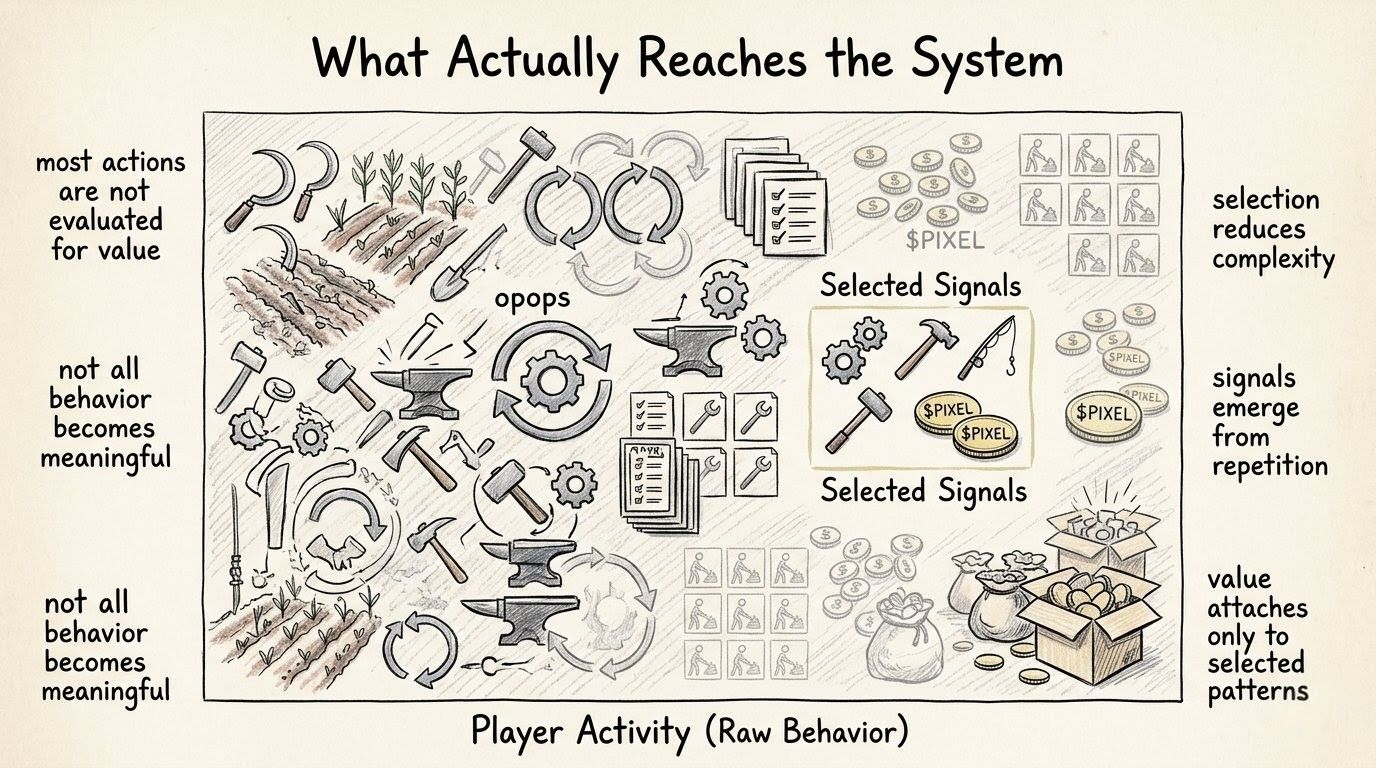
because the softness is in the interaction layer. the strictness is in the reward layer. Coins let the world stay busy. Pixels makes the system careful. Ronin gives weight when things need settlement. Trust Score guards the exit. Stacked decides where rewards should press. RORS asks if the pressure paid back.
that is the machine under the farm.
and i think this is where old P2E people get the wrong read. they look for the payout path first, like the game is supposed to exist as a machine for extraction. but Pixels seems to be asking a different question. not how do we pay everyone for playing, but how do we pay the right behavior without teaching everyone to destroy the economy.
that is a brutally different question.
and probably the only one that matters.
because if rewards are too easy, the world becomes a farm in the worst way. if rewards are too tight, players stop caring. if rewards are random, nobody trusts the loop. if rewards are blind, bots win. so Stacked has to sit there like this strange economic nervous system, feeling where the game needs pressure and where it needs restraint.
reward as control, not candy.
i don’t fully like that sentence, but it fits.
on Pixels once rewards become targeted, they stop being neutral. they shape players. they tell people what the game wants more of. they pull attention. they train behavior. if the Task Board surfaces something, players move. if Stacked funds a campaign, players respond. if RORS cuts the oxygen, that behavior fades back into the background.
so the game is not only reacting to players.
it is teaching players what to become.
and that makes the whole “fun-first” idea more complicated. fun is still there, sure. the world has to feel playable before any economy matters. but under the fun, there is a selection process. which actions become worth repeating. which loops deserve reward. which players receive the right push at the right time. which parts of the world get reinforced because they help the game live longer.
this is where Pixels starts feeling less like a P2E correction and more like a live economy learning system.
not perfect, not clean, but much more serious than “play game, get token”.
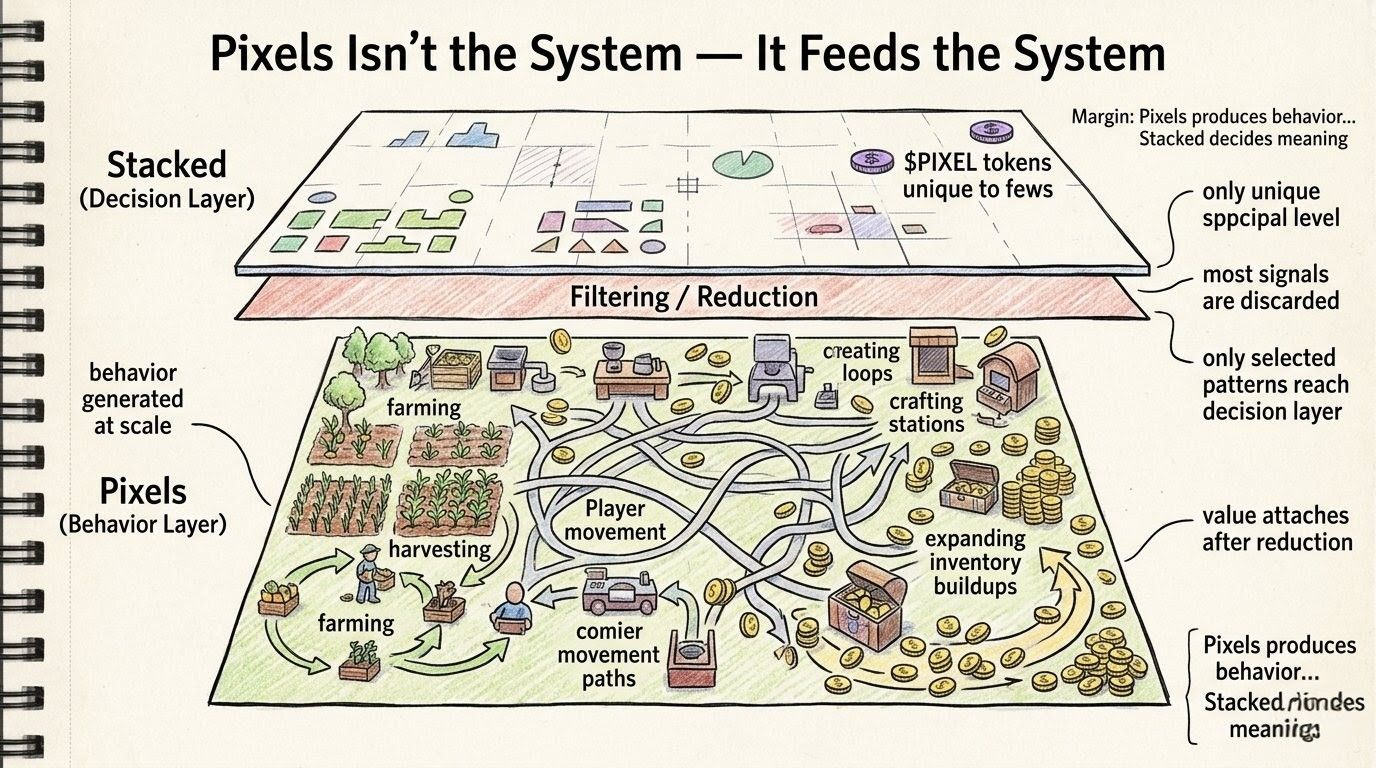
and maybe that is the real difference between rewards and sustainable rewards on pixely. a reward can be paid once. a sustainable reward has to prove it should exist again. Stacked is trying to make that proof visible to the Pixels system, even if the player only sees the soft version of it on the surface.
so when i think about Pixels now, i don’t think the reward is asking “did you do enough”.
i think it is asking something closer to.
did this behavior deserve to be bough
and if yes, for how long?
and at what cost?
that is the part that makes the whole thing feel sharper about Pixels. because the player can still feel like they are choosing freely, but the economy is quietly deciding which choices are worth amplifying. not everything gets ignored, not everything gets paid, and not everything gets to become Pixels.
most activity keeps the world moving.
only some behavior gets purchased.
and that distinction is probably where Pixels survives if it survives.
because the future of this Pixels system is not just more rewards. more rewards alone is how old games died. the future is better reward control. better targeting. better feedback. better ability to say no to activity that looks busy but gives nothing back.
so maybe Pixels doesn’t reward activity.
maybe it buys behavior it wants to keep.
and once that thought lands, the whole farm feels different. not fake, not less fun, just less innocent. every reward starts looking like a small negotiation between me and the Pixels system. i bring behavior. the system brings budget. Stacked watches the result. RORS decides whether the exchange made sense.
and somewhere inside that exchange, Pixels is trying to do the thing early play-to-earn never learned how to do.
pay players without becoming a machine that only exists to be drained.