
For a long time, I thought of blockchain confirmation as something final. An action happens, gets written somewhere permanent, and from that point forward it exists in a way that feels official. That mental model held up for a while. But the more time I spend inside games like Pixels, the more I realize it was always a simplification.
The truth is messier. And honestly, more interesting.
Most of what players do in these ecosystems never gets anywhere near a chain. It just happens locally, gets processed, and fades. Yet the systems still feel economic. Still feel like they carry weight. That invisible space between "happened" and "recorded" is where all the real design decisions are hiding.
Pixels pulls this off in a way that's easy to overlook.
When you first drop in, there's a looseness to it. You tend to your land, you work your cycles, you pick up resources. No one's pushing you toward a paywall. No pressure to spend before you've even found your footing. The game gives off an egalitarian energy like every hour you put in carries the same value as anyone else's. At least, that's how it reads at first.
But I started noticing something after extended observation. Players with broadly similar habits were landing in noticeably different places. Not just in terms of earnings, but in terms of what actually stuck around. Some players' effort seemed to build on itself over time, becoming something referenceable, maybe even portable. Others were running what looked like productive loops but were essentially treading water their progress reset in ways they probably didn't realize.
That asymmetry felt intentional. Quiet, but intentional.
Here's the underlying reality most discussions skip over: you physically cannot push every game action onto a blockchain. It's not a philosophical stance it's a resource constraint. The computation costs, the latency, the sheer volume of trivial events that would flood any distributed ledger. If everything you did in Pixels got immortalized on-chain, the whole thing would buckle. So the system has to be selective. Something has to make that call.
What I kept landing on, the more I turned it over, was $PIXEL.
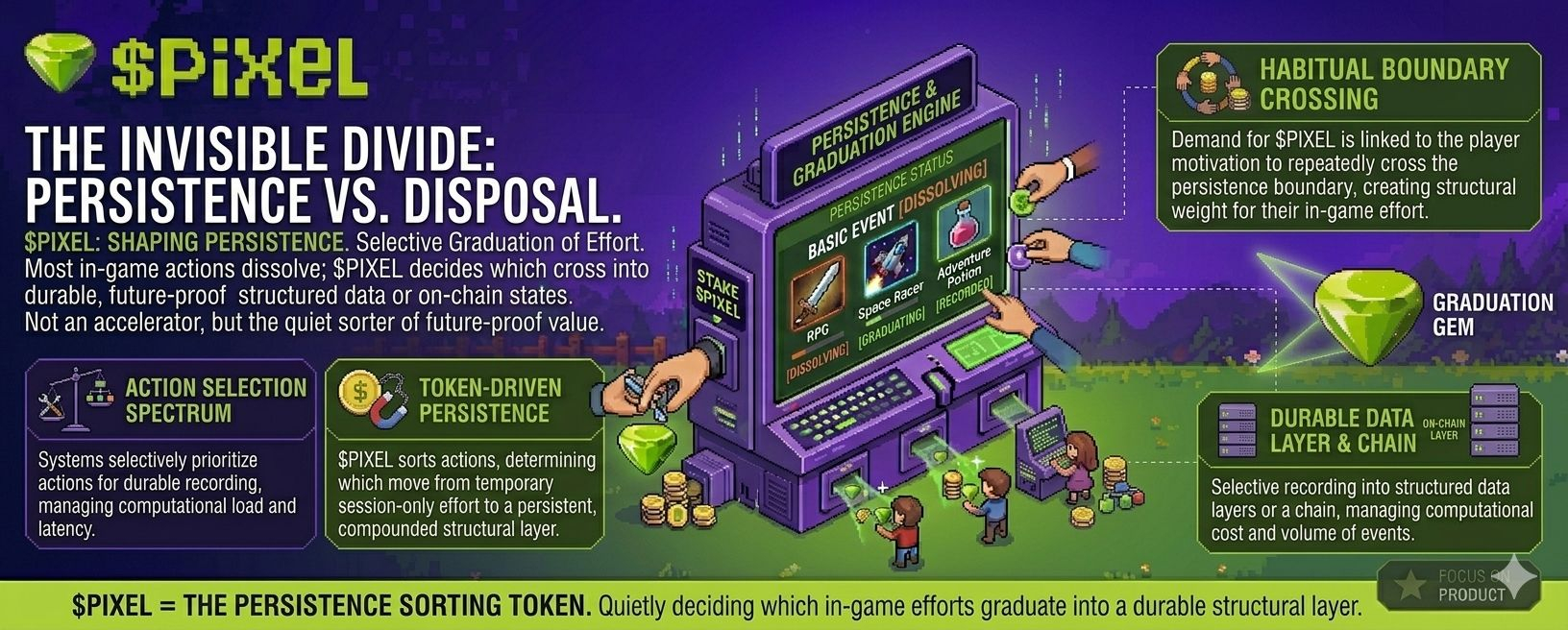
I came in treating it the way I'd treat most in game tokens a convenience layer, a time skipper, maybe a shortcut to certain content. That's the standard playbook. But watching player behavior over time changed my read. It doesn't quite behave like acceleration. It behaves more like a sorting mechanism. Not one that blocks you outright, but one that quietly calibrates which of your actions graduates beyond the current session.
You can ignore it entirely. Plenty of players do. They grind, they wait, they repeat. The game doesn't punish them explicitly. But something shifts when $PIXEL enters the picture. The compression of time is real, but that's almost secondary. What actually changes is whether what you're building right now has any chance of mattering in a context beyond this login.
I keep reaching for the word persistence because visibility doesn't quite capture it.
Most reward systems are built around being seen leaderboards, drop rates, event rankings. What Pixels seems to be quietly building is something different: a divide between actions that exist only within their own moment, and actions that get lifted into a layer where they can be carried forward. That layer might be onchain. It might just be structured data that other systems can eventually parse. Either way, something that was temporary stops being temporary.
It reminded me, unexpectedly, of how zero knowledge proofs work in privacy infrastructure. You don't prove everything. You prove just enough to satisfy a specific condition, and the rest stays uncommitted. The selectivity is the point. Pixels isn't a privacy system, obviously, but the logic of selective exposure feels related. Not every event is worth the cost of being globally visible.
And exposure, in any distributed system, carries a cost.
So what you get instead of an all or nothing architecture is something more like a spectrum. A lot of actions are cheap, frequent, entirely disposable. They serve their moment and dissolve. A smaller set carries enough intention or requires enough resource that they cross into something more durable. That's where compounding begins.
This reframes the "free to play" framing in a way that matters. The game is genuinely accessible. There's no hard entry price. But economically, it's still running a selection process. It's just running it through incentives rather than restrictions which means most people don't notice it until they've been in long enough to see the pattern.
From a token perspective, that changes the analysis significantly. Demand for $PIXEL isn't purely a function of player count or average spend. It's a function of how many players feel motivated to push their actions across that boundary repeatedly. To convert temporary effort into something with structural weight. If that's a one-time curiosity, the token stays shallow. If it becomes something players return to habitually as part of how they build inside the game, the token embeds itself in the loop rather than sitting awkwardly adjacent to it.
Both futures are plausible.
The version where this works well is elegant: a self regulating system where studios manage the onchain load without locking anyone out, players retain the sensation of freedom, and the whole thing stays lean enough to scale. Over time, patterns of "promoted" behavior might even become legible a kind of emergent prioritization driven by how the community actually moves.
But the fragile version is easy to picture too. If players start connecting the dots and realize their effort only gets structural weight when they spend, the openness starts feeling performative. That perception shift is hard to reverse. People tolerate a lot, but they're unusually sensitive to discovering that freedom was partly aesthetic.
There's also a quieter risk that gets less attention. What if a majority of players simply don't care whether their actions persist? If the local loop is satisfying enough on its own if the feedback of farming and trading is sufficient without any of it crossing into a lasting layer then the pressure to use $PIXEL for that purpose may never organically build. The game functions. The token's structural role just stays smaller than the design might have intended.
I'm not sitting on a tidy resolution here. This is less a conclusion than a reorientation.
The conversation used to center on how much gets written to a chain. That question still matters, but it's starting to feel like the surface layer. The deeper question is about selection about which actions a system decides are worth carrying forward, and which ones it's comfortable letting dissolve once the session ends.
Pixels doesn't answer that question with policy. It leaves it to behavior, to incentive, to the slow accumulation of player choices over time.
And $PIXEL, whether by deliberate design or by structural consequence, keeps showing up at exactly that threshold quietly shaping what the system chooses to hold onto.