
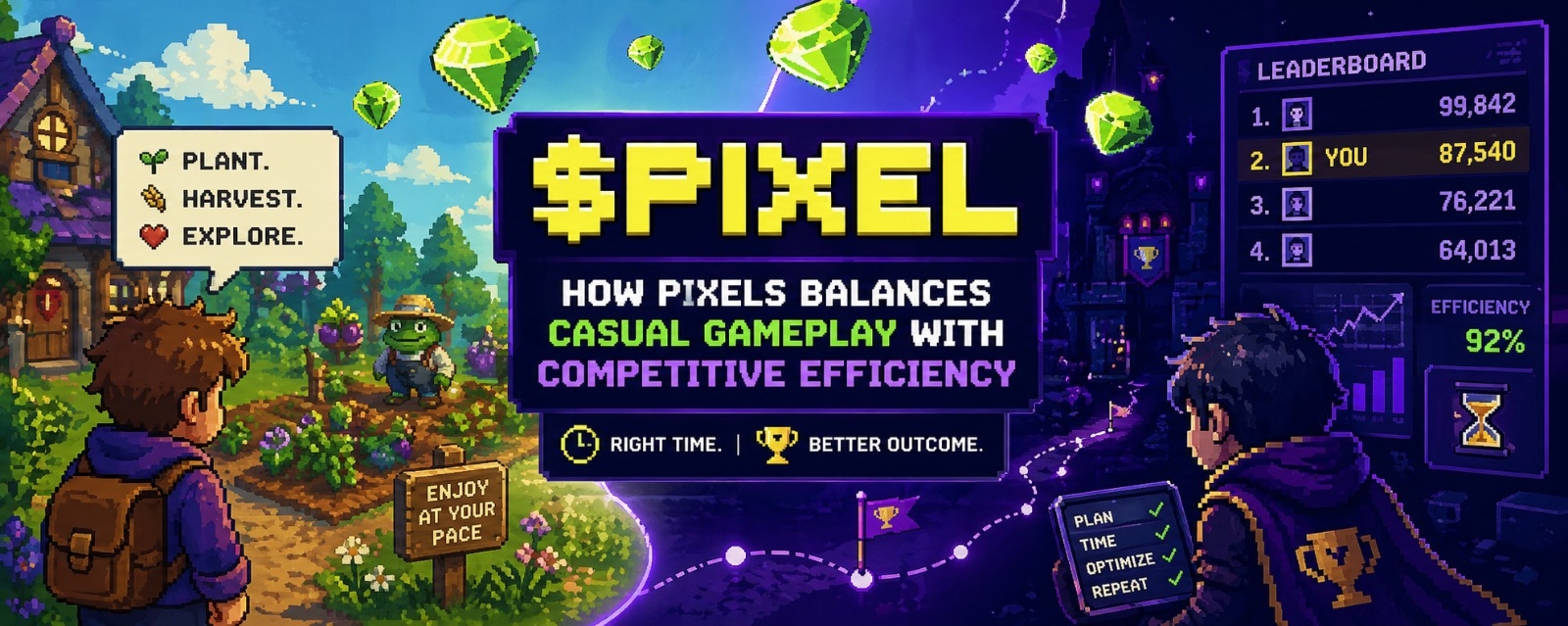
I’ve been spending time inside Pixels long enough that the shift from “playing casually” to “playing correctly” doesn’t feel like a decision anymore. It just happens. At first, it’s light. You plant, harvest, wander, maybe miss a few cycles and it doesn’t matter. The system absorbs that. Nothing breaks.
But the longer you stay, the more you notice that the game isn’t just letting you play. It’s quietly sorting you.
The balance between casual play and competitive efficiency doesn’t sit in difficulty or skill. It sits in how the system reacts to timing.
There’s a moment that comes up often. You log in slightly late, your crops are ready, but the energy window has shifted. If you harvest now, you lose alignment with the next task chain. If you wait, you waste idle time. Neither option feels wrong, but one clearly fits the system better. That’s where the split begins. Casual players take the immediate reward. Efficient players delay and re-route. Same action. Different relationship with time.
That small decision compounds. Over a few sessions, it becomes obvious that Pixels isn’t rewarding activity equally. It’s rewarding activity that fits its internal rhythm. You can play a lot and still feel slightly off. Or play less, but in tighter loops, and everything seems to move faster. Not because of effort. Because of placement.
One example that kept bothering me was task chaining during limited events. I noticed that certain quests would only fully “pay off” if completed within a narrow overlap window. Finish too early and the follow-up task doesn’t activate in time. Finish too late and the multiplier effect disappears. Nothing in the interface tells you this directly. You only feel it after missing it once or twice. So the system isn’t blocking access. It’s filtering outcomes.
Another one shows up in resource conversion. Early on, you can freely convert and craft without much consequence. Later, small inefficiencies start stacking. Converting items at the wrong moment or in the wrong batch size doesn’t just cost you resources, it delays your ability to enter higher-value loops. That delay isn’t visible as a penalty. It shows up as slower progression compared to players who timed it better. You start realizing that the game isn’t asking how much you do. It’s asking when you do it. That’s where the tension builds.
Because from the outside, Pixels still feels casual. You can log in, click around, enjoy the flow, and nothing pushes back. But underneath, there’s a second layer quietly measuring how aligned you are with its internal pacing. And that layer doesn’t care if you’re playing for fun. It only cares if your actions fit. This is the point where efficiency stops feeling optional. Not because the game forces it, but because you begin to feel the gap.
The tradeoff is subtle but real. The more you optimize, the less flexible your play becomes. You start planning sessions instead of drifting through them. You delay actions that would have been satisfying just to catch a better window later. It works. Your output improves. But something soft in the experience tightens. You’re no longer just inside the game. You’re negotiating with it.
There’s a part of me that thinks this is exactly what makes the system strong. It avoids the usual trap where rewards get farmed blindly. By tying outcomes to timing and sequencing, it reduces random extraction. It becomes harder to brute force progress without understanding the flow. But it also introduces a quiet bias.
Players who figure out the rhythm early don’t just progress faster. They start occupying better positions in the system. Their loops stabilize. Their mistakes shrink. Newer or more casual players aren’t locked out, but they’re always slightly out of sync. Not excluded. Just… behind the curve.
At some point, the presence of $PIXEL makes this impossible to ignore. Not in a dramatic way. It just becomes clear that these timing differences are not abstract. They translate into something measurable. The token doesn’t create the behavior, it reveals it. What looked like small inefficiencies now carry weight. So here’s what I keep testing, without fully answering it:
If you play casually for a week, do your outcomes drift further from the system’s center, or does it recalibrate around you?
If two players spend the same time, but one aligns tightly with event windows and the other doesn’t, how long before their paths stop overlapping completely? And the harder one. If you remove the pressure to optimize, does the system still feel rewarding, or does it start to feel loose?I don’t have a clean answer yet. It still feels like Pixels is holding that line carefully. Letting anyone in, but not letting everyone land in the same place. Which sounds fair. Until you start noticing how much of your play is no longer spontaneous.
