

I wasn’t trying to understand Pixels… but the more I ignored it, the more it kept making sense.
At first, it was just another name in the feed.
Another Web3 game.
Another reward loop.
Another system I assumed I already understood.
So I didn’t look into it deeply.
Because if you’ve been around long enough, you start to recognize patterns early. And most of the time, those patterns don’t change.
Users come for rewards.
Rewards get optimized.
The system slowly loses balance.
That cycle is almost expected now.
So I didn’t feel the need to study it.
But then something slightly unusual started happening.
It didn’t disappear.
It didn’t spike and fade.
It didn’t get loud and then quiet again.
It just… stayed present.
Not in a way that demanded attention — more like something quietly sitting in the background.
And over time, that started to feel intentional.
So I took a closer look.
Not at the surface, but at the structure.
And the first thing that stood out wasn’t what was happening…
It was what wasn’t happening.
There wasn’t that usual sense of instability.
No obvious signs of the system being stretched too quickly. No aggressive push to maximize short-term engagement. No feeling that rewards were being overused just to keep momentum alive.
Everything felt… restrained.
That’s not something you usually see in early-stage Web3 systems.
Most of them expand first, then try to control later.
This felt like control was already built in.
That’s where Stacked started to make more sense to me.
Not as a feature… but as a mechanism.
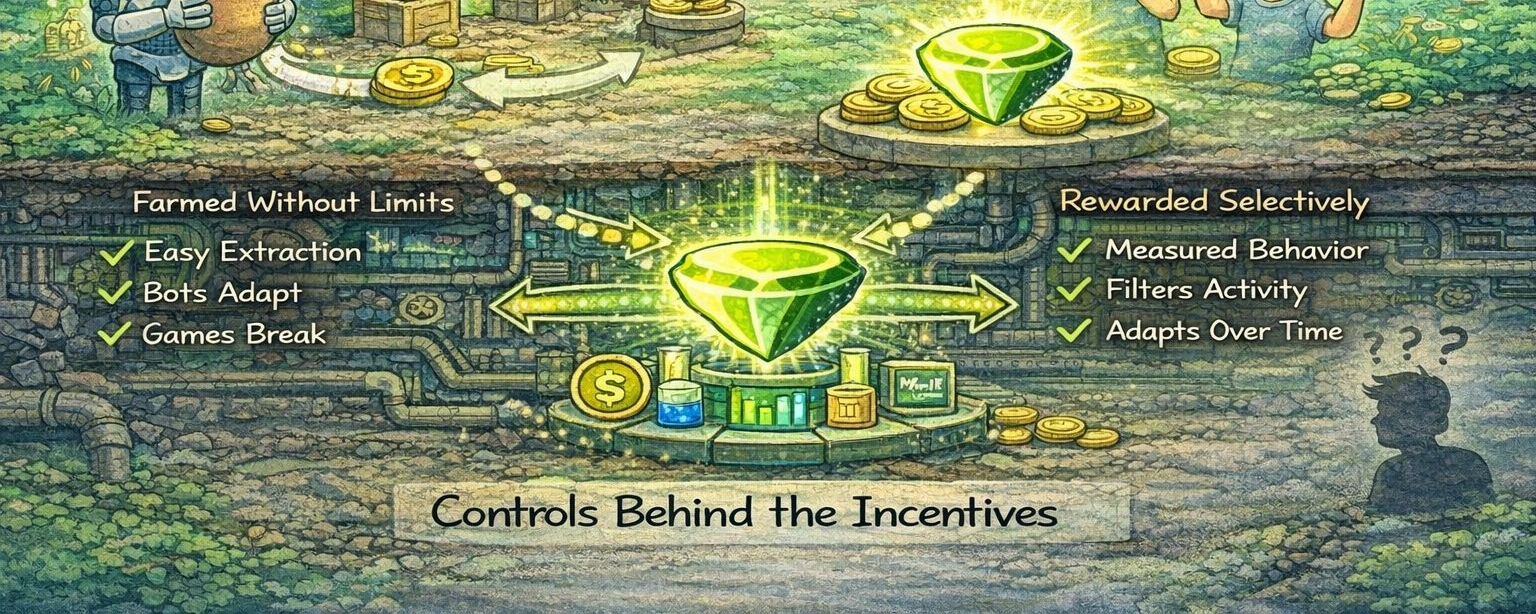
Instead of treating rewards as something fixed, it treats them as something that needs to be continuously adjusted based on behavior.
Not every action gets rewarded.
Not every player is treated the same.
And not every incentive is meant to drive immediate activity.
At first, that felt limiting.
But the more I thought about it, the more it felt necessary.
Because without that kind of control, reward systems don’t last.
They get exploited.
They get drained.
They lose meaning.
What’s interesting here is that rewards don’t feel like the center of the system.
They feel like a tool being used carefully.
And that changes how everything behaves around it.
Even from a market perspective, the signals feel different.
Attention comes in waves, but it doesn’t create instability. Activity increases, but it doesn’t collapse right after. Liquidity doesn’t vanish the moment things cool down.
That kind of behavior usually means one thing:
The system underneath isn’t under stress.
At least not yet.
Another thought that stayed with me is where the value is actually coming from.
In most cases, rewards are created.
Here, it feels more like they’re being redirected.
Value that would normally flow outward — into ads, platforms, acquisition channels — seems to be moving inward, toward players.
But not randomly.
Selectively.
That’s a very different dynamic.
It turns rewards from something that inflates… into something that circulates.
Still, I’m not treating this as a finished story.
Because systems like this don’t get tested in quiet phases.
They get tested under pressure.
More users.
More scale.
More complexity.
That’s when balance becomes harder to maintain.
And that’s where I’m still unsure.
But I can say this —
It’s one of the few times I’ve looked at a Web3 game and felt like the system underneath is being taken more seriously than the surface.
And that’s not something I notice often.
For now, I’m just watching.
Not trying to predict anything.
Just observing whether that sense of control holds… or starts to slip over time.
Curious if anyone else has had that same feeling with Pixels… or if it still looks like just another game at first glance.