
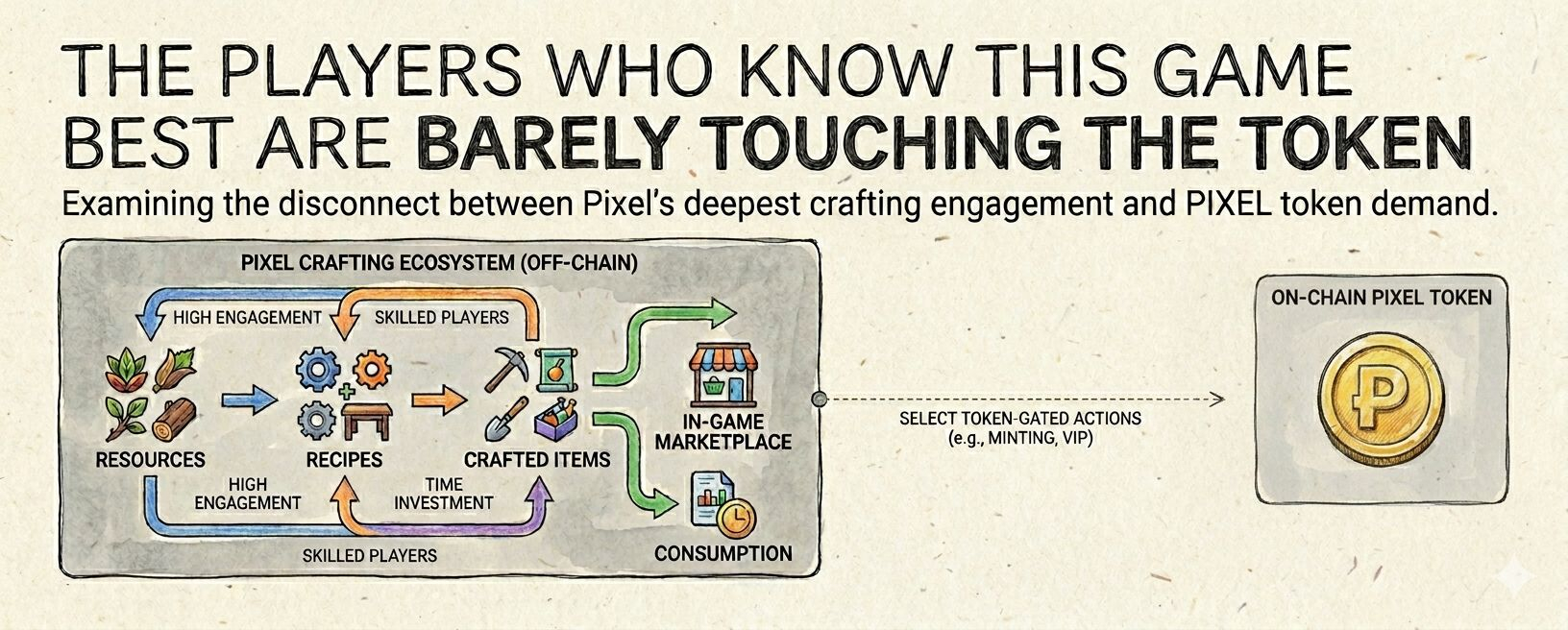
There is a specific kind of Pixel player I kept noticing the more time I spent inside the game's economy. Not the casual daily task completers. Not the land owners managing plots from a distance. The crafters. Players who have spent weeks understanding which resources combine into which outputs, which recipes produce the highest value items, which crafting chains create the most efficient progression paths. These players know Pixel's internal economy more deeply than almost anyone else in the community. They have invested real time and genuine intellectual energy into understanding how the game's production systems work. And when I looked carefully at what their engagement actually generates at the token level something quietly uncomfortable came into focus.
The crafting system in Pixel runs almost entirely off-chain. Resources gathered through farming and gameplay exist as in-game items not on-chain assets. Recipes are executed inside Pixel's infrastructure. Crafted outputs circulate through the game's internal economy as items that players use, trade through the in-game marketplace, or consume in further production chains. The whole system resource input, recipe execution, item output, item consumption operates on a track that barely touches PIXEL. A player can spend three hours inside Pixel's crafting economy on a given day, executing complex production chains, generating real in-game economic activity, trading outputs with other players and produce almost no on-chain PIXEL demand from any of it. What keeps bothering me is not that this is a design oversight. It is that this is the game's deepest engagement layer and it runs almost completely parallel to the token economy that PIXEL is supposed to represent.
What feels more important here than the current price or the upcoming unlock schedule is what this architectural separation means for how you should read Pixel's engagement data. When the game reports high daily active user numbers and deep session engagement the natural assumption is that engagement translates into token demand at some proportional rate. It doesn't. Not automatically. Not from the crafting layer. The players generating the most complex in-game economic activity the ones running multi-step production chains, optimizing resource flows, building crafting-based trading strategies are generating that activity inside a system that exists almost entirely outside the blockchain layer. Their engagement is real. Their time investment is real. Their contribution to the game's internal economy is real. Their PIXEL demand from all of that activity is close to zero unless they specifically cross into one of the token-gated actions pet minting, guild access, VIP functions that sit above the crafting layer rather than inside it.
I keep coming back to what this means for the quality of PIXEL demand at scale. The token utility narrative points at crafting as part of the game's economic depth — and the game genuinely has that depth. But depth of gameplay and depth of token demand are not the same measurement and Pixel's crafting architecture separates them more cleanly than the surface narrative acknowledges. The players most capable of sustained, knowledgeable, economically sophisticated participation in the game are spending their most engaged hours in a system that generates almost no on-chain signal. What the market may be pricing wrong is the assumption that engagement quality and token demand quality move together inside Pixel's economy. They don't. They diverge specifically at the layer where the most skilled players spend the most time.
I'm not fully convinced the team sees this as a demand problem. The crafting system was likely built to serve gameplay depth first and token integration second, and that priority produced a genuinely good crafting experience. The off-chain architecture protects the crafting economy from the speculative behavior that would distort it if every resource and recipe output existed as a tradeable on-chain asset. Those are legitimate design reasons for building it the way it was built. But legitimate design reasons don't dissolve the structural consequence they create. The most engaged segment of Pixel's player base has its deepest daily investment anchored in a system that generates almost no PIXEL demand regardless of how sophisticated or sustained that engagement becomes. That is a specific and testable condition. If on-chain PIXEL activity data over the next two quarters shows demand growing proportionally with reported user engagement the separation I'm describing is being bridged somewhere I'm not seeing. If on-chain activity stays thin while engagement metrics stay high the crafting layer's architectural separation from the token economy is the explanation sitting quietly underneath both numbers at once.
If you have spent serious time inside Pixel's crafting system I am genuinely curious whether this matches what you noticed.