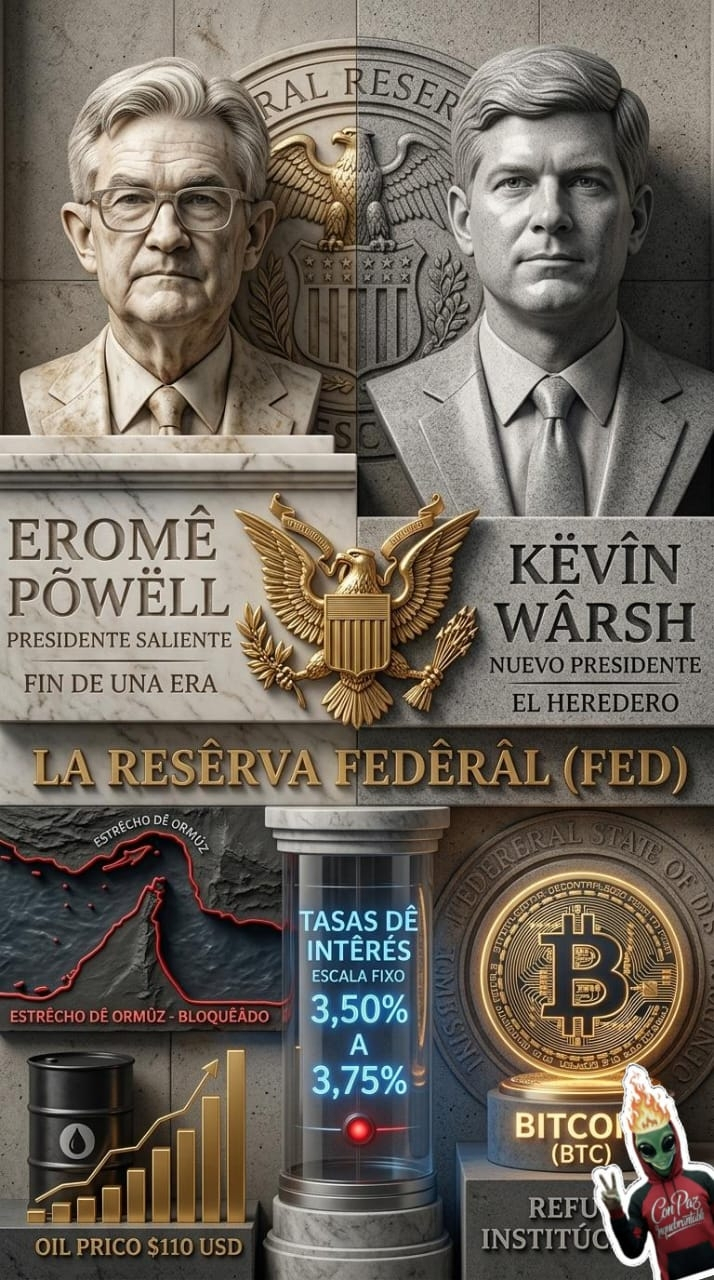
A GUARD CHANGE AT THE FEDERAL RESERVE AS GEOPOLITICS AND ENERGY REWRITE THE GLOBAL PLAYBOOK.
The global financial landscape is at a historic turning point. On April 28, 2026, markets are not just watching a routine decision on the cost of money; they are witnessing the closing of a chapter that has defined the world economy for nearly a decade: the last session led by Jerome Powell before his official exit in mid-May. 🏛️
1. The "Lock" on Rates amid the Crisis in Ormuz ❄️
Under absolute consensus of 100%, according to the FedWatch indicator, the Federal Open Market Committee (FOMC) has decided to keep interest rates in the range of 3.50% to 3.75%. This inaction is not a lack of will, but a direct response to an explosive geopolitical context.
The blockade of the Strait of Ormuz by Iran has shaken the energy foundations. Just today, Brent crude has hit $111 a barrel, accumulating a 53% revaluation since February. This "supply shock" generates inflationary pressures that, in practice, have destroyed any plan the FED had to cut rates in the first half of 2026. 🌍⚠️
2. The Profile of Kevin Warsh: Independence or Alignment? 💼
After years of a tense relationship and biting public criticism, President Donald Trump has achieved his goal of renewing the leadership of the entity. Economist Kevin Warsh, officially nominated, is now waiting at the door of the Federal Reserve.
Unlike Powell's measured approach, Warsh arrives with a vision of "regime change." Exclusive data suggests that his strategy will focus on two pillars: aggressively reducing the FED's balance sheet and betting on artificial intelligence as a productivity engine to curb inflation. However, his closeness to the White House raises doubts on Wall Street about the future autonomy of the central bank. Will the FED remain a neutral arbiter or become a political engine?
3. The Dollar and the Global Domino Effect 💵
As Powell says goodbye, the Dollar Index (DXY) shows unusual strength, driven by risk aversion. This firmness is suffocating emerging markets and forcing central banks in Europe and Mexico to consider emergency hikes to prevent capital flight. The "soft landing" Powell sought for years is now under its toughest test due to energy costs.
4. Bitcoin and the New Institutional Safe Haven 🚀📊
For the crypto sector, the hawkish tone of this latest meeting is a double-edged sword. While the lack of liquidity often hits risk assets hard, the narrative of Bitcoin (BTC) as "digital gold" strengthens amid monetary uncertainty.
The big funds managing Bitcoin ETFs are rebalancing their portfolios in light of the possibility that Warsh will push for a more volatile policy starting in June. In this scenario, BTC is not just a speculative asset, but a gauge of institutional fear at the end of the Powell era. 📊✨
Published on April 28, 2026. Information in development. #ArthurHayes’LatestSpeech #OpenAIReportedlyWorkingonanAISmartphone #OpenAI据称正在研发AI智能手机 #BinanceSquareFamily #BinanceSquareTalks