
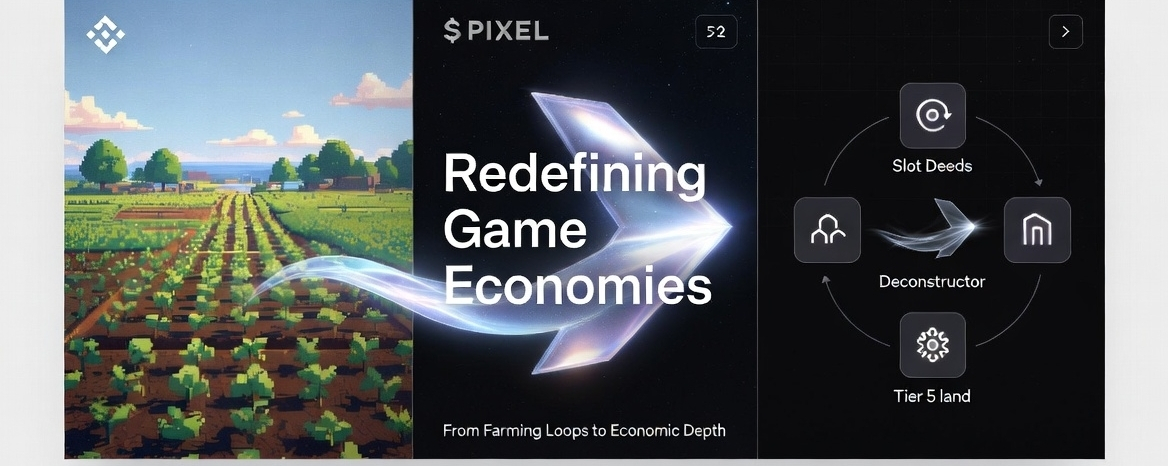

I’ve spent hundreds of hours farming in Pixels, but after the Tier 5 update, one question has been quietly haunting me:
What if Pixels isn’t just improving the play-to-earn model… but is actually redefining what a mature game economy in Web3 should look like?
It started with a subtle shift in my own gameplay. Before April 15, I used to log in and grind on autopilot — plant, harvest, craft, repeat. But Tier 5 changed that. With 105 new recipes, specialized industries that only work on NFT lands, and Slot Deeds limited to just 20% of land capacity with a 30-day renewal requirement, I suddenly found myself pausing before every big decision.
Instead of asking “How much can I produce?”, I started asking “Is this worth committing to right now?”
The Deconstructor took this feeling even deeper. Watching it strategically break down old industries to extract rare materials using heart fragments felt surprisingly sophisticated. It doesn’t just destroy value — it recycles it in a circular way. Nothing is completely wasted, yet nothing comes without cost or careful thought.
This is what makes Pixels feel different.
Most games treat their economy as simple background support for fun. Pixels seems to be attempting something more ambitious: keeping the cozy, relaxing farming loops as the welcoming front door, while carefully building a deeper economic system underneath that gently shapes player psychology, decision-making, and long-term behavior.
$PIXEL sits right at the heart of this design. It no longer feels like just another utility token. It acts more like a quiet timing mechanism — the bridge between provisional effort and value that the system fully recognizes as permanent.
I’ve started noticing myself hesitating more often before finalizing upgrades or renewing Slot Deeds. That small hesitation isn’t annoying. It’s meaningful. The system is slowly conditioning me to prioritize quality and strategy over raw volume — and strangely, I’m enjoying the game even more because of it.
Of course, this path carries real risks. The increasing complexity could gradually push away casual players who simply want to relax and farm without heavy thinking. There’s a fine line between thoughtful design and over-engineering. If that balance breaks, the soul and accessibility of the game might suffer.
I’m still torn between excitement and caution. Some days it feels like we’re watching the early stages of a genuine evolution in Web3 gaming. Other days I wonder whether we’re trading the simple joy of early gaming for a more calculated, efficient machine.
Pixels has the potential to become a blueprint for future game economies — one where fun and economic depth are not enemies, but carefully balanced partners.
What do you think? Could this hybrid model of fun-first gameplay backed by a mature economic system redefine how successful Web3 games are built, or are we risking making play feel too structured and serious?
This is for educational purposes only ~ NFA, DYOR.