
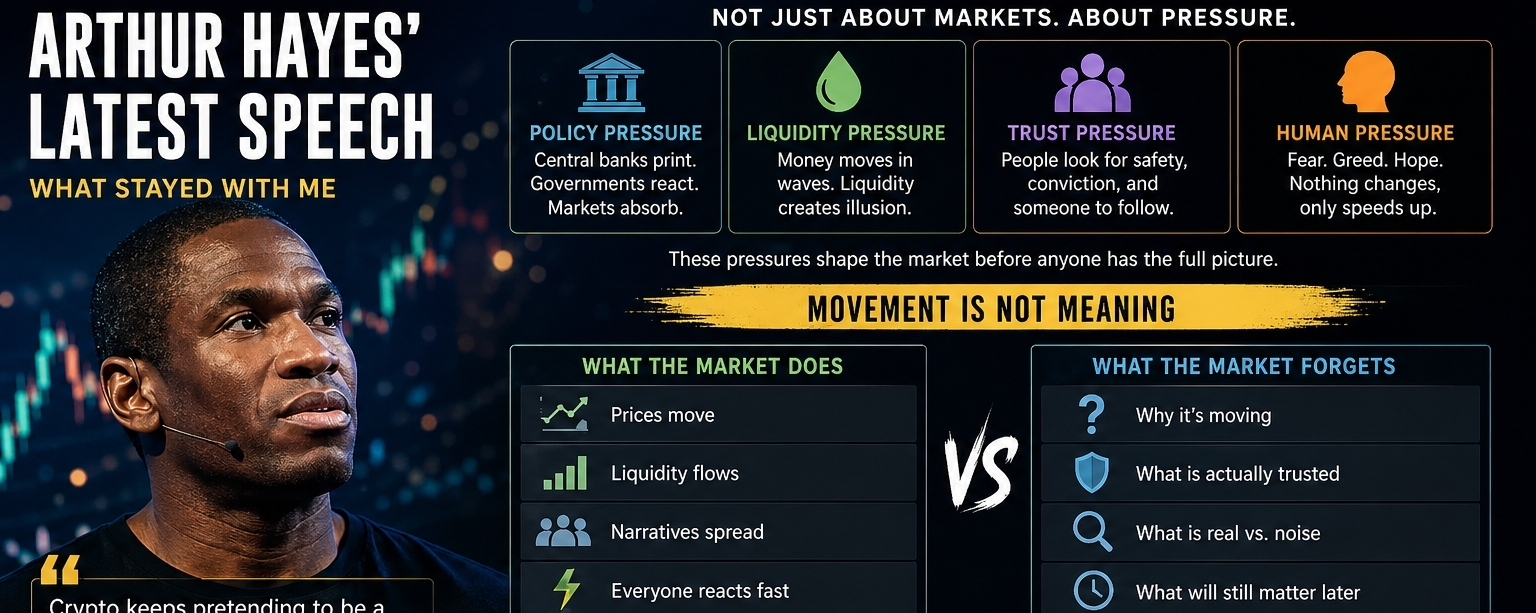
Arthur Hayes’ latest speech stayed with me longer than I thought it would.
At first, I almost treated it like another market speech. Another smart person talking about liquidity, policy, money, cycles, and the strange way crypto keeps reacting to the same forces again and again. I have seen enough of this market to know how quickly everything starts sounding familiar. Every new idea comes wrapped in urgency, but after a while, the urgency itself becomes noise.
Still, something in this one did not fully disappear.
Maybe it was not because the speech felt completely new. It did not. What caught me was the way it pointed back to a problem crypto keeps trying to solve but never really escapes. The problem of trust. The problem of proof. The problem of whether action actually means belief, or whether it is just another reaction to money moving through the system.
That is what I kept thinking about.
Crypto is very good at movement. It can move capital fast, move narratives faster, and move people before they even understand why they are moving. A price goes up and suddenly everyone finds meaning in it. A token catches volume and suddenly it looks important. Liquidity arrives and the market starts treating it like confirmation.
But movement is not always meaning.
That line kept sitting with me.
Arthur Hayes’ speech made me think less about prediction and more about pressure. The kind of pressure that builds underneath markets before people have language for it. Policy pressure. Liquidity pressure. Trust pressure. Human pressure. Crypto likes to imagine itself as something clean and separate, but it still lives inside the same old human patterns. People still chase safety. They still chase yield. They still follow confidence when it looks strong enough. They still mistake activity for proof.
And maybe that is why the speech kept returning to my mind. It felt like it was circling something bigger than one cycle.
The real question is not only where Bitcoin goes, or how liquidity shifts, or what trade comes next. Those things matter, but they are not the deepest part. The deeper question is what people believe when the system starts moving again. Do they trust the record, or do they trust the people around the record? Do they believe in decentralization, or do they just believe in price when price is rising? Do they want freedom, or do they want a better version of the same machine?
I do not know.
That uncertainty is probably the most honest part.
The speech did not make crypto feel simple. It made it feel heavier. It reminded me that this market is not just about technology or money. It is about how people behave when both of those things become unstable. It is about how quickly conviction appears when liquidity returns, and how quickly it disappears when the tide pulls back.
That is the part that feels real to me.
Arthur Hayes was talking about markets, but what stayed with me was not just the market view. It was the reminder that crypto keeps returning to an old question in a new form. Can people trust a system because it records everything, or does trust still need something more than records? Can action prove belief, or does it only prove that people were willing to move at that moment?
I keep coming back to that tension.
Signal versus noise. Action versus proof. Trust versus record.
Crypto keeps building better rails, better markets, better ways to move value. But the older problem remains underneath it all. People still need something to believe in, and belief is harder to measure than volume. It does not always show up on-chain. It does not always appear in a chart. Sometimes it only shows itself when the easy money leaves.
That is why the speech stayed with me.
Not because it solved anything.
Because it reminded me that the most important questions in crypto are usually the ones that do not resolve quickly.
#ArthurHayes’LatestSpeech #BinanceLaunchesGoldvs.BTCTradingCompetition #StrategyBTCPurchase #EthereumFoundationUnstakes$48.9MillionWorthofETH #TetherFreezes$344MUSDTatUSLawEnforcementRequest