
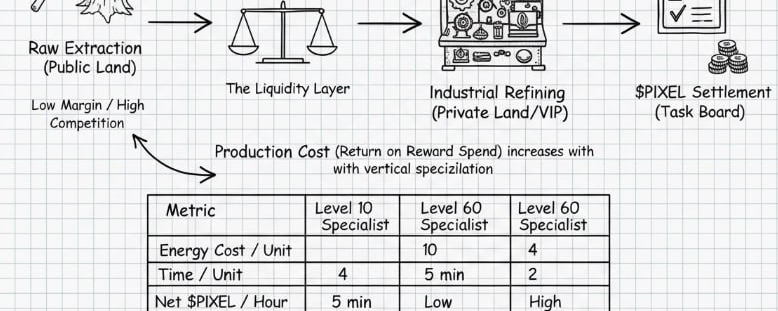
99% of crypto games fail because they don't have "Vertical Depth." everyone does the same thing, everyone earns the same thing, and the market becomes a race to the bottom.
pixels Chapter 2 fixed this by introducing Industrial Friction.
i’ve been tracking the "Refining Spread" on the secondary markets.
in the old days, a crop was a crop. now, a Tier 4 refined resource is a completely different asset class.
this is where the "Specialist's Moat" comes in.
because high-tier crafting stations require massive $PIXEL reinvestment to upgrade, and high-tier skills require thousands of hours of focused energy, the system creates natural monopolies.
if i’m a Master Woodworker, my cost to produce a Tier 4 plank is 40% lower than yours.
this means i can set the market price at a level where i’m profitable, but you are literally losing money if you try to compete.
the system is designed to force inter-dependency.
The Laborer: Produces raw Tier 1 resources on public land.
The Specialist: Buys raw materials, uses upgraded stations to refine them.
The Task Optimizer: Buys refined goods to fulfill high-value PIXEL tasks.
this is the "B2B" (Business-to-Business) shift that most people are missing.
if you are trying to be all three people at once, your Return on Reward Spend (RORS) will always be lower than the person who picks one spot and owns it.
the Task Board isn't a list of chores; it's a settlement layer for a complex industrial economy.
on the Ronin Network, PIXEL acts as the lubricant for this trade.
i don't want to sell my $PIXEL for USDT. i want to spend it to upgrade my station to Tier 5 so i can tighten my grip on the local lumber market.
the game has successfully shifted the goal from "extraction" to "industrial dominance."
stop looking at the crops. start looking at the supply chain.
are you a worker, or are you a factory?
because in Chapter 2, only the factories survive the squeeze.