
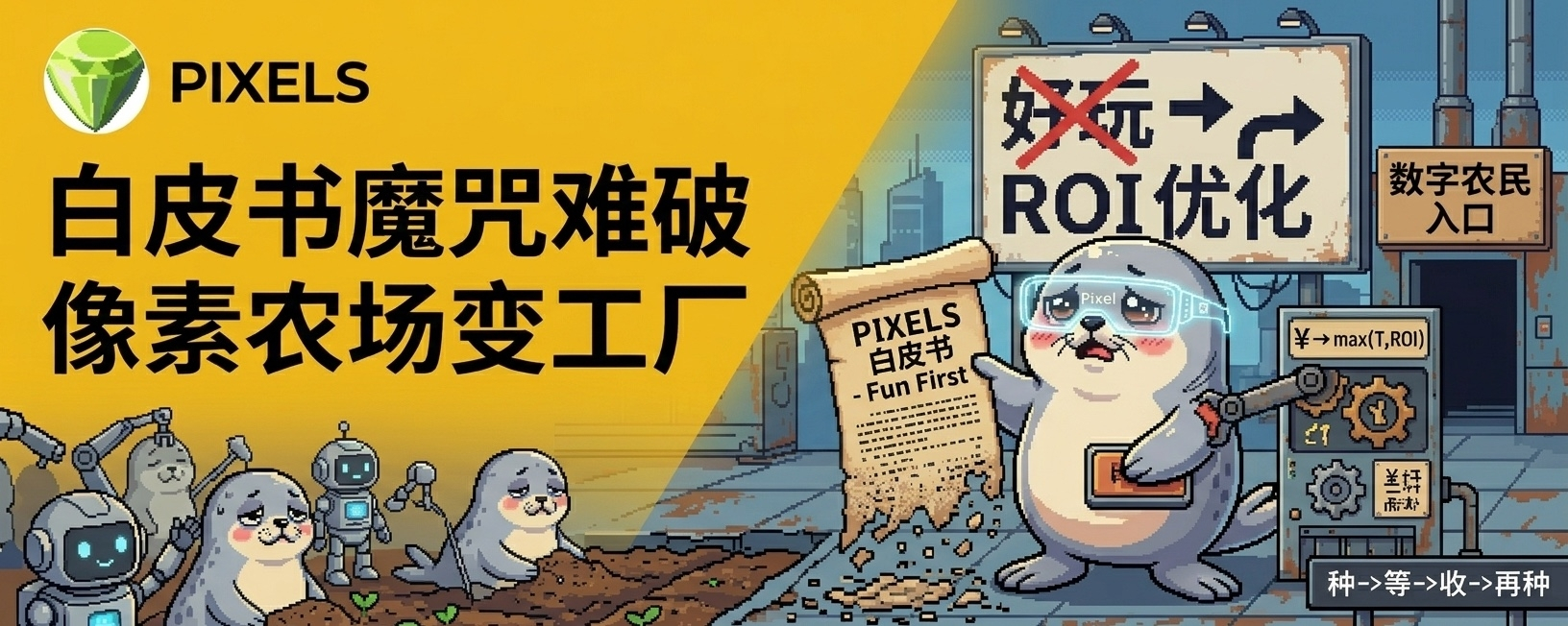
Today is the last day I’m participating in the @Pixels #creatorpad event.
This journey started with high hopes, but it's been a tough ride, a bit painful too, because the #pixel visuals, honestly, are as bad as their name suggests—absolutely terrible. Even the text symbols in the interface are intentionally designed in a rough pixel style that makes my eyes hurt.
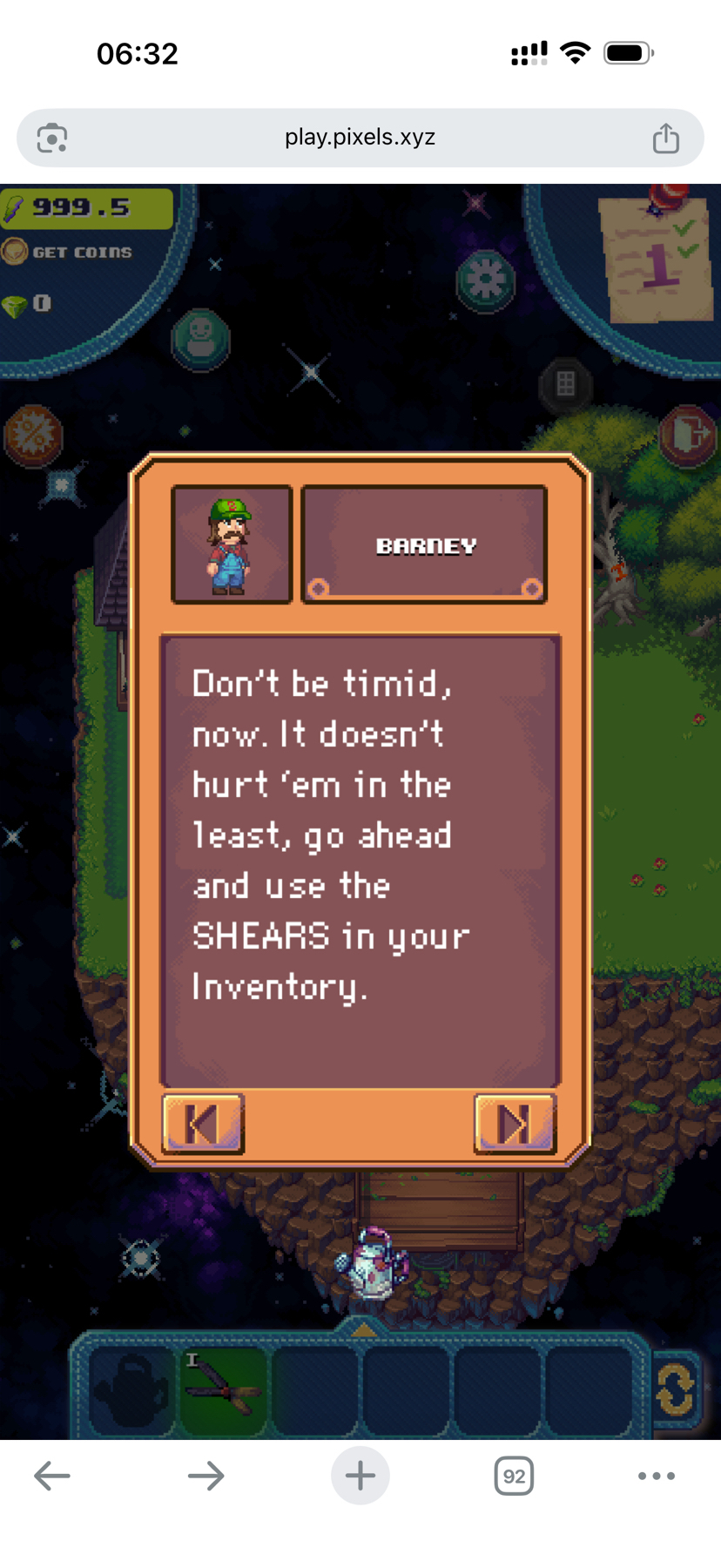
So, the unpleasantness isn’t because of \u003cc-32/\u003e poor yields, but because I’m increasingly aware of the structural deficiencies in this game regarding 'fun', which is the most fundamental aspect.
There is a particularly striking statement in the Pixels whitepaper that left a deep impression on me:
'Fun First. No matter how you plan to grow and monetize the application layer - there needs to be an intrinsic motivator that drives users to use the platform. For games, it’s quite obvious—though hard to execute—games need to be fun! Our design team needs to focus on creating real value for our users—by creating a game that people genuinely enjoy and want to spend time playing.'
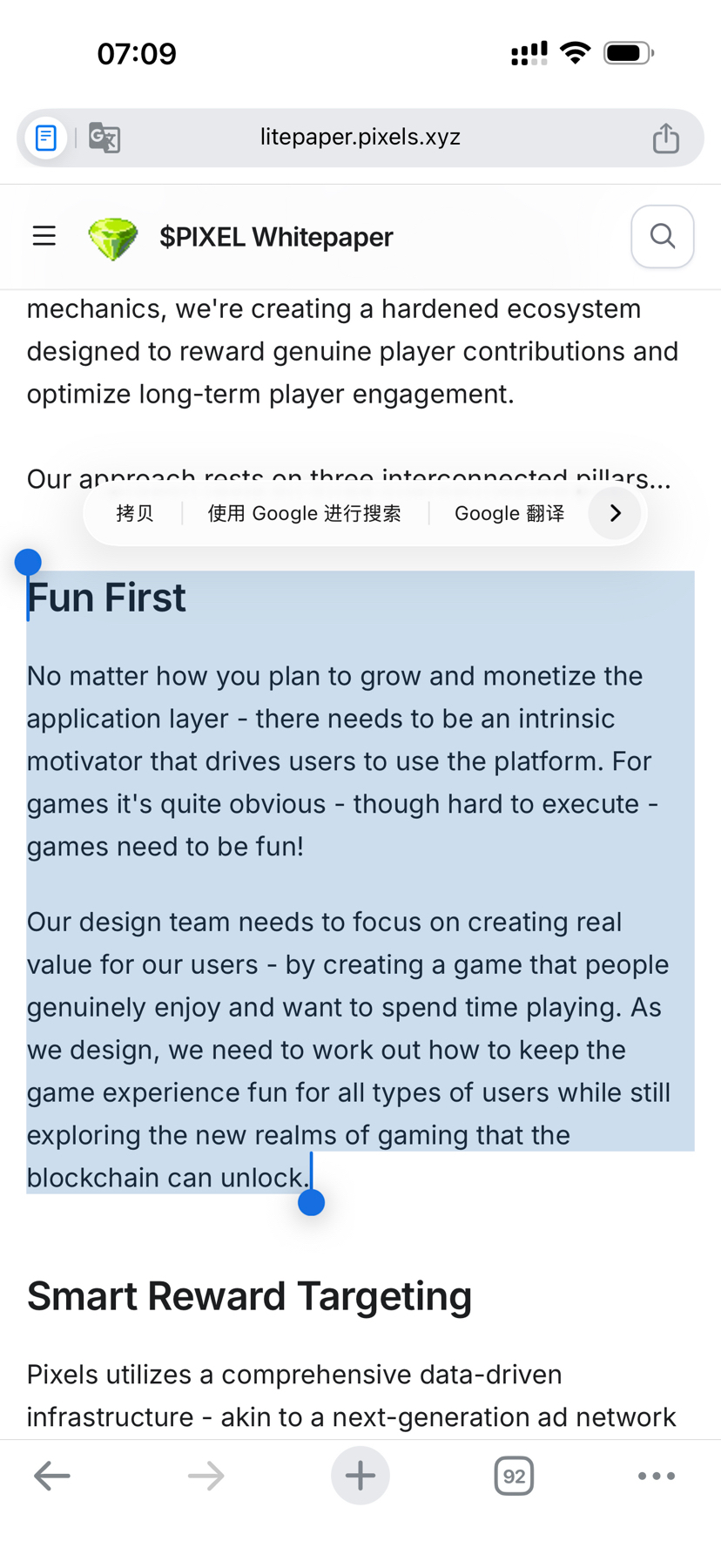
This statement is written clearly and sincerely, and it immediately touched me at the outset. It clearly acknowledges that games first need intrinsic motivation, making people want to spend time playing, rather than just being pushed by external rewards. Unfortunately, this statement has almost become an island in the whitepaper. Following it are a lot of discussions about economic models, reward mechanisms, token sustainability, and smart reward systems… The understanding is on point, but the execution seems particularly brutal.
I originally planned to exit earlier. One night after finishing my daily grind, I stared at the screen for a few seconds, and suddenly thought, 'Am I playing a game, or just completing some repetitive task?' At that moment, I almost closed the page. But in the end, I persevered because the endeavor itself was more worth exploring than whether it was fun or not.
The 'unfun' aspect of Pixels is structural.
Describing it as 'boring' alone is too lazy. Its dullness stems from three structural levels, which I deeply felt during these 15 days.
➤ ❶ Operational Layer: You’re not playing; you’re mechanically executing.
The core loop is very simple: plant → wait → harvest → replant. Even traditional games, despite their repetitiveness, stimulate dopamine through random events, unexpected feedback, or small surprises. But in Pixels, most actions result in highly predictable outcomes, with almost no surprises and no real room for mistakes. I later roughly counted that about 70% of my daily actions were pure repetitive actions, 20% was waiting or traveling, and the moments that truly felt 'interesting' were less than 10%. It didn’t give me immersion; it gave me clear fatigue.
➤ ❷ Decision Layer: You’re not thinking; you’re applying formulas.
At first, I seriously studied the gameplay, trying different crop combinations and time allocations. But I quickly realized that the optimal solution converged highly. You don’t need innovative strategies; just find that standard answer and execute it strictly. Here, players are no longer decision-makers but more like optimizers. Once yield becomes the core driving force, behavior naturally shifts from enjoying the process to maximizing output.
➤ ❸ Growth Layer: You’re not getting stronger; you’re accumulating time.
What made me most uncomfortable was the growth mechanism. In many classic games, growth comes from more skilled play, deeper understanding, and better choices. But in Pixels, growth is essentially a function of time: the more time you invest, the more resources you get, and the stronger your character becomes. I had a jarring realization—'If I play smarter today, it won’t make me significantly stronger tomorrow; but if I grind for two more hours today, it will.' This statement pulled 'gaming' back to the raw logic of time-for-resources.
The gap between the whitepaper's promises and the brutal reality.
The whitepaper shouts 'Fun First', emphasizing the need to create experiences that people can genuinely enjoy, unlocking new gameplay with blockchain. But in practice, I felt that 'fun' was systematically marginalized, replaced by three other things: predictability, quantifiability, and scalability.
Predictability makes every step of yield stable and calculable, minimizing risk, which is favorable for the economic system but also completely eliminates surprises; quantifiability turns every experience into ROI calculations, where 'is it worth doing' completely replaces 'is it fun'; scalability allows projects to accommodate a large number of users and quickly expand content, but at the cost of sacrificing individual players' deep enjoyment.
Pixels actually did something quite radical: it actively lowered the fun of the game and created a highly efficient 'behavior filtering system'—filtering out users willing to accept repetitive labor and exchange time for stable outputs.
This is not just Pixels' case, but a consensus failure of the entire blockchain gaming industry.
At this point, it goes far beyond Pixels itself. The core contradiction repeatedly discussed in blockchain gaming over the past few years has always pointed to the same issue: Play and Earn are fundamentally in conflict.
An almost consensus view has formed in the industry: players enter primarily for profit, but what can truly keep them engaged is genuine fun. Most projects ultimately choose the former. The result is that player numbers can increase, but the real 'players' are dwindling, with more leaving behind task executors and yield optimizers.
As professional analysts have pointed out, when 'making money' becomes the core mechanism, it directly conflicts with 'having fun'. Humans prioritize satisfying income needs, and once profit is introduced, player behavior shifts from 'playing' to 'optimizing yield'. The biggest mistake made by the first generation of Web3 games was driving participation through incentives rather than relying on the design of the game itself.
Pixels is relatively restrained; it has a low entry barrier and some sense of community, but it still hasn’t completely escaped this curse. The gameplay is relatively shallow, and the core loop is singular. Once compared with traditional excellent farming games, the lack of layered fun, emotional connection, and unexpected surprises becomes immediately apparent. The entire industry seems to prioritize tokens, financing, and economic models over the truly challenging task of 'making games fun'.
Ultimately, players gradually became 'mercenaries' migrating between different projects, constantly searching for the next yield point, with few genuinely investing in long-term ecological development.
The one thing Pixels truly got right, and its limitations.
If I had to say what Pixels did right, I’d rather point out its sort of 'honesty'. Many blockchain games engage in simple repetitive gameplay while promoting immersive experiences or rich adventures, whereas Pixels more directly drives behavior through systems, even introducing AI to analyze user behavior without excessive pretense.
With this level of honesty, Pixels may still live for a long time, maybe even indefinitely.
But this honesty also exposes problems. It turns the game into an efficient behavior filtering and economic maintenance tool, rather than a truly enjoyable entertainment product.
I even feel that its deliberately designed rough pixel style serves as a user filter. It doesn’t need those who truly pursue Fun First.
I persisted through these 15 days not because it made me happy, but because it consistently provided me with a 'reason' to log in. Joy is an intrinsic, sustainable driving force; whereas a 'reason' is external and can be replaced at any time by another project with higher returns.
The clarity of the last day.
Today, after completing the last task, I closed the page without a strong sense of relief, but rather a strange clarity. Although the last 15 days were not pleasant, they gave me a more sober understanding of blockchain gaming.
In 2026, the industry must face a reality: No matter how loudly the whitepaper shouts Fun First, if it cannot truly be implemented in daily task loops, decision depth, and growth experiences, it’s just beautiful self-comfort. When a product can operate without relying on 'fun', are we players still willing to invest time and emotion in it? The future of blockchain gaming—will it continue to transform players into efficient digital farmers, or will it truly return to the essence of 'gaming'?
I don’t think Web3 users don’t need 'gameplay', nor do I believe that economic supremacy is the future of blockchain gaming.
The voices of ordinary users in the community
Finally, I want to list some genuine voices of ordinary players I've seen in the community. I hope the Pixels team and the entire blockchain gaming industry can seriously listen to these voices, which do not come from KOLs.
'Playing Pixels feels more like a job, mechanically completing tasks every day, with joy long gone, leaving only the obsession with making money.'
'The whitepaper says Fun First, yet the core loop is all about repetitive labor. While playing, my eyes hurt, my fingers ached, and I just wanted to uninstall.'
'If the game itself isn’t fun, no matter how intricate the economic model is, it’s just a short-term tool; eventually, retention will collapse.'
'What we want is a game that truly makes people want to keep playing, not just a digital farm dressed in pixels.'
'I hope the next update focuses not just on token data but also on how to give players a little surprise in the moment, rather than just long-term reasons.'
\u003cm-169/\u003e\u003ct-170/\u003e\u003cc-171/\u003e
References
Did Web3 Gaming Die in 2025? The Five Reasons Behind GameFi Decline, CCN, 2025.
https://www.ccn.com/news/crypto/web3-gaming-die-in-2025-the-five-reasons-behind-gamefi-decline/
More than 90% of Web3 games failed after a $15 billion boom as gamers never showed up: Caladan, coindesk, 2026.
https://www.coindesk.com/markets/2026/04/23/more-than-90-of-web3-games-failed-after-usd15-billion-boom-as-gamers-never-showed-up-caladan
Why Play to Earn Games Are Failing, games.gg, March 3, 2026.
https://games.gg/news/why-play-to-earn-games-are-failing/
Web3 Gaming Isn’t for Gamers (Yet), CCN.
https://www.ccn.com/news/crypto/web3-gaming-gamers-balancing-play-earn-pay-win/
Should You Play Ethereum Farming Game ‘Pixels’, Decrypt.
https://decrypt.co/251303/should-you-play-ethereum-farming-game-pixels-dont-care-crypto
Why Web3 Gaming Struggled to Keep Players, games.gg.
https://games.gg/news/why-web3-gaming-struggled-to-keep-players/
Web3 Gaming’s Scaling Crisis: Why Innovation Alone Isn’t Enough, DeFi Planet, 2025.