
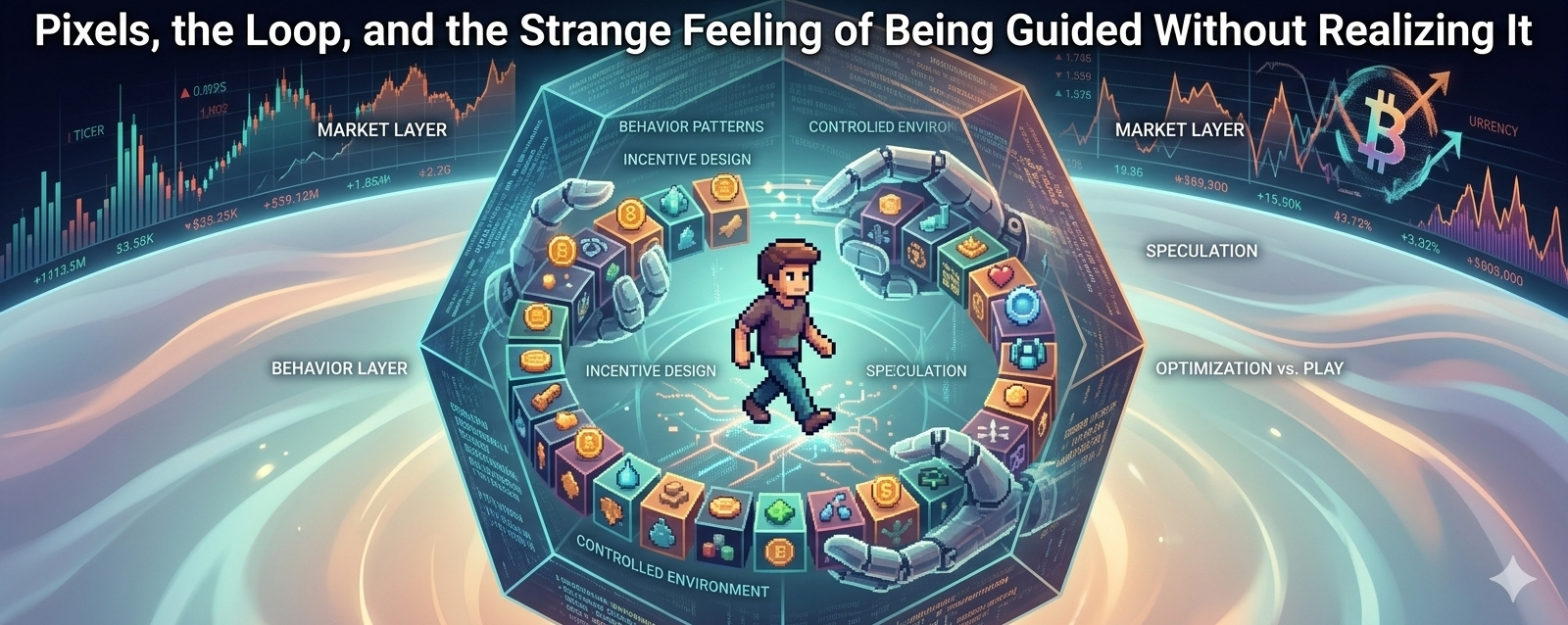
@Pixels I did not really notice the shift at first. At the beginning, Pixels felt like any other game with a familiar rhythm to it. Log in, do the same cycle, collect what you can, upgrade something small, and keep moving. It had that easy repetition that makes everything feel harmless at the start. But after a while, something changed in a way that was hard to point at directly. I stopped feeling like I was simply playing for fun and started feeling like I was adapting myself to the system without even thinking about it. My timing changed naturally. My choices became more careful. Some actions began to feel worth doing, while others slowly started feeling unnecessary. Nothing about it was loud or dramatic. It was subtle enough that I almost missed it, but once I noticed it, I could not unsee it. The game was not just reacting to my actions. It seemed to be shaping the way I approached those actions in the first place.
That is what makes Pixels different to me. I have seen enough Web3 games to recognize the usual pattern. People come in with curiosity, they follow the loop, they push activity for a while, and then eventually the whole thing starts to feel tired or too predictable. Most of the time it becomes a simple cycle of effort and reward, and once the rewards stop feeling meaningful, the game begins to lose its pull. But Pixels does not sit in that exact same space for me. The longer I stayed inside it, the more I started feeling that rewards were not always flowing in a flat or obvious way. Two actions could take similar effort, but the outcome would not always feel equal. That made me stop thinking in terms of pure grinding and start thinking in terms of behavior. It began to feel like the system cared less about how much activity existed and more about how that activity was being carried out. That small difference changes everything. It makes the experience feel less mechanical and more psychological, because you are no longer just repeating a loop. You are adjusting yourself to a structure that seems to notice patterns, not just volume.
And once I started looking at it that way, even the sinks and progression systems began to feel different. Things that might normally seem like simple barriers started looking more like part of a larger design. Fees, upgrades, friction, pacing, and resource movement all seemed to play a role in how the whole economy breathes. Instead of just slowing the player down, they shape where value goes and how it moves. That is what gave the whole thing a more experimental feeling to me. It no longer felt like a standard game economy sitting on top of a token. It felt more like a controlled environment where different pieces of behavior, reward, and retention are being tested together in real time. There is something almost modular about it, like the game is trying to figure out which patterns create meaningful participation and which patterns only create noise. That is not something most people notice immediately, but once you do, it changes the way every decision feels. You stop playing in a fully random way and begin making choices that are quietly shaped by the structure itself.
At the same time, there is still another layer that exists above all of that, and that is the market. No matter how carefully the internal system is designed, the token side still behaves like a token side. Attention moves it. Liquidity moves it. Sentiment moves it. Timing moves it. That is where the disconnect becomes impossible to ignore. Inside the game, the structure might be trying to reward smarter behavior, better alignment, and more meaningful participation. But outside the game, price does not care about any of that in the same way. The market reacts to pressure, narrative, and momentum far faster than any internal design can fully control. So even if the system underneath is elegant, disciplined, and well thought out, it can still feel vulnerable from the outside. That gap between the behavior layer and the market layer is what makes the whole thing so interesting to me. One side is trying to create order, while the other side still follows the usual chaos of speculation.
That is probably why I do not see Pixels as just another farm-and-exit style game. It feels more intentional than that. Not perfect, not complete, and maybe not even fully settled yet, but definitely more intentional. The more accurately a system defines valuable behavior, the more it starts shaping the people inside it. That is both the strength and the risk. On one hand, the game becomes smarter. On the other hand, it can start narrowing the way people naturally interact with it. Players begin to optimize before they even realize they are optimizing. They stop wandering as freely. They stop experimenting as much. They start moving in ways that feel efficient instead of playful. And that is where the emotional side of gaming starts to matter more than the mechanics. Because people do not only stay for rewards. They stay for how a system makes them feel while chasing those rewards.
What keeps me coming back is not really the grind itself. It is the sense that Pixels is trying to understand something deeper about how people behave when value, progression, and participation are all tied together. It feels like an experiment in incentive design, but one that is still trying to remain fun enough to hold attention. That is not easy to do. A system can be clever and still miss the reason people return in the first place. It can be efficient and still feel too controlled. It can reward the right behavior and still lose the spontaneity that makes a game feel alive. That tension is what I keep noticing here. Pixels does not feel like a perfect answer, but it does feel like it is asking an important question. How far can a game go in shaping behavior before it stops feeling like a game and starts feeling like a structure you are simply learning to move through?