
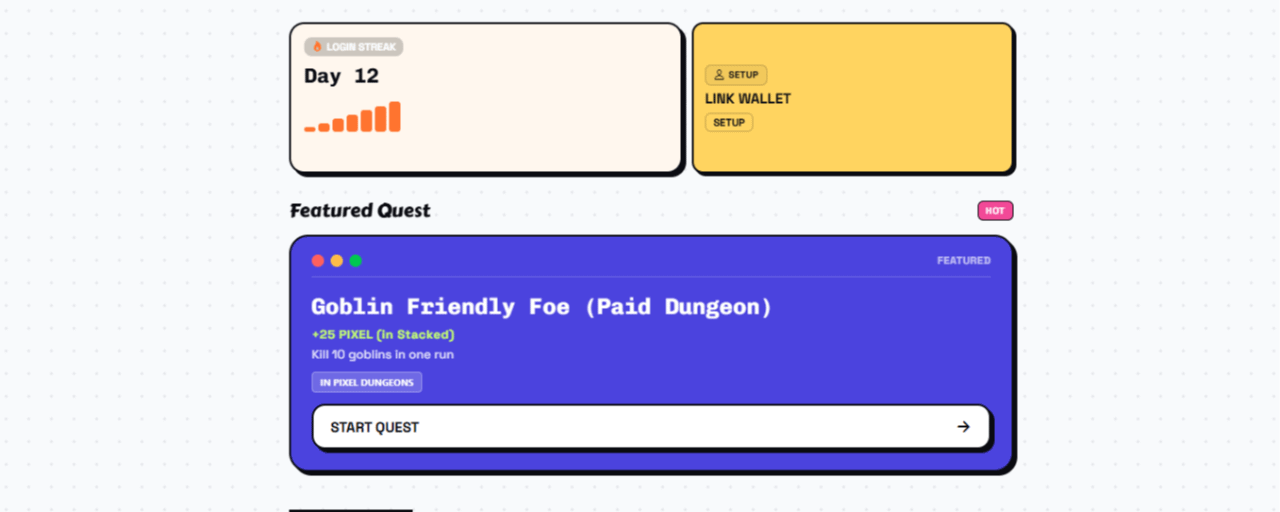
The more I think about Pixels and Stacked, the more I feel the key word is not simply “rewards.”
The key word may be alignment.
That distinction is important.
A game can distribute rewards and still build a weak economy.
A platform can create activity and still fail to create real value.
A campaign can attract users and still struggle to keep them after the excitement fades.
That is because activity alone is not enough.
What matters is whether the incentives are aligned with the long-term health of the ecosystem.
This is where Stacked becomes interesting to me.
It seems to approach rewards not as random giveaways, but as a way to encourage behavior that actually matters inside a live game economy.
That means asking deeper questions:
Are players returning because they feel more connected?
Are rewards supporting real participation or only short-term farming?
Are incentives helping users discover more of the ecosystem?
Are they improving retention, loyalty, and long-term value?
These questions are not just technical.
They are strategic.
Because in Web3 gaming, the biggest challenge has never been only attracting attention.
It has been turning attention into participation, and participation into durable value.
That is where many older play-to-earn models struggled.
They created incentives, but the incentives were not always aligned with healthy behavior. In some cases, rewards encouraged extraction more than commitment.
What I find meaningful about the current Pixels direction is that it feels like an attempt to move beyond that pattern.
If Stacked can help games reward the right actions, reduce wasted incentives, and understand player behavior more clearly, then it may become more than a rewards layer.
It may become part of a better alignment system.
And that matters for PIXEL as well.
Because when the surrounding ecosystem becomes more aligned, the token story can also become more meaningful. Not just as a game token, but as part of a broader structure around rewards, loyalty, and participation.
Nothing in crypto is guaranteed.
Execution still matters.
Adoption still matters.
But I think the direction is worth watching.
The future of Web3 gaming may not be won by the projects that simply give out the biggest rewards.
It may be won by the projects that learn how to make incentives point in the right direction.