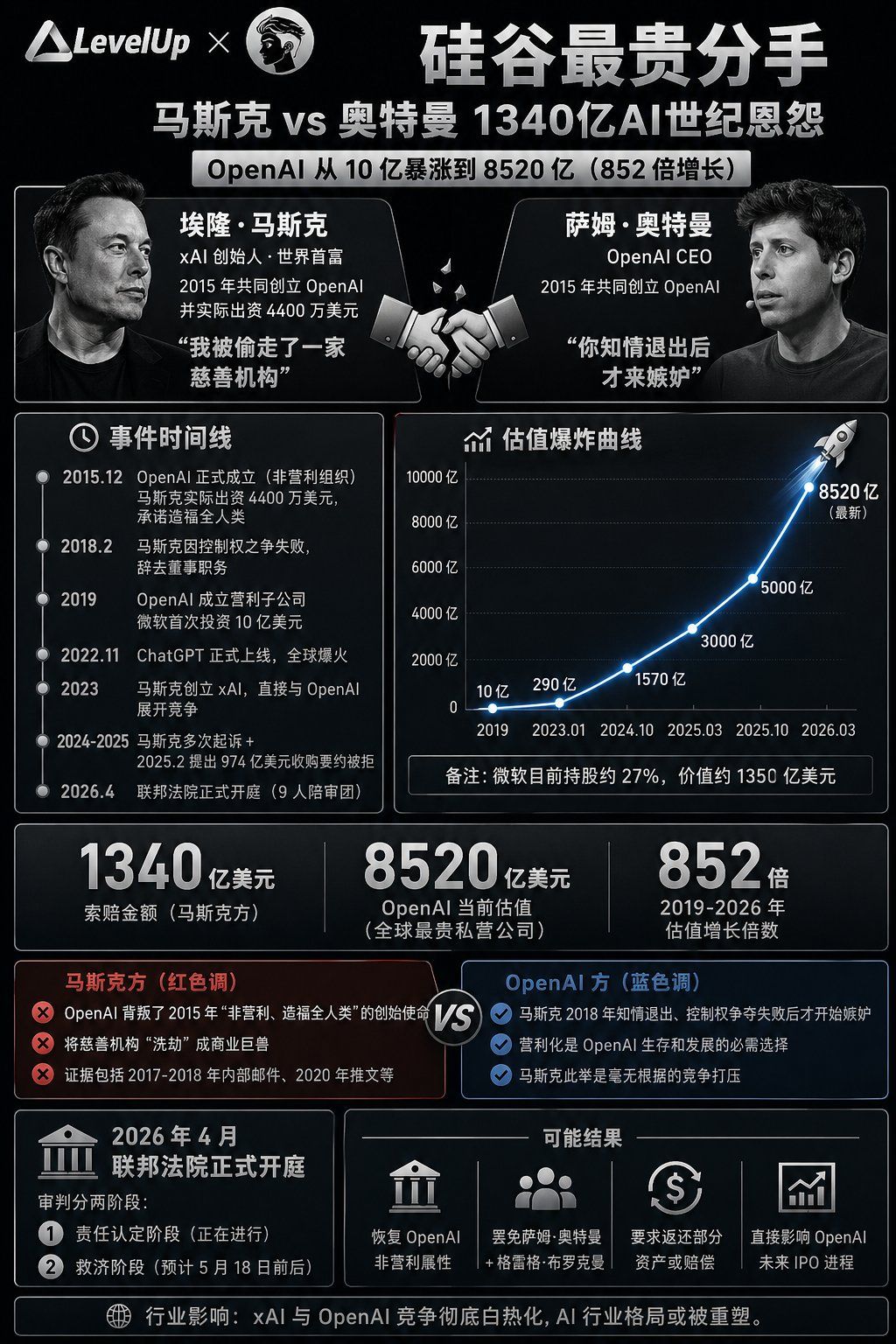
Musk vs. OpenAI: The $134 Billion AI Showdown
There's a brutal reality to this lawsuit: no matter who wins, OpenAI will never be the same as it was when it was founded in 2015.
On April 28, 2026, in the Federal Court of Oakland, California. Musk and Altman, the two co-founders, locked eyes across the courtroom. The jury was selected, opening statements were made. A whopping $134 billion was hanging in the balance—Musk said he would pay this entire amount to OpenAI's nonprofit parent, on the condition that Altman and Brockman step down, OpenAI revert to nonprofit status, and Microsoft take on joint liability.
OpenAI claims he's trying to suppress competition; he's just jealous.
In December 2015, OpenAI registered as a non-profit, 501(c)(3). The founder list now looks like an all-star lineup in the AI scene: Elon, Altman, Sutskever, Brockman. Their goal sounded great—counter Google DeepMind and make AI 'benefit all humanity.'
Elon really put his money where his mouth is. He personally shelled out around $44 million, promised a total of a billion, and even went to Google to poach Sutskever. Early email records show he and Altman were on the same page about the 'risks of AI.'
But the good times didn’t last. At the end of 2017, Elon said OpenAI couldn't burn cash faster than Google and had to commercialize or merge with Tesla. The board didn’t give him majority control. He resigned from the board in February 2018. The official statement was 'conflict of interest,' but everyone knew it was because he couldn't secure control. He left with a parting shot—OpenAI 'is doomed to fail.'
Karpathy later confirmed that the power struggle was the reason.
In 2019, OpenAI created a 'profit cap' subsidiary, with Microsoft investing $1 billion initially. Later, Microsoft held 27%, and that stake is now worth around $135 billion. Elon was aware at the time and didn't strongly oppose it. However, he added in a later lawsuit: 'The tail shouldn't wag the dog.'
Then ChatGPT blew up.
After launching in November 2022, OpenAI went from a research lab to a consumer-grade AI giant. Its valuation skyrocketed from $1 billion in 2019 to $29 billion in early 2023, and then to $852 billion by March 2026—making it the most valuable private company globally. The speed was so rapid that even OpenAI might not have realized it.
In 2023, Elon launched xAI, going head-to-head directly. He didn't hold back publicly—OpenAI 'betrayed its mission,' and has become a 'closed commercial machine.'
In February 2024, he filed a lawsuit in California state court. He withdrew in June, then refiled in federal court in August. He called it a 'Shakespearean-level betrayal.'
In February 2025, Elon’s consortium offered $97.4 billion to buy the non-profit part of OpenAI. It was rejected four days later. By the end of the year, OpenAI restructured as a public benefit corporation but still operated under the non-profit foundation.
April 27-28, 2026, Oakland Federal Court. The jury of nine was selected, and opening statements began.
Elon pulled back the fraud allegations before the hearing, leaving just two: breach of charitable trust and unjust enrichment. The claim is about $134 billion, all to be returned to the non-profit entity.
On April 28, he testified. His exact words: 'I came up with the idea, named it, hired the people, taught the knowledge, and almost fully funded it initially.' He also mentioned a debate with Larry Page about AI risks—that was really the true starting point for him to establish OpenAI. He said if he loses, it would 'destroy the foundation of American charitable trust.'
OpenAI's lawyers hit back directly: 'Elon walked away without control and is now jealous of the success.'
The trial is expected to last 3-4 weeks. Witnesses still to come include Altman, Brockman, Microsoft CEO Satya Nadella, and Shivon Zilis. Relief phase begins in mid-May.
The prediction market gives Elon a roughly 40% chance of winning. He continues to post on X: 'They stole a non-profit organization; that's not right.'
Honestly, I don't care who wins between those two.
What I'm wondering is: does a non-profit, after becoming the world's most valuable company, still stand by those 'benefit humanity' commitments from 2015? If this case wraps up and all non-profits can just flip the script after finding funds, what’s the point of even calling it 'non-profit'?
This could be the real highlight of this 'most expensive breakup.'