
I have been watching the cryptocurrency space long enough to recognise the distinct sound of a narrative shifting. For the last eighteen months, the conversation around Web3 gaming has been a dirge of failed tokenomics and ghost towns. Yet, recently, a quiet murmur has started to build around Pixels, a social casual game on the Ronin Network. It is attracting attention not because it has reinvented the wheel, but because it has managed to put a somewhat square peg into a round hole: making a crypto game that people actually seem to open voluntarily. The market is noticing it because, amidst the wreckage of the Play-to-Earn collapse, this project has somehow retained an audience. But let us be honest, retention in this sector is often just a measure of how long it takes for people to realise the math does not add up.
The bigger problem here is not about onboarding the next billion users, as the marketing decks love to claim. It is about the fundamental friction of digital ownership. For two decades, we have had perfectly functional economies in games like World of Warcraft or EVE Online without a blockchain in sight. The problem Web3 claims to solve is the walled garden—players spending thousands of hours grinding for assets they technically do not own. It is a valid frustration. However, the solution often introduces a parasitic layer of fees, volatility, and custody issues that the average player simply does not want to manage. When a casual farmer has to worry about gas fees and wallet security just to water a digital turnip, the cure becomes worse than the disease.
What most casual observers miss is that Pixels is not really a game in the traditional sense; it is a coordination game disguised as a farm. The deeper idea here is not the farming mechanics, which are rudimentary at best, but the social layer enforced by resource scarcity. The project understands that in a Web3 environment, the value is not generated by the gameplay loop itself, which is usually tedious, but by the social pressure to participate in an economy. It is a digital company town. Players are not just playing; they are performing economic labour for tokens that have no intrinsic value outside the closed loop of the ecosystem. The "game" is just the interface for a complex transactional relationship.
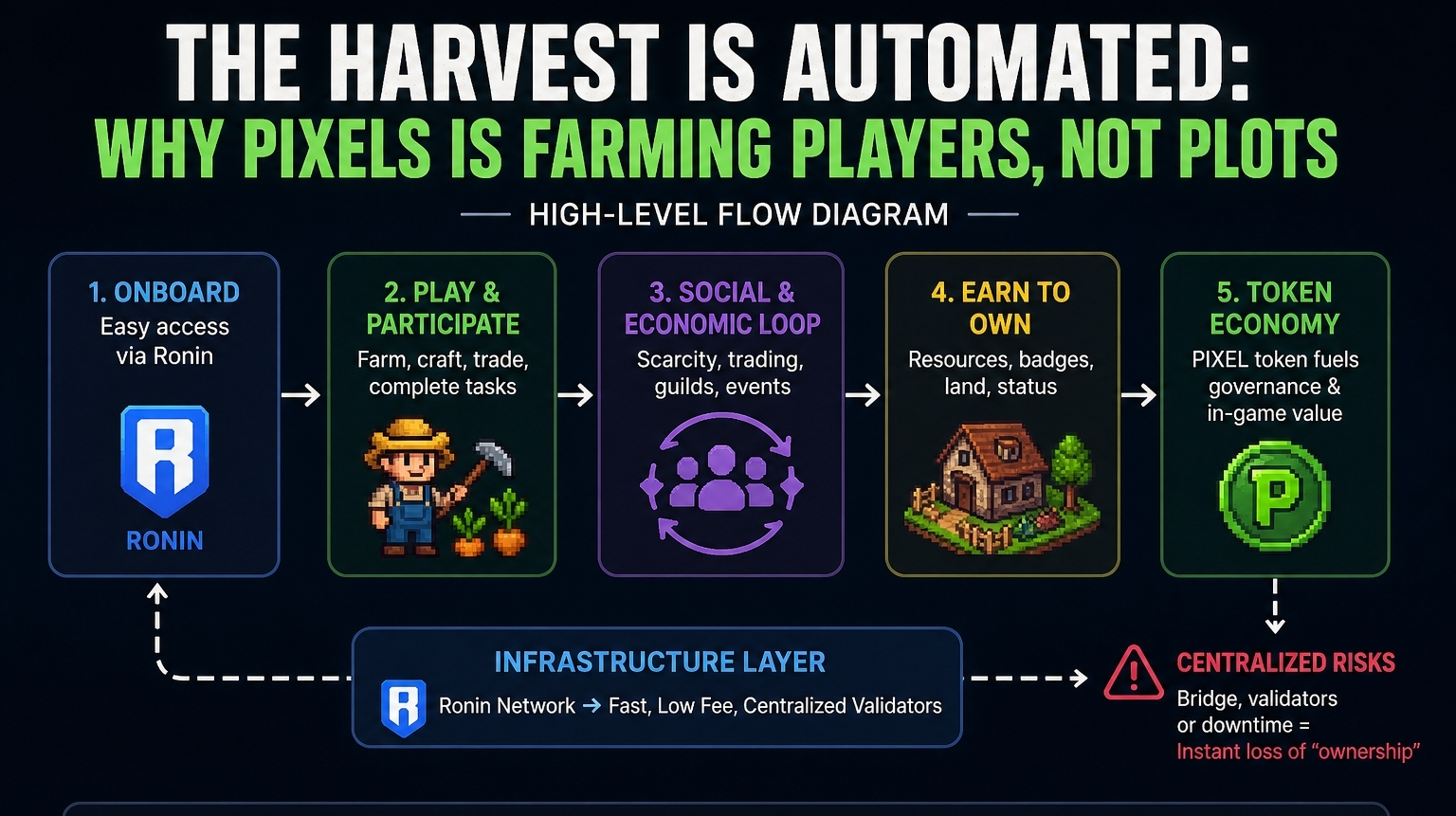
Looking at the system architecture, the reliance on the Ronin Network is the most telling design choice. Ronin, for those who remember the $600 million hack of 2022, is an Ethereum-linked sidechain built specifically for Axie Infinity. It prioritises speed and low fees over decentralised security. Pixels utilises this to minimise the friction that usually kills crypto games. You log in, you click, you harvest. The heavy lifting of identity and settlement is abstracted away. But let's call it what it is: a walled garden with a different landlord. By centralising the infrastructure to ensure a smooth user experience, they have essentially recreated the Web2 model they claim to disrupt, only now the database is called a blockchain and the assets are tokens. If the centralised validators go down or the bridge is compromised again, the "ownership" vanishes instantly.
The economic layer is where my scepticism hardens. The PIXEL token is the fuel for this engine, but it sits in a precarious position. It acts as a governance token and an in-game currency, a combination that rarely ends well. In a healthy economy, currencies are stable mediums of exchange. In crypto gaming, tokens are speculative assets. This creates a misalignment of incentives. The developers want the token price to go up to reward early investors and the treasury. The players want the token to be affordable so they can play the game. These goals are mutually exclusive. When the primary purpose of a token is speculation rather than utility, the game economy becomes a ticking clock. The only question is who gets left holding the bag when the liquidity dries up.
Where the model gets interesting, and perhaps a little devious, is in its shift away from pure "Play-to-Earn" to a model they call "Play-to-Own." It sounds benign. Instead of earning cash, you earn resources and badges. This softens the immediate financial expectation, reducing the pressure on the tokenomics. It is a clever marketing pivot that acknowledges the failures of the previous bull run. By focusing on land ownership and social status rather than raw token emission, they are trying to build a digital serfdom where the value is derived from digital real estate. It is a move designed to extract more time from players rather than just money, banking on the human desire to build and accumulate, even if the accumulation is meaningless in the real world.
The hard problem facing Pixels is the very thing it tries to ignore: content. A blockchain can verify a transaction, but it cannot generate fun. For all the talk of tokenomics and decentralisation, the core loop of the game is a repetitive clicker. In the traditional gaming world, games survive on expansion packs, storylines, and gameplay innovation. In Web3, the gameplay is often an afterthought to the financial mechanism. The challenge is that once the financial incentive diminishes, or the token price stabilises and stops offering moon-shot returns, players are left with a mediocre game. There is very little evidence to suggest that "ownership" alone can retain users who are bored.
So, is this the future of gaming? I have seen this movie before. I saw it with Decentraland, with The Sandbox, and with the myriad of "metaverse" projects that were going to replace the internet. They are all still there, mostly empty, waiting for the next hype cycle to bring in a fresh wave of tourists. Pixels is currently enjoying the spotlight because it has executed the basics better than its peers. It is functional, it is social, and it runs on a chain built for scale. But it is still an economic experiment pretending to be a pastime. Until the game is worth playing without the promise of a financial return, it remains a leveraged bet on human greed.