
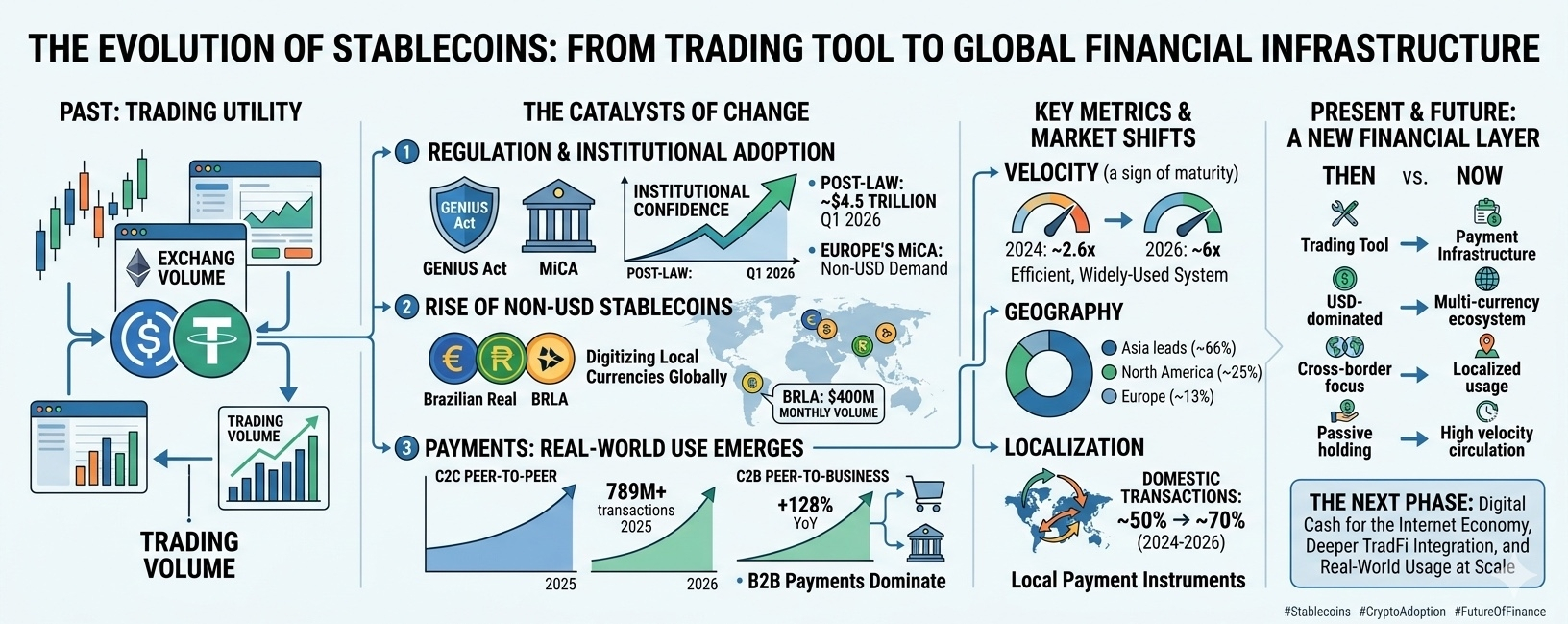
Stablecoins have undergone a quiet but powerful transformation. Once seen merely as a utility for crypto traders, they are now positioning themselves as a foundational layer of the global financial system. Recent insights from Andreessen Horowitz (a16z crypto) highlight how regulation, usage patterns, and market structure are accelerating this shift.
Let’s break down what’s actually happening beneath the surface.
1. Regulation: From Uncertainty to Acceleration
For years, regulatory ambiguity kept major institutional players on the sidelines. That dynamic is now changing.
The introduction of the GENIUS Act marks a turning point. Rather than creating the trend, regulation is amplifying existing momentum.
Before the law: steady growth in trading volume
After implementation: surge to ~$4.5 trillion in Q1 2026
This signals something critical:
Institutional confidence follows regulatory clarity.
In parallel, Europe’s Markets in Crypto-Assets Regulation (MiCA) reshaped market structure by forcing compliance-driven changes, including delistings of non-compliant assets like Tether in certain regions.
The result?
A new demand wave for non-USD stablecoins, proving regulation doesn’t kill innovation—it redirects it.
2. Rise of Non-USD Stablecoins
Historically, stablecoins have been dominated by USD-backed assets. That dominance still exists—but cracks are forming.
MiCA and regional financial needs are driving the growth of alternatives:
Euro-backed stablecoins in Europe
Real-backed assets like BRLA in Brazil
BRLA’s growth—from near zero to $400M monthly volume—shows how local currencies + blockchain rails can unlock adoption.
Key insight:
Stablecoins are no longer just exporting the US dollar—they are digitizing local currencies globally.
3. Payments: The Real Use Case Is Emerging
The biggest misconception?
That stablecoins are mainly for trading.
That narrative is breaking down.
C2C Still Dominates — But C2B Is Exploding
Peer-to-peer (C2C): largest volume (789M+ transactions in 2025)
Peer-to-business (C2B): fastest growth (+128% YoY)
This indicates a transition:
From speculative usage → real-world economic activity
4. Stablecoin Cards and Spending Infrastructure
Payment infrastructure is evolving rapidly.
Projects using card rails (e.g., Etherfi Cash, Kast, Wallbit) are enabling users to:
Hold stablecoins
Spend them seamlessly in real-world transactions
Collateral deposits surged from near zero to $300M/month.
Even though these are technically collateral systems, the implication is clear:
Stablecoins are integrating into everyday financial behavior.
5. Velocity: A Sign of a Mature Network
One of the most overlooked metrics is velocity—how often each unit of money is used.
2024: ~2.6x
2026: ~6x
This nearly 2x increase signals:
Higher demand than supply growth
More active usage, not passive holding
In traditional finance, high velocity is a hallmark of:
Efficient, widely-used payment systems
6. Shift in Transaction Structure
If you strip away trading and DeFi mechanics, something interesting appears:
Estimated real payment volume: $350B–$550B annually
B2B payments dominate
This is crucial.
Businesses are:
Paying suppliers
Settling invoices
Managing treasury flows
All using stablecoins.
Translation:
Stablecoins are quietly entering the backbone of commerce.
7. Geography: Asia Leads the Charge
Stablecoin adoption is not evenly distributed.
Asia: ~66% of volume (Singapore, Hong Kong, Japan)
North America: ~25%
Europe: ~13%
Others: minimal
Asia’s dominance reflects:
Faster fintech adoption
Higher demand for digital dollar alternatives
Strong trading + payment ecosystems
8. Localization Over Globalization
Stablecoins were originally seen as cross-border tools.
That narrative is fading.
Domestic transactions: ~50% → ~70% (2024–2026)
Cross-border share: declining
This signals a major shift:
Stablecoins are becoming local payment instruments built on global rails.
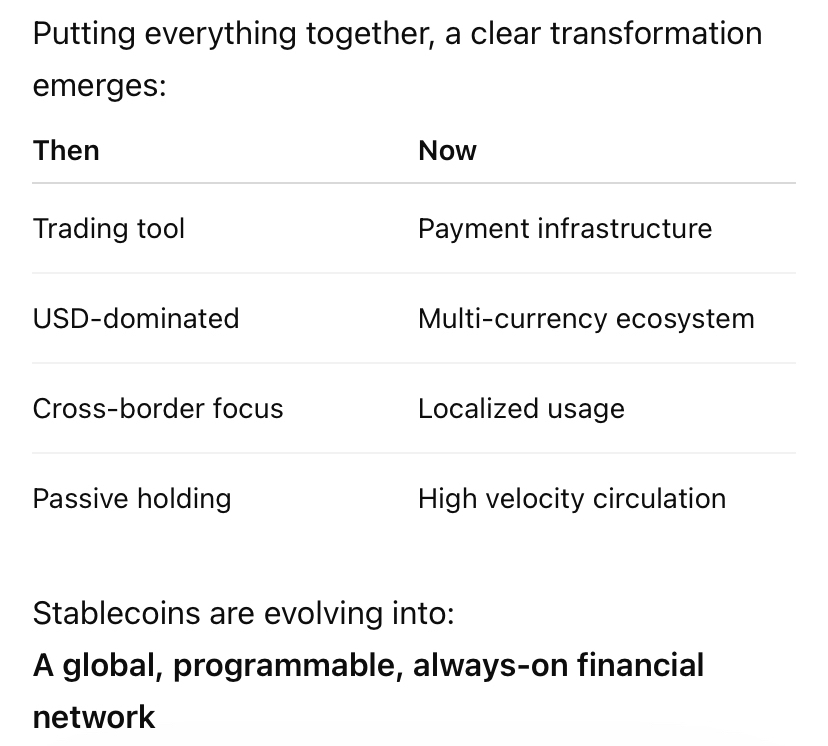
9. The Bigger Picture: A New Financial Layer
Final Takeaway
The data challenges the popular narrative.
Stablecoins are not just:
A hedge
A trading pair
A remittance tool
They are becoming:
Digital cash for the internet economy
Still early—but the direction is no longer unclear.
The next phase will likely be defined by:
Deeper integration with traditional finance
Expansion of local currency stablecoins
Increased regulatory standardization
And most importantly:
Real-world usage at scale