
I’ve been around the crypto space long enough to recognize when a narrative begins to shift.
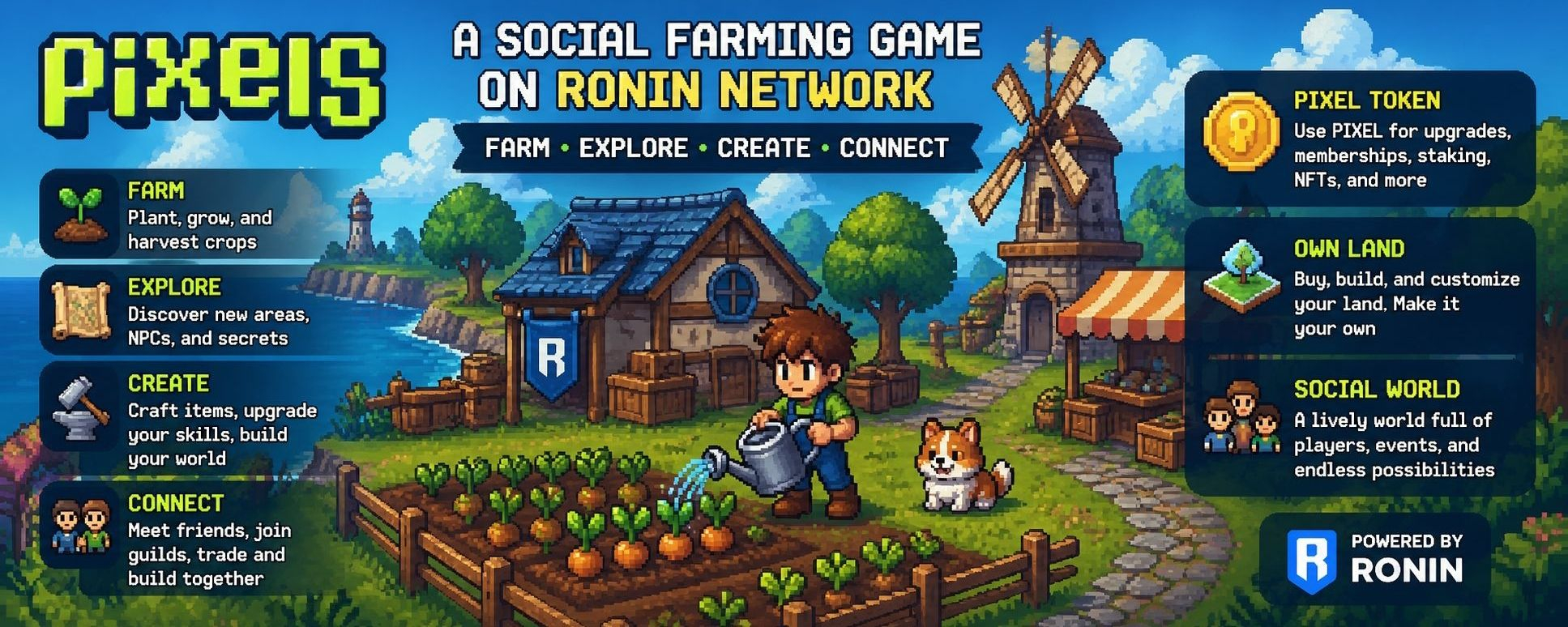
For the past eighteen months, Web3 gaming has largely been defined by failure broken tokenomics, empty worlds, and communities that disappeared as quickly as they formed. But recently, a quieter conversation has started to emerge around Pixels, a social casual game built on the Ronin Network.
What’s notable isn’t that Pixels has revolutionized gaming. It hasn’t. What it has done, however, is far more subtle: it has managed to create a crypto game that people return to voluntarily. In a sector where most projects struggle to retain attention beyond initial incentives, that alone is enough to turn heads.
But retention in Web3 often comes with a caveat. Staying power doesn’t always indicate success—it can just as easily reflect how long it takes for participants to recognize structural flaws in the system.
At its core, the broader issue isn’t onboarding the next billion users, despite what pitch decks suggest. It’s the persistent friction tied to digital ownership. Traditional games have supported thriving economies for decades without blockchain infrastructure. Players invested time, effort, and even money into ecosystems they didn’t technically own but for most, that wasn’t a problem worth solving.
Web3 attempts to address this “ownership gap,” but in doing so, it often introduces new complications: transaction fees, wallet management, security risks, and volatility. For the average player, especially in a casual setting, these complexities can outweigh any theoretical benefit. When tending a virtual farm requires navigating financial infrastructure, the experience starts to feel less like entertainment and more like administration.
Pixels approaches this differently but not necessarily in the way it appears on the surface.
Rather than functioning purely as a game, Pixels operates more like a coordination system wrapped in familiar mechanics. The farming, crafting, and exploration loops are intentionally simple. The real engine lies beneath: a social economy shaped by scarcity, participation, and interaction.
Value isn’t generated through gameplay depth. It’s generated through collective activity.
In that sense, Pixels resembles a kind of digital company town. Players aren’t just engaging for fun—they’re contributing to an ecosystem where time, attention, and behavior translate into economic output. The game becomes an interface for structured participation, where rewards exist primarily within the boundaries of the system itself.
The infrastructure reinforces this model. Built on Ronin, a sidechain designed for speed and low transaction costs, Pixels minimizes the friction that has historically hindered Web3 adoption. The experience feels seamless log in, interact, harvest, repeat.
But this convenience comes with trade offs.
By abstracting away complexity, the system reintroduces a degree of centralization. It begins to resemble the very Web2 environments blockchain was meant to disrupt only now ownership is mediated through tokens rather than traditional databases. The reliance on centralized validators and bridge mechanisms raises a familiar question: how durable is ownership if the underlying infrastructure fails?
Then there’s the economic layer.
The PIXEL token plays multiple roles as currency, governance tool, and speculative asset. Historically, combining these functions has proven unstable. A healthy in-game currency benefits from predictability and accessibility. A speculative token, by contrast, thrives on volatility.
This creates an inherent tension.
Developers and early stakeholders benefit from price appreciation. Players, on the other hand, need affordability to sustain engagement. When those incentives diverge, the economy becomes fragile. Over time, the system depends less on utility and more on continued belief raising the risk that late participants absorb the downside.
To its credit, Pixels has adapted. The shift from “Play-to-Earn” to “Play-to-Own” reflects a broader evolution within Web3 gaming. Instead of emphasizing direct financial rewards, the model leans into ownership, progression, and status.
It’s a strategic pivot.
By focusing on land, resources, and identity within the game, Pixels reduces immediate pressure on its token economy. At the same time, it encourages longer term engagement by tapping into intrinsic motivations: building, collecting, and belonging.
But this also introduces a different dynamic.
What’s being cultivated isn’t just gameplay it’s commitment. Time becomes the primary investment, with value tied to accumulation within a closed system. The appeal shifts from earning to maintaining a presence, from extracting value to reinforcing it.
And that leads to the central question: what happens when the incentives fade?
Because ultimately, no amount of infrastructure or economic design can replace one critical element compelling content.
A blockchain can validate ownership. It cannot create meaningful experiences.
Without ongoing innovation, narrative depth, or evolving gameplay, even the most efficient systems risk becoming repetitive. If engagement is driven primarily by economic participation, then sustainability depends on the continued relevance of that economy.
We’ve seen similar cycles before. Projects that captured attention during periods of hype, only to struggle once speculation cooled. Virtual worlds that promised permanence but relied on constant influxes of new participants to sustain activity.
Pixels, to its credit, has executed more effectively than many of its predecessors. It works. It’s accessible. It fosters interaction. And for some players, it has created a genuine sense of connection.
But beneath that success, it remains what much of Web3 gaming has always been: an evolving experiment at the intersection of finance, technology, and human behavior.
The real test isn’t whether players show up when rewards exist.
It’s whether they stay when they don’t.
So the question isn’t just whether Pixels is farming crops.
It’s whether, over time, it’s been farming players.