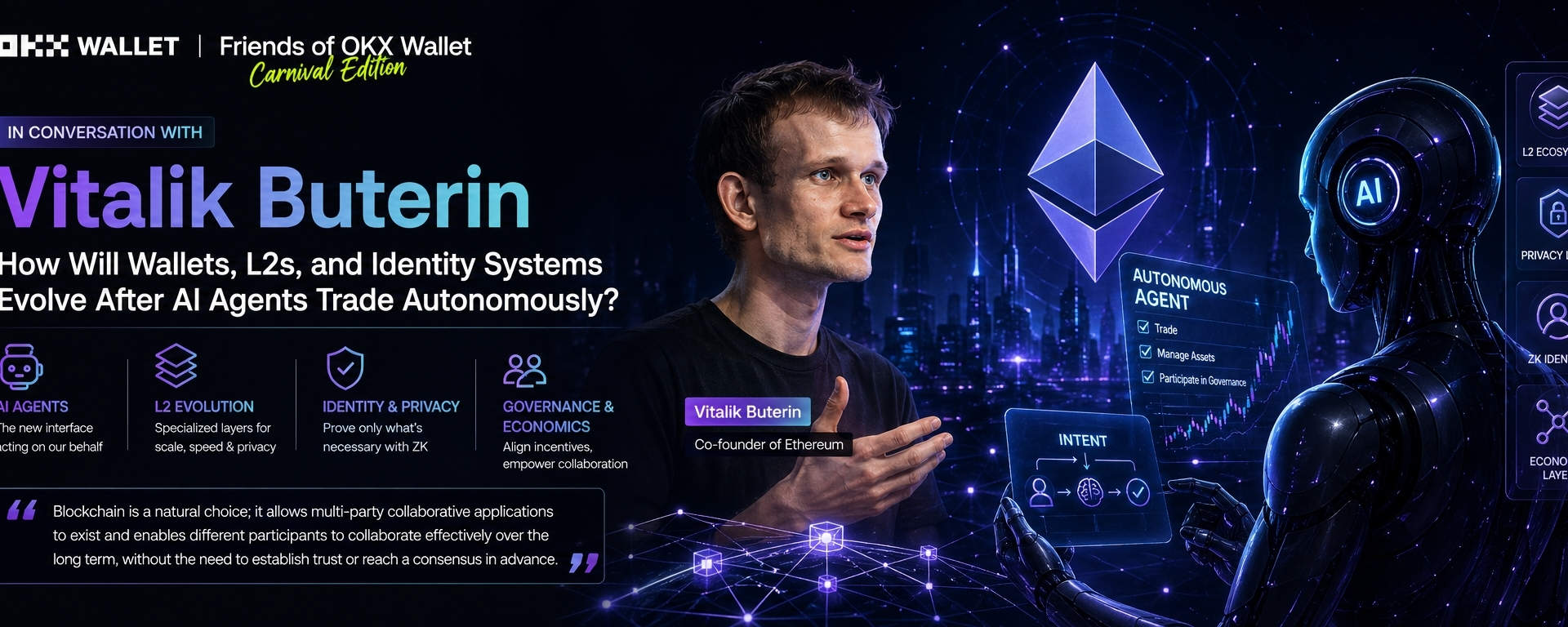
I used to think wallets were just tools… simple interfaces to send, receive, and store crypto.
But the more I study the direction of AI and blockchain, the clearer it becomes: wallets are evolving into something far more powerful — autonomous systems that act on our behalf.
This shift became obvious while exploring the ideas of Vitalik Buterin in a recent discussion with OKX Wallet.
And honestly… it changes everything.
The blockchain didn’t change… but how we use it is about to
At its core, Ethereum still does the same two things:
It acts like a public bulletin board
It processes computation (DeFi, apps, transactions)
But AI is rewriting how we interact with it.
Before, I had to open apps, switch tabs, and manually execute every action.
Now? An AI Agent can:
Analyze opportunities
Execute trades
Interact with multiple protocols
Manage strategies… all at once
I’m no longer clicking buttons — I’m giving intent.
That’s a massive shift.
AI is becoming the interface… not the user
At first, I thought AI would replace users.
But that’s not really true.
As Vitalik Buterin explains, humans are still the users — AI is just the new interface.
It’s like the difference between:
Searching manually on Google
Asking AI and getting everything done instantly
The same thing is happening in crypto.
Soon, I might not even “use” a wallet directly.
Instead, I’ll interact with an AI… and it will handle everything underneath.
The real game changer: autonomous Agents
Here’s where things get serious.
Agents won’t just assist — they’ll act:
Trading on-chain
Holding assets
Participating in governance
And that raises a big question:
How do these Agents interact with each other?
The answer is something most people ignore:
👉 An economic layer
Without it, decentralized AI can’t cooperate.
Blockchains like Ethereum become critical here because they:
Enable trustless coordination
Provide incentives
Allow long-term collaboration without central control
This is where crypto stops being optional… and becomes infrastructure.
L2 isn’t just about scaling anymore
I used to think Layer 2 solutions were just for cheaper fees.
That’s outdated thinking.
According to Vitalik Buterin, L2s will specialize:
High-frequency trading → L2
Account security → L1
Privacy → dedicated L2s
Projects like:
Tornado Cash
Railgun
show what’s coming next.
Different layers for different purposes.
Not one chain doing everything.
Identity is being completely redefined
This part changed how I think about privacy.
I used to believe identity meant showing who I am.
Now I realize… that’s inefficient.
The future is:
Proving just enough
Revealing nothing extra
Using concepts from Zero-knowledge proof, I can:
Prove I’m trustworthy
Prove my funds are clean
Without exposing my identity
And this works for both:
Humans
AI Agents
That’s how a unified system becomes possible.
Wallets are turning into intelligent systems
This is the biggest shift.
Wallets are no longer:
Static apps
Simple interfaces
They’re becoming:
AI-powered agents
Security layers
Decision-makers
But there’s a catch…
If they rely on centralized servers, privacy disappears.
That’s why future wallets must:
Be secure
Be verifiable
Be user-aligned (not company-controlled)
Otherwise, the whole system breaks.
The biggest risk nobody talks about
AI makes everything faster…
Including attacks.
That means:
Governance becomes harder
Sybil attacks become easier
Exploits scale faster
Even public goods funding gets affected.
Behind every Agent is still a human — and that’s where responsibility stays.
Where this is all going
If I had to summarize the future in one sentence:
AI will run the actions… but blockchain will enforce the rules
And the key pieces shaping this future are:
Agent-based wallets
Specialized L2 ecosystems
Privacy-first identity systems
Decentralized economic coordination
We’re not just upgrading crypto…
We’re building a system where machines interact economically on our behalf.
And honestly?
We’re still early.