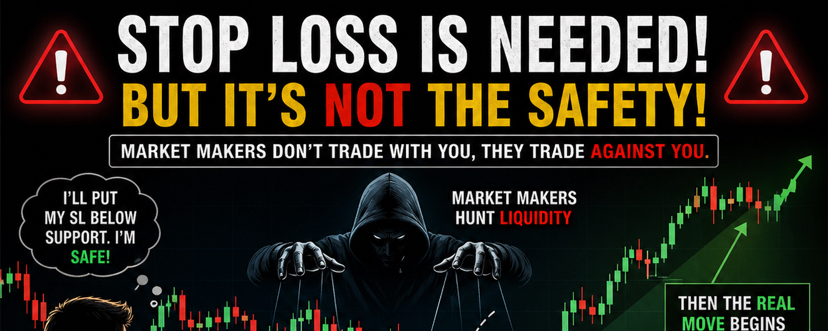
In trading, most people believe their stop loss is a private safety tool—something that protects them from losing too much. But in reality, the market doesn’t treat it that way. Your stop loss is not hidden; it is visible liquidity sitting on the chart where large numbers of traders collectively place their risk. And in many cases, that liquidity becomes the very thing the market moves toward.
📌 Stop Loss = Visible Liquidity
A stop loss is not just a protective measure—it represents a price level where traders are forced to exit their positions. When thousands of traders place their stops in similar areas, those zones become highly attractive liquidity pools. The market naturally moves toward these areas because liquidity is required for large orders to be executed.
📉 How Price Actually Behaves
Many traders are confused when they see sudden wicks, fake breakouts, or sharp spikes that quickly reverse. These moves often feel random, but they usually aren’t. Price frequently expands toward areas where stop losses are clustered, triggers them, collects liquidity, and then continues in the intended direction. What looks like manipulation is often just market mechanics at work.
💀 Why Most Retail Traders Lose
The typical trader follows a simple pattern: enter a trade, place a tight stop loss in an obvious location, and wait. The problem is that these obvious levels are exactly where most traders cluster their risk. As a result, many retail traders unintentionally become exit liquidity—getting stopped out just before the market moves in their original direction.
🧠 The Smarter Way to Think About Risk
Stop losses are still essential and should never be removed. The goal is not to trade without them, but to place them more intelligently. Avoid obvious levels, understand market structure, and pay attention to where liquidity is building. Professional traders don’t just think about entries—they think about where others are likely wrong.
🔄 The Mindset Shift That Matters
Instead of asking, “Where is my stop loss safe?” the better question is, “Where is the majority of traders likely placing their stop losses?” Because in many cases, price is engineered to reach those zones first before any real directional move continues.
📊 Final Reality Check
A static stop loss placed in a predictable zone is often an easy target. But a dynamic approach—combined with awareness of liquidity and structure—can significantly improve survival in the market. In trading, it’s not just about protecting capital; it’s about understanding how and why price moves the way it does.
#stoploss #liquidity #Information #tradingtechnique #market