
One of the biggest questions surrounding Web3 gaming today is whether projects are creating real, sustainable economies or simply repeating the same short-term cycles seen in earlier GameFi trends. @Pixels , powered by $PIXEL, presents an interesting case that sits somewhere between these two possibilities.
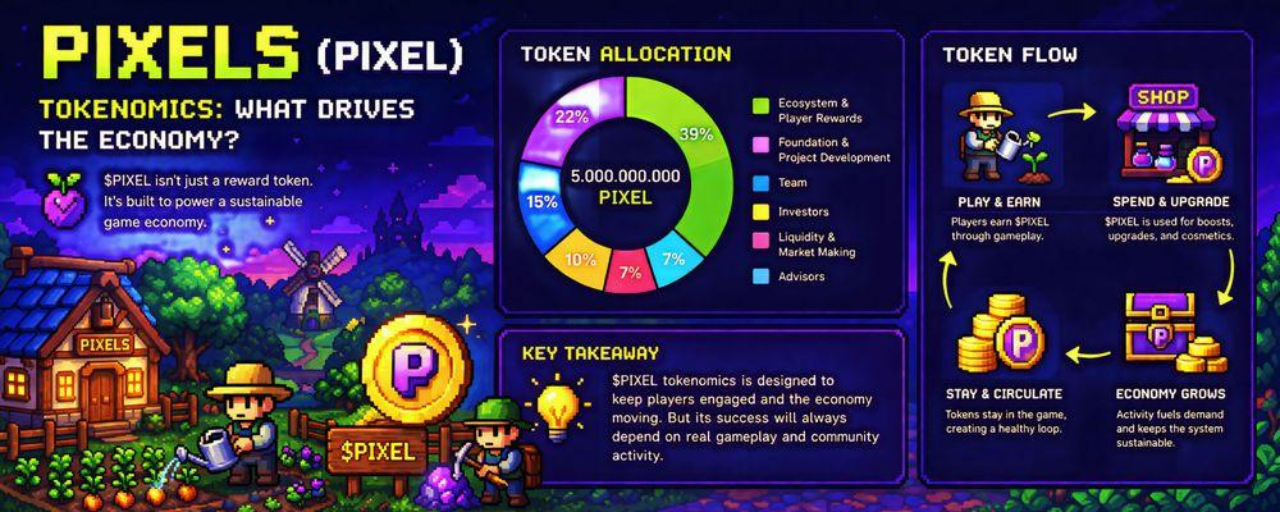
At a surface level, Pixels follows familiar mechanics: players farm resources, craft items, and participate in a player-driven marketplace. However, the deeper structure of the game suggests a more intentional design. Instead of focusing solely on rewards, Pixels emphasizes continuous interaction within its ecosystem. Every resource produced is meant to be used, traded, or reinvested, creating a circular flow rather than a one-way extraction.
This circular economy is one of the key differences. In many previous GameFi models, value was quickly extracted by players who entered early and left once rewards declined. Pixels attempts to reduce this behavior by making resources useful beyond immediate profit. Players are encouraged to keep resources within the system, whether through crafting, upgrading, or participating in more advanced activities.
The role of $PIXEL further reinforces this structure. Rather than functioning only as a reward token, it is integrated into multiple layers of gameplay. From unlocking features to enhancing efficiency, $PIXEL becomes part of the decision-making process. This creates a more stable demand compared to systems where tokens are primarily sold off by users.
Another critical factor is player retention. Pixels appears to focus heavily on daily engagement, encouraging players to return regularly through structured gameplay loops. This is important because retention is often a stronger indicator of long-term success than short-term user spikes. A stable player base can support a healthier economy, even during periods of lower market excitement.
However, the system is not without risks. Like any GameFi project, Pixels still depends on continuous development and user growth. Without new content or expanding participation, even a well-designed economy can slow down. Additionally, balancing resource production and demand will remain a long-term challenge.
From a broader perspective, @Pixels reflects an evolution in Web3 gaming design. It moves away from pure speculation and toward systems that rely on interaction, consistency, and player behavior. This approach aligns more closely with traditional gaming models, where value is created through engagement rather than extraction.
So, is Pixels building a real economy? The answer is not fully clear yet — but it is definitely moving in a more sustainable direction compared to many previous GameFi projects.
