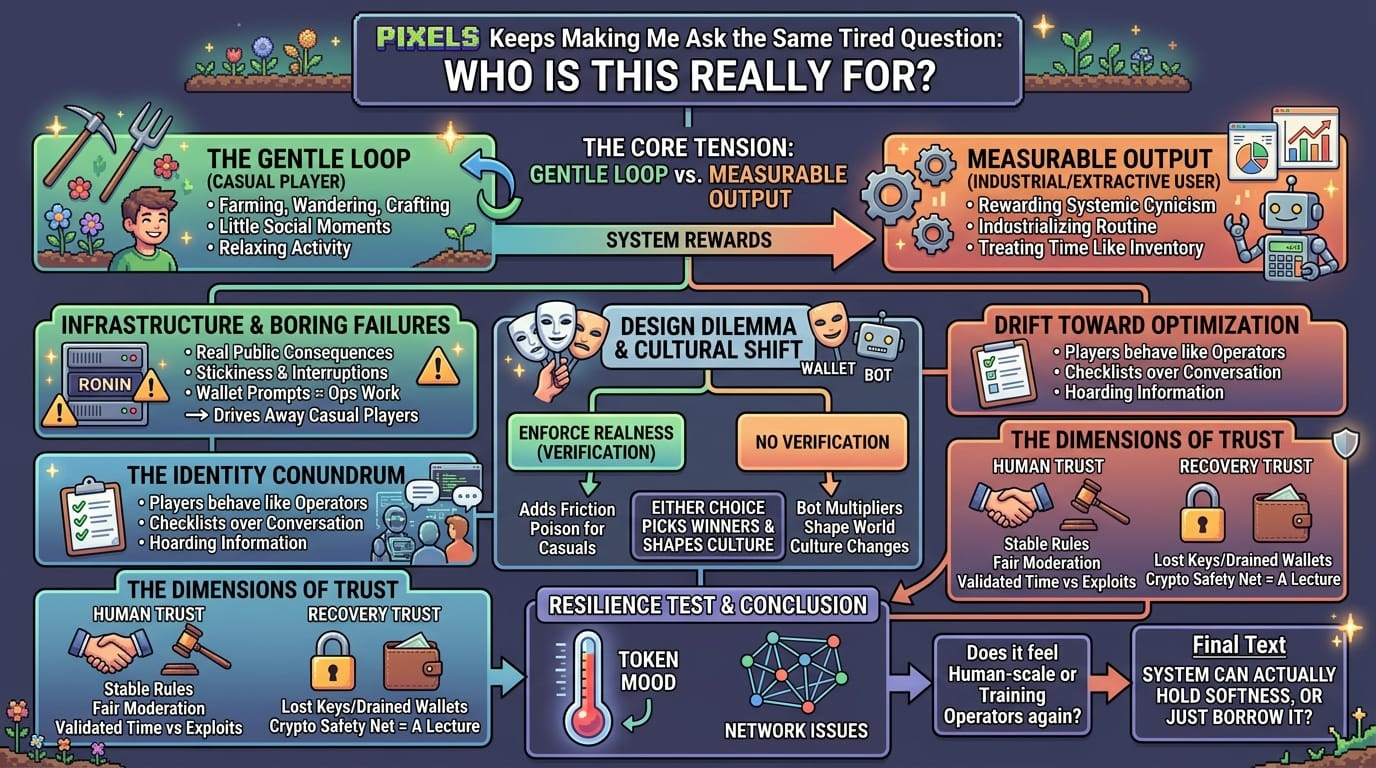
I didn't take it seriously at first because I've become that person who hears Web3 game and immediately looks for the trapdoor. Not because I think every team is cynical but because the system is. The system rewards the wrong kind of attention. It rewards people who can turn a gentle loop into a measurable output. And once that happens, the gentle loop doesn’t stay gentle.
Pixels is one of those projects that shows up like background music. Farming wandering crafting little social moments. It's on Ronin which has its own weight Ronin isn't some clean experiment it's infrastructure that's had to be real in public with consequences. That should make me more confident I guess but it mostly makes me more aware of what can go wrong in boring ways.
Maybe that's too harsh but boring failures are the ones that kill games. Not the dramatic hack headlines (though those matter too). I mean the slow stuff: the day the network feels sticky, the wallet prompts interrupt the rhythm, the did it go through? uncertainty that instantly turns a relaxing activity into light ops work. Casual players don't want ops work. They don't want to be reminded they’re standing on rails.
I keep coming back to identity because identity is where these worlds either become social or become theater. A wallet is a neat container but it doesn t map cleanly to a person. One person can be many wallets. Many wallets can be one routine run by automation. And in a farming world routine is the whole point. It’s the heartbeat. So of course the heartbeat is what gets industrialized first.
That's where things start to feel uncomfortable because the moment you accept that, you start seeing the real design problem. Do you try to enforce realness with verification? If you do, you add friction, and friction is poison for anyone who just wanted to wander around and make something small. If you don't you're effectively letting the world be shaped by whoever can multiply themselves and repeat the loop more efficiently than a normal human can. Either choice changes the culture. Either choice picks winners.
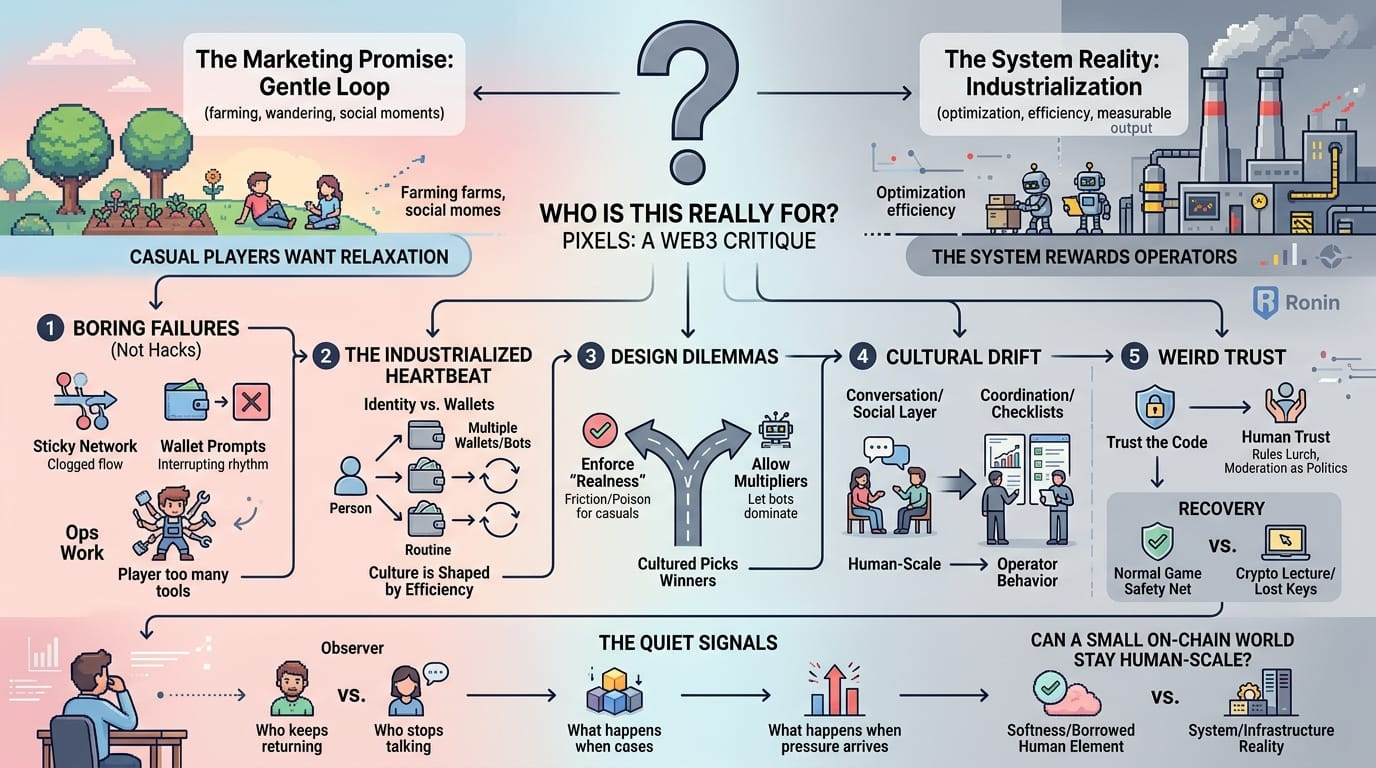
And it's not just bots in the cartoonish sense. It’s the quieter drift toward optimization. People who are really into it start to behave differently. They talk in checklists. They hoard information. They treat time like inventory. The social layer is still there, but it starts sounding like coordination rather than conversation.
Trust gets weird here too. Not trust the code the human kind trust that the rules won't lurch trust that moderation won’t become politics, trust that your time won't be invalidated by some exploit or imbalance that takes weeks to unwind. And then the ugliest trust question the one nobody likes to mention in a cozy setting recovery. Lost keys drained wallets wrong approvals tired mistakes. In a normal game, there's a boring safety net. In crypto, the safety net is often a lecture. Even if the lecture is philosophically consistent it leaves a mark on the mood.
I keep coming back to how Pixels behaves when the room temperature changes when the token mood sours when the network has a rough day when casual stops being a marketing word and has to be a lived experience. Does the world still feel like a place you can drop into without thinking or does it start training everyone to think like operators again?
Some days I catch myself wanting Pixels to prove that a small on chain world can stay human scale. Then I remember how many times I ve wanted that. And I'm left watching the quiet signals who keeps returning, who stops talking, what happens when pressure arrives wondering if the softness is something the system can actually hold or just something it borrows until it can't.