
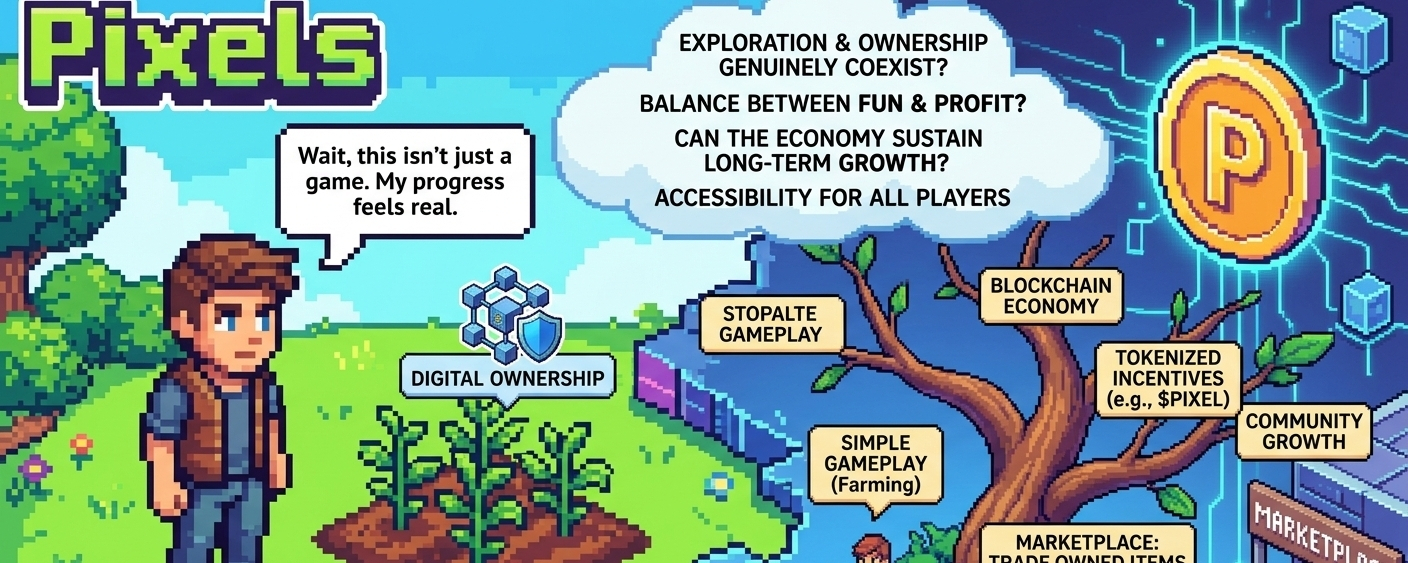
I didn’t expect much when I first clicked into Pixels. Another blockchain game, I thought. I’ve seen enough of those to recognize the pattern colorful interface, promises of “ownership,” maybe a token, and a community trying to will value into existence. But something about this one made me pause. Maybe it was the simplicity. Or maybe it was the feeling that I wasn’t being rushed into understanding it.
At first glance, it looks like a farming game. That’s what pulled me in nostalgia, probably. I’ve spent enough time in digital worlds planting crops, collecting resources, and building something out of nothing. But here, there was this subtle difference I couldn’t immediately name. It didn’t scream “blockchain” at me. It just… existed, like a game that wanted me to explore before asking anything in return.
So I started wandering.
The more I clicked around, the more I realized Pixels isn’t really trying to impress with complexity. It’s doing the opposite. It strips things down to something intuitive plant, gather, trade, repeat. But then the realization slowly creeps in: everything I’m doing is tied to ownership. Not in an abstract way, but in a way that feels oddly grounded. My progress isn’t locked into some invisible server logic. It’s mine, in a more literal sense.
That’s when I started connecting the dots.
This isn’t just a game it’s an economy disguised as one.
And that’s where things get interesting, but also a little uncomfortable.
Because I’ve seen what happens when economies enter games. The mood shifts. Players become participants, then optimizers, then sometimes… opportunists. Fun starts competing with profit. And somewhere along the way, the original magic either evolves or disappears entirely.
Pixels feels like it’s trying to balance on that edge.
There’s a token involved, of course. There always is. And that immediately pulls the project into a different arena the market. Now it’s not just about gameplay, it’s about value, speculation, and timing. I can already imagine the cycles: early adopters exploring casually, then a wave of attention as people start talking about earnings, then the inevitable surge of users chasing returns rather than experience.
I’ve watched this story play out before.
But what caught my attention here is how quietly Pixels introduces you to all of this. It doesn’t start with the token. It starts with the world. That might seem like a small design choice, but it changes how you enter the ecosystem. Instead of asking, “How do I make money here?” I found myself asking, “What can I do here?”
That shift matters.
Still, I can’t ignore the bigger picture forming in my head. Blockchain gaming is in a strange place right now. There’s a lingering skepticism—people have been burned by projects that promised sustainable economies but collapsed under their own incentives. Inflation, botting, lack of real engagement… the list goes on.
So naturally, I start questioning things.
What happens when too many players join just to extract value?
Can a simple farming loop hold attention long enough without becoming repetitive?
Is the economy designed to reward participation—or just early positioning?
These aren’t criticisms, just patterns I’ve learned to watch for.
And yet, I keep coming back to the feeling I had in the first few minutes. It didn’t feel forced. It didn’t feel like I was being sold something. It felt like I stumbled into a space that’s still figuring itself out, in a way that’s oddly refreshing.
There’s also something clever about how Pixels leans into accessibility. It doesn’t demand deep technical knowledge. You don’t need to understand blockchain mechanics to start playing. That lowers the barrier significantly, and it might be one of the reasons it’s gaining traction. Not everyone wants to “learn Web3.” Most people just want to experience something new without friction.
But traction can be a double-edged sword.
The moment a project starts growing, expectations grow with it. Suddenly it’s not just a game it’s a “top project,” a “potential leader,” something people start placing bets on. And that’s when pressure builds. Development timelines matter more. Token performance gets scrutinized. Community sentiment becomes volatile.
I’ve seen promising ideas crumble under that weight.
So I find myself in this strange middle ground. Part of me is genuinely curious, even a little excited. The simplicity, the accessibility, the quiet introduction it all works. But another part of me stays cautious. Because I know how quickly narratives can shift in this space.
Today it’s a charming farming world with a growing community.
Tomorrow it could be a case study in sustainability or a reminder of how hard it is to merge games with financial systems.
And maybe that’s what makes Pixels interesting to me. It’s not trying to be everything at once. It feels like an experiment that’s aware of its own limits, even if it doesn’t say it out loud.
As I close the tab, I realize I’m not walking away with a clear conclusion. I’m walking away with a question.
Is this the beginning of a new kind of digital world where ownership and gameplay genuinely coexist… or just another moment where we’re trying to turn play into profit and hoping it lasts?
