
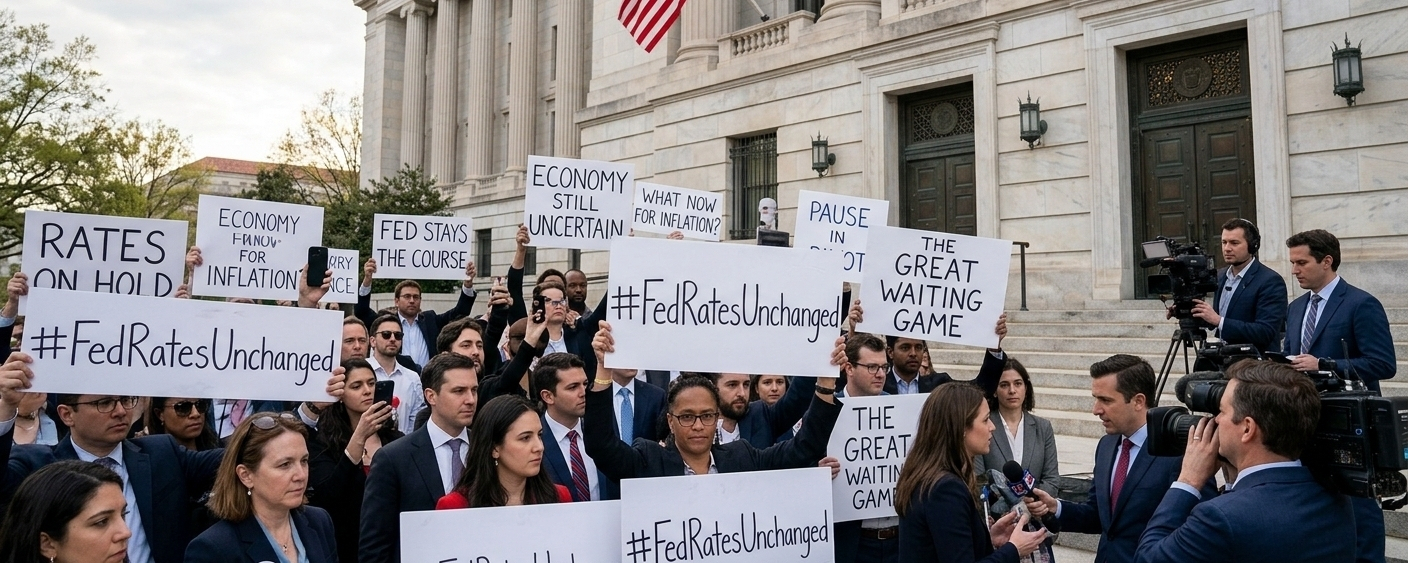
Fed Rates Unchanged: The Great Pivot Paused
The Federal Reserve concluded its April 2026 meeting on Wednesday with a decision that surprised few but signaled a growing rift within the world’s most powerful central bank. By maintaining the federal funds rate at its current range of 3.5%–3.75%, the Fed has now held steady for three consecutive meetings, grappling with a volatile cocktail of geopolitical conflict, surging energy costs, and a looming leadership change.
A Committee Divided
While the "hold" was expected by markets, the vote itself was anything but routine. The FOMC (Federal Open Market Committee) saw its most significant internal disagreement in over three decades.
The Vote: 8–4 in favor of holding rates steady.
The Dissidents: For the first time since October 1992, four officials broke rank.
Stephen Miran, a Trump appointee, pushed for an immediate 25-basis-point cut to stimulate a "sluggish" labor market.
Conversely, three other members—Beth Hammack, Neel Kashkari, and Lorie Logan—objected to the Fed’s statement language, which still suggests a "bias" toward future rate cuts. They argue that with inflation heating up, the door to future hikes must remain open.
en.
The "Energy Factor" and Global Tensions
The primary driver behind the Fed’s caution is the ongoing Middle East conflict. As the war impacts global supply chains, Brent crude has surged toward $120 a barrel, creating what economists call "imported inflation."
"Inflation remains elevated, in part reflecting the recent increase in global energy prices," the Fed stated in its official release.
The central bank is currently caught in a "wait-and-see" trap: cutting rates could fuel the fire of rising energy costs, while raising them could further stifle a labor market that is already showing signs of exhaustion.
The "End of an Era" for Powell
This meeting was particularly poignant as it likely marks Jerome Powell’s final act as Fed Chair. With his term set to expire on May 15, 2026, the spotlight is shifting to his expected successor, Kevin Warsh.
Warsh, who was recently confirmed by the Senate Banking Committee, faces a murky path. While he has previously expressed a desire for more accommodative policy (lower rates), the reality of 3% inflation and $120 oil may force him to maintain the restrictive stance he is inheriting.
Market Reaction: A Shrug and a Sigh
Wall Street responded with a mixed bag of results as investors digested the news:
S&P 500: Edged down 0.03%
Nasdaq: Inched up 0.06%
Dow Jones: Dropped 0.56%
For the average consumer, the #FedRatesUnchanged status means that while borrowing costs for mortgages and car loans won't climb higher for now, they aren't coming down anytime soon either.
Key Economic Indicators (April 2026)
Indicator
Status
Fed Funds Rate
3.5% – 3.75%
Headline PCE Inflation
Projected 2.7% (up from 2.4%)
Unemployment Rate
Holding steady at 4.4%
Crude Oil (Brent)
Approaching $120/barrel
The Bottom Line: The Fed is standing still because the world is moving too fast. With a new Chair arriving in June and a war-torn energy market, the era of "easy money" feels like a distant memory.