
The blockchain world has grown into something far bigger than most people imagined during the early Bitcoin years. Every second, millions of transactions move across decentralized networks, smart contracts execute automatically, NFTs are created and traded, governance proposals are voted on, and entire digital economies continue expanding without pause. Behind all this activity sits an ocean of valuable data, but the truth is that most of this information still feels scattered, messy, and difficult to use properly. Different blockchains store information in different formats, developers constantly deal with infrastructure limitations, and many applications spend more time organizing data than actually building useful products. The industry created transparency, but accessibility remained complicated.
This is exactly the problem Chainbase is trying to solve, and the scale of its ambition is much bigger than many people realize at first glance. Chainbase is building what it calls a Hyperdata Network, a decentralized infrastructure layer designed to collect, organize, verify, and distribute blockchain data in a way that becomes easy for developers, AI systems, and decentralized applications to understand and use. Instead of forcing projects to run expensive nodes, maintain indexing infrastructure, or rely completely on centralized providers, Chainbase transforms fragmented blockchain activity into structured datasets that can be accessed in real time across multiple ecosystems.
What makes the project especially interesting is the timing of its arrival. The blockchain industry is no longer only focused on payments or speculative trading. We’re entering a completely different phase where artificial intelligence, decentralized finance, automation, and cross-chain systems are beginning to merge together. AI systems require massive amounts of organized and machine-readable data to function efficiently, but raw blockchain information is often chaotic and difficult for AI models to interpret directly. Chainbase positions itself directly between these two worlds by turning blockchain activity into AI-ready information.
That idea may sound technical on the surface, but its long-term implications are enormous. Modern digital economies already run on data. The biggest technology companies in the world became powerful because they controlled information pipelines, recommendation engines, analytics systems, and massive structured datasets. Blockchain networks generate some of the most transparent and verifiable data in existence, yet much of it remains underutilized because accessing and organizing it across different chains is still extremely difficult. Chainbase is trying to unlock that hidden value by creating a decentralized data economy where information itself becomes programmable and reusable.
The project uses a dual-chain architecture that combines Cosmos infrastructure with EigenLayer security systems. Instead of forcing one blockchain to handle every task at once, Chainbase separates responsibilities across different systems to improve scalability, interoperability, and performance. Cosmos helps coordinate communication and governance across the network, while EigenLayer adds additional security through Ethereum restaking mechanisms. This combination creates a stronger foundation for large-scale data processing while still maintaining decentralization.
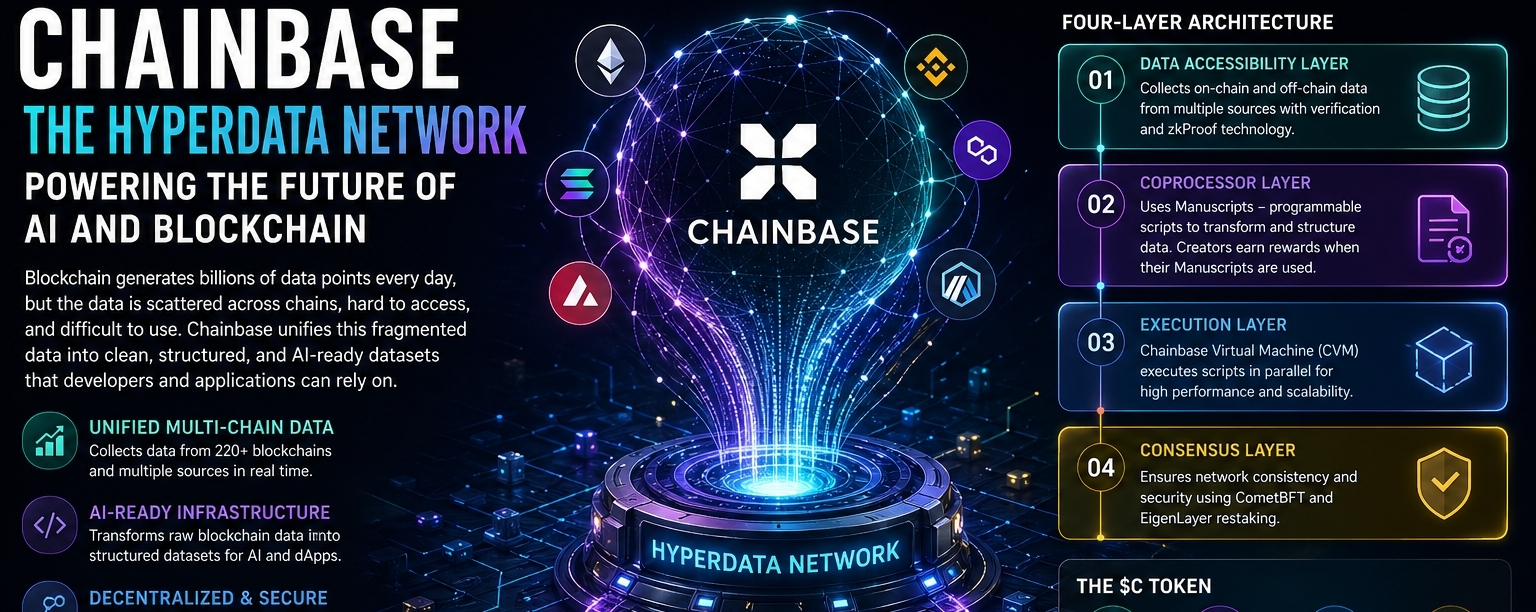
The entire network operates through four major layers, and understanding these layers explains why Chainbase is being discussed more seriously inside infrastructure and AI conversations. The first layer focuses on data accessibility. This part of the system gathers blockchain activity from both on-chain and off-chain sources, including transactions, smart contract logs, governance actions, wallet balances, staking movements, and external metadata. Instead of leaving the information fragmented across separate ecosystems, Chainbase organizes everything into structured formats that applications can query more efficiently.
The second layer introduces one of the project’s most innovative concepts called Manuscripts. Manuscripts are programmable scripts that define how blockchain data should be processed and transformed. Developers can create Manuscripts that track token transfers, analyze wallet behavior, organize NFT activity, monitor liquidity flows, or identify suspicious market patterns. Once these scripts are published inside the ecosystem, other developers can reuse them rather than rebuilding the same infrastructure repeatedly.
This creates something very powerful because it turns blockchain data engineering into its own decentralized economy. Contributors who create useful Manuscripts can receive rewards whenever their logic gets used by applications or developers. Over time, this could evolve into a massive open marketplace of reusable blockchain intelligence tools. Instead of thousands of teams rebuilding identical backend systems from scratch, developers could build on top of shared infrastructure while data contributors earn incentives for their work.
The third layer is the execution environment powered by the Chainbase Virtual Machine. This system processes large-scale data workloads using parallel execution methods designed for speed and efficiency. Blockchain ecosystems generate enormous amounts of information continuously, and traditional systems often struggle under heavy computational demand. AI applications especially require rapid access to clean and structured datasets in real time. Chainbase designed its execution layer specifically to support these kinds of advanced computational requirements.
The fourth layer handles consensus and verification across the network. Since the infrastructure operates in a decentralized environment, all participating nodes must agree on processed data and system states. This layer ensures consistency, trustworthiness, and synchronization while maintaining scalability. The combination of Cosmos coordination systems and EigenLayer security mechanisms creates additional crypto-economic protection for the network.
What makes Chainbase stand out even more is that the project already operates at significant scale. The ecosystem has integrated hundreds of public blockchains and processed hundreds of billions of data calls while supporting massive daily query volumes from developers and applications worldwide. These numbers matter because infrastructure projects are not measured only by narratives or social media excitement. Long-term value usually comes from utility, developer adoption, and real usage inside the broader ecosystem.
At the center of the network sits the $C token, which acts as the economic foundation of the ecosystem. The token supports governance, staking, operator incentives, network coordination, and data marketplace participation. Validators and operators stake tokens to secure the infrastructure, while developers and contributors can earn rewards for providing useful datasets or creating valuable Manuscripts. This creates an economic system where participation and contribution become directly connected to the network’s growth.
The project gained major attention when Binance announced Chainbase as one of the featured projects in its HODLer Airdrops program. Eligible users who participated during the snapshot period received token allocations, and the listing introduced Chainbase to a much larger audience globally. While exchange exposure helped increase visibility, much of the deeper interest surrounding the project came from its connection to the rapidly growing AI narrative inside crypto markets.
We’re now entering a period where AI and blockchain are beginning to overlap more aggressively than ever before. AI systems require transparent and reliable information. Blockchain networks produce enormous amounts of verifiable activity every day. Chainbase is attempting to become the infrastructure layer that allows these two technologies to work together efficiently. If decentralized AI applications continue growing over the next several years, projects capable of organizing and delivering machine-readable blockchain data may become extremely important.
Still, the path forward is not without risks. Infrastructure is one of the most competitive sectors in the blockchain industry. Many companies are trying to dominate data indexing, interoperability, analytics, and AI integration. Chainbase will need to continue expanding developer adoption and ecosystem usage consistently if it wants to maintain long-term relevance.
Scalability also remains a serious challenge for every decentralized infrastructure project. Maintaining decentralization while supporting massive real-time workloads is difficult, especially as blockchain activity continues increasing across multiple ecosystems. If the network becomes too dependent on a small number of contributors or operators, questions about decentralization could eventually appear.
Token economics will likely remain another important area investors watch closely. Staking participation, unlock schedules, operator growth, query demand, and ecosystem expansion may all influence the long-term sustainability of the network. Many blockchain projects initially attract attention through listings and narratives, but sustainable growth usually depends on real adoption rather than temporary speculation.
Regulatory uncertainty may also play a role in the future because AI-driven infrastructure exists in a rapidly evolving legal environment. Governments worldwide are still trying to understand decentralized systems, AI governance, and digital data ownership. Projects operating between these sectors may eventually face new rules or compliance requirements as regulation develops globally.
Even with those uncertainties, there is something undeniably important about the direction Chainbase is taking. The crypto industry is slowly shifting away from purely speculative narratives and moving toward utility-driven infrastructure that powers real applications. Data itself is becoming an asset class inside decentralized systems. Blockchain activity is no longer just a permanent record sitting quietly on-chain. It is becoming programmable intelligence that can power AI agents, analytics platforms, autonomous systems, financial applications, and entirely new digital economies.
Chainbase understands that future very clearly. Instead of focusing only on short-term hype cycles, the project is building infrastructure for a world where decentralized networks and artificial intelligence operate side by side. In that future, organized and accessible data may become just as valuable as the blockchains generating it.
The coming years will determine how quickly AI and blockchain truly converge, but one thing already feels obvious. As decentralized ecosystems continue growing, the demand for trustworthy, structured, and reusable blockchain data will become impossible to ignore. And right now, Chainbase is positioning itself directly at the center of that transformation, quietly building a system that could eventually power some of the most advanced applications of the next digital era.