The 8-Figure ICT Framework is a professional trading strategy that focuses on following "smart money" (large institutions). Instead of guessing where the market will go, you wait for the market to show its hand on a big scale, then zoom in to find a safe entry.
Think of it like being a hunter: Phase 1 is finding the right forest, Phase 2 is waiting for the target to enter your trap, and Phase 3 is taking the shot.
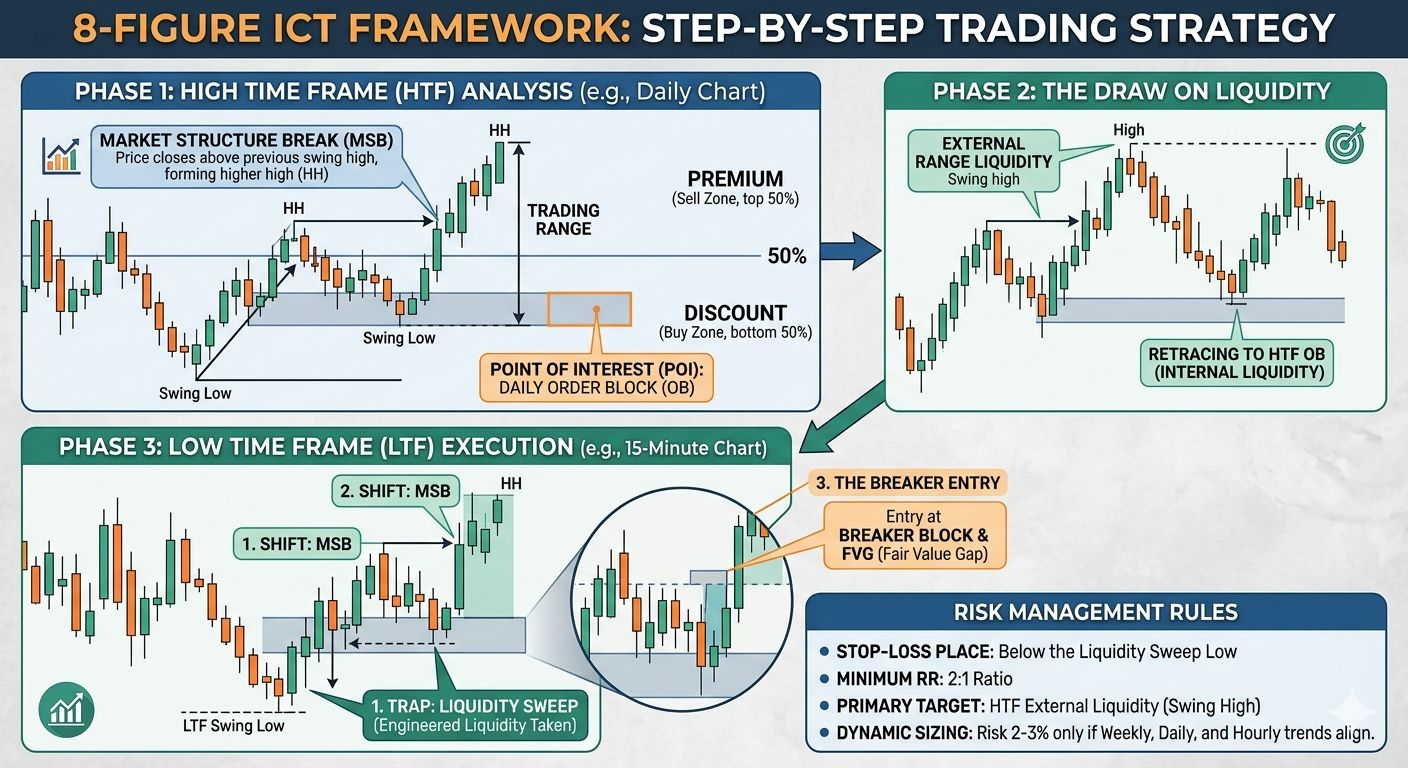
Phase 1: Finding the "Big Picture" (HTF Analysis)
Before you trade, you need to know which way the "tide" is moving.
Pick Your Pair: Choose a high time frame (like the Daily chart) to see the trend and a low time frame (like the 1-Hour chart) to trade.
The Breakout: Look for a Market Structure Break (MSB). This is when the price pushes past a previous high or low, proving that the trend has changed or strengthened.
The Golden Zone: Once a breakout happens, don't chase the price! Divide the move in half. Only buy if the price drops into the bottom 50% (Discount) or sell if it rises into the top 50% (Premium).
The Order Block: Find the last "opposite" candle before the big breakout. This is your Point of Interest (POI) —the area where big banks likely left their orders.
Phase 2: The Magnet (Draw on Liquidity)
Markets move like a pendulum between two points:
1. External Liquidity: The "peaks" (swing highs/lows).
2. Internal Liquidity: The "gaps" or Order Blocks inside the range.
Once the price hits a new high, it usually gets "pulled" back like a magnet to the HTF Order Block you identified in Phase 1. You are simply waiting for the price to return to that zone.
Phase 3: The "Sniper" Entry (LTF Execution)
Once the price touches your HTF Order Block, switch to your lower time frame (e.g., the 15-minute or 1-hour chart).
1. The Trap (Liquidity Sweep): Wait for a small "fake out" where the price drops below a recent low. This tricks retail traders into selling right before the price turns around.
2. The Shift: After that "fake out," wait for the price to aggressively break upward.
3. The Entry: Enter your trade at the Breaker Block (the point where the "fake out" started). You’ll often see a Fair Value Gap (FVG)—a sudden jump in price—which confirms big players are buying.
Rules for Success
To keep your account safe, follow these "Golden Rules":
Stop-Loss: Place your "emergency exit" just below the lowest point of the "fake out." If the price goes there, your idea was wrong, and you get out with a small loss.
The 2:1 Rule: Never take a trade unless the potential profit is at least **double** what you are risking.
The Target: Aim for the "External Liquidity" (the high point created back in Phase 1)
Confidence Boost: If the Weekly, Daily, and Hourly charts all point in the same direction, you have a "high-conviction" trade and can consider risking a slightly larger percentage of your account.
Summary for Implementation
1. Identify the trend and the "cheap" zone on a big chart.
2. Wait for the price to return to the "Big Bank" buying zone (Order Block).
3. Zoom in and wait for a "fake out" followed by a strong move in your direction.
4. Enter and target the old highs.|
I am creating an automated system based on this strategy , if you want to use that system follow and comment "system" and i will share it with you.
#strategy #ict #trading #analysis #smartmoney $BTC