
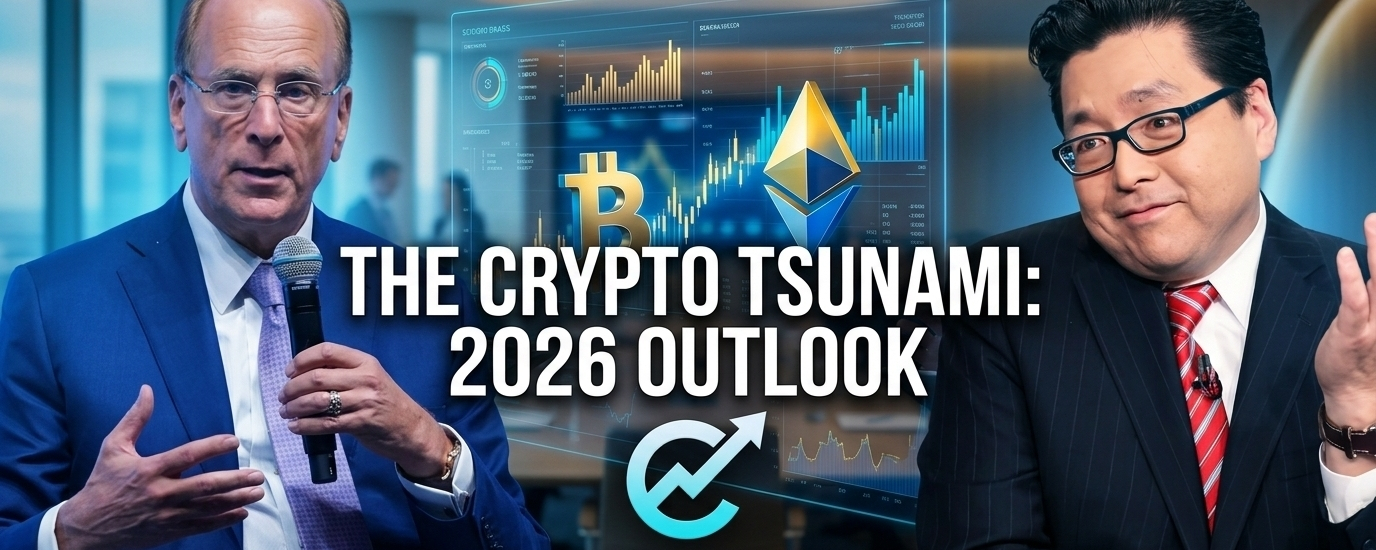
"Institutional Tsunami": BlackRock and the Structural Repricing of Digital Assets
As institutional adoption hits a pivotal turning point, top market strategists point to liquidity convergence, AI-driven utility, and tokenization as the catalysts for the next cycle.
New York — The global financial architecture is undergoing a quiet yet profound transformation. While retail investors are still caught in the currents of short-term volatility, the institutional narrative is shifting towards a more strategic horizon. Industry leaders, including Larry Fink, CEO of BlackRock, have indicated that integrating digital assets into global markets is no longer just a trend; it has become a structural necessity.
Liquidity Catalyst
The 'tsunami' predicted by strategists for 2026 is based on changing global liquidity dynamics. Historically, risk assets respond with high sensitivity to the expansion of the money supply and easing financial conditions. Market watchers see the current landscape—marked by a sharp defensive posture—as often heralding a significant repricing event.
As institutional capital searches for yields that surpass traditional debt markets, the efficiency of settlement on-chain has shifted from the sidelines to the forefront of boardroom discussions. It's no longer just about price movements, but about the operational shift towards programmable finance.
Convergence: AI and Programmable Economics
The most compelling argument for the future of digital assets lies in the emerging convergence between AI and blockchain-based settlement layers. As independent software agents begin to engage in economic activities, the limitations of traditional banking infrastructure are becoming apparent.
Programmable networks, boundless and operational 24/7, like Ethereum, are increasingly viewed as the utility layer for this new economy based on machine-to-machine transactions. This utility provides a long-term valuation metric independent of retail speculation, linking the success of these networks to actual institutional demand.
Institutional Blueprint
Institutional interest has shifted towards 'tokenizing' real-world assets. By integrating traditional financial instruments into the ledger, companies aim to reduce settlement delays and cut costs associated with outdated clearinghouse procedures.
Bitcoin continues to hold its ground as a strategic reserve asset, serving as hard digital money in a world characterized by continuous monetary expansion. Meanwhile, Ethereum and its ecosystem are positioning themselves to be the foundational infrastructure for the expansion of tokenized finance.
Outlook
If the next phase of the market is indeed institutional in nature, the level of participation will be significantly greater than what has been seen in previous cycles. The term 'tsunami' underscores the potential for a sudden and rapid repricing once the overall liquidity environment becomes favorable.
For investors, the current environment represents a crucial turning point. The structural forces supporting the long-term fundamental case for digital assets remain intact. As the global financial system continues its shift towards on-chain operations, the role of these assets is expected to become increasingly central in the global investment dialogue.
---
Disclaimer: This content is for informational and educational purposes only and does not constitute financial or investment advice. Investing in digital currencies carries significant risks; always conduct your own research and consult a specialized financial advisor before making any investment decisions.