

The x402 protocol is ushering in a new era—AI agents with economic autonomy that can freely exchange services. Cryptocurrency networks are becoming the core value exchange layer of this future.
SOON stands at the forefront of this transformation, leveraging its high-performance infrastructure to support this AI-driven new economy of value exchange. This marks the official launch of the SOON × x402 Social Experiment Trilogy.
Why x402 X SOON?
Introduction to x402
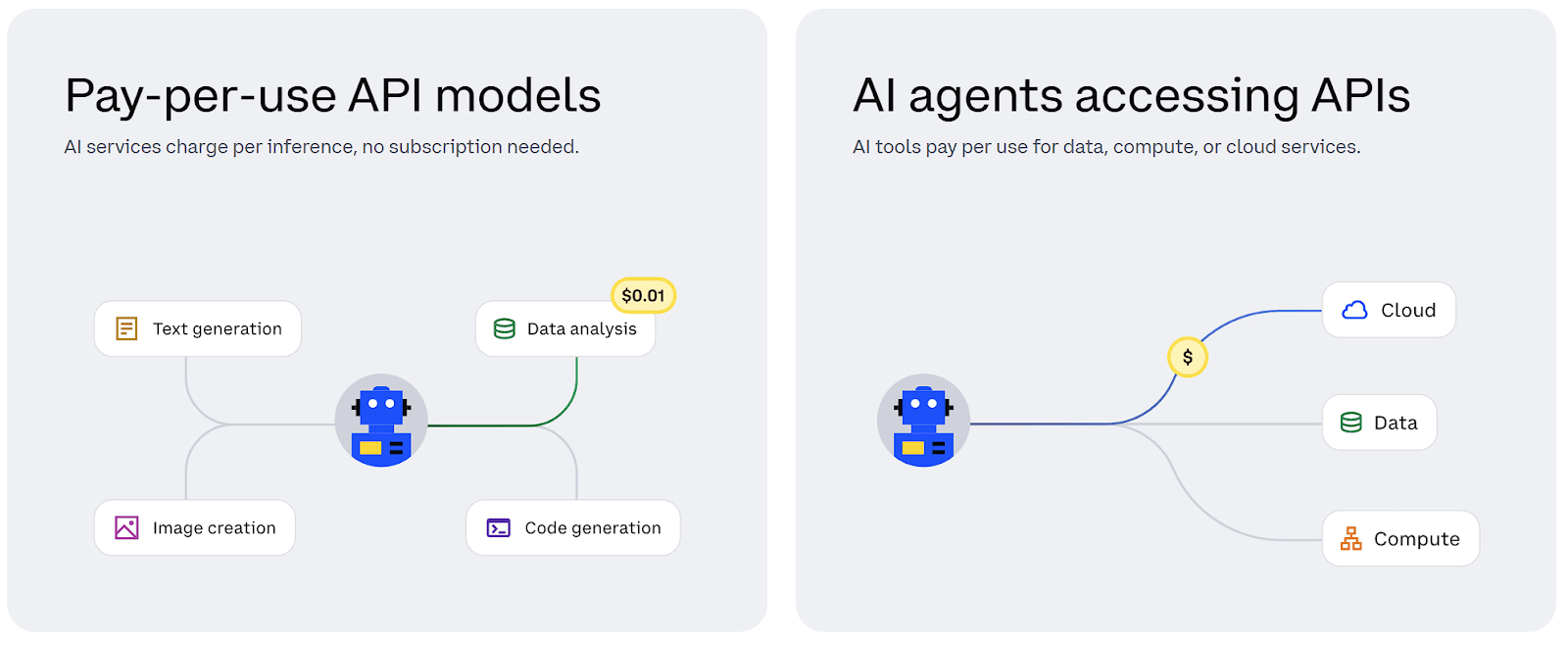
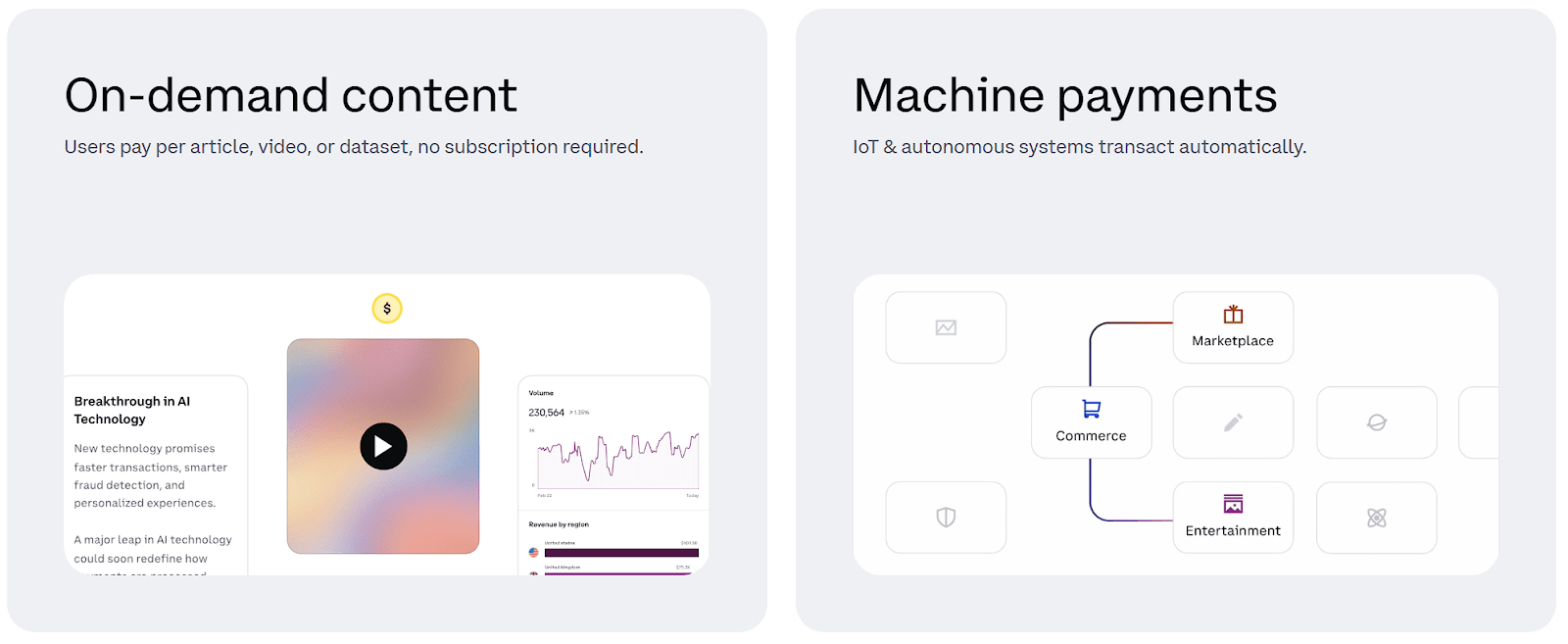
x402 is a native internet payment protocol that uses the HTTP standard's reserved '402 Payment Required' status code, allowing websites and applications to charge for resources directly within the standard HTTP request/response process.
The protocol was developed by Coinbase to simplify the micropayment process between human users and autonomous AI agents, eliminating the need for independent payment processors and account systems by embedding payment functions into the existing internet infrastructure.
Why are x402 and SOON a natural fit?
The service exchange frequency and scale of autonomous AI agents will far exceed human interactions. Therefore, network performance and transaction costs become the most critical limiting factors in the future AI economy depicted by x402.
SOON's high-performance infrastructure is exactly what can solve this bottleneck: the network has <400ms finality speed and transaction costs below $0.00001.
This efficiency will reduce the interaction costs between AI agents to nearly zero, effectively eliminating transaction friction and making a large-scale AI economy a reality.
This is the starting point of the SOON × x402 social experiment trilogy.
Chapter One: Social Experiment on Asset Issuance
We will open the first chapter of the trilogy—a complete reconstruction of the asset issuance method.
This is a social experiment about economic behavior, market psychology, and protocol design.
Participants use USDC to pay through the x402 protocol, predicting market trends for the next 10 seconds. Those who predict correctly will automatically mint tokens; those who predict incorrectly will have their funds enter a public pool.
When the funding pool reaches a preset liquidity threshold or all supply is minted, the asset will launch trading on-chain.
The entire process is fully decentralized, automated, and driven by participant behavior.
The previous $PING experiment validated that 'payment itself can become a programmable action', and AI agents possess economic agency, capable of autonomously initiating token issuance. The market response can be compared to the BTC inscription movement, marking the discovery of new protocol primitives.
SOON is further advancing this primitive, exploring what new paradigms arise when prediction markets combine with token issuance—speculation itself becomes a mechanism for asset creation.
The core question is: Can prediction markets achieve true fair launches?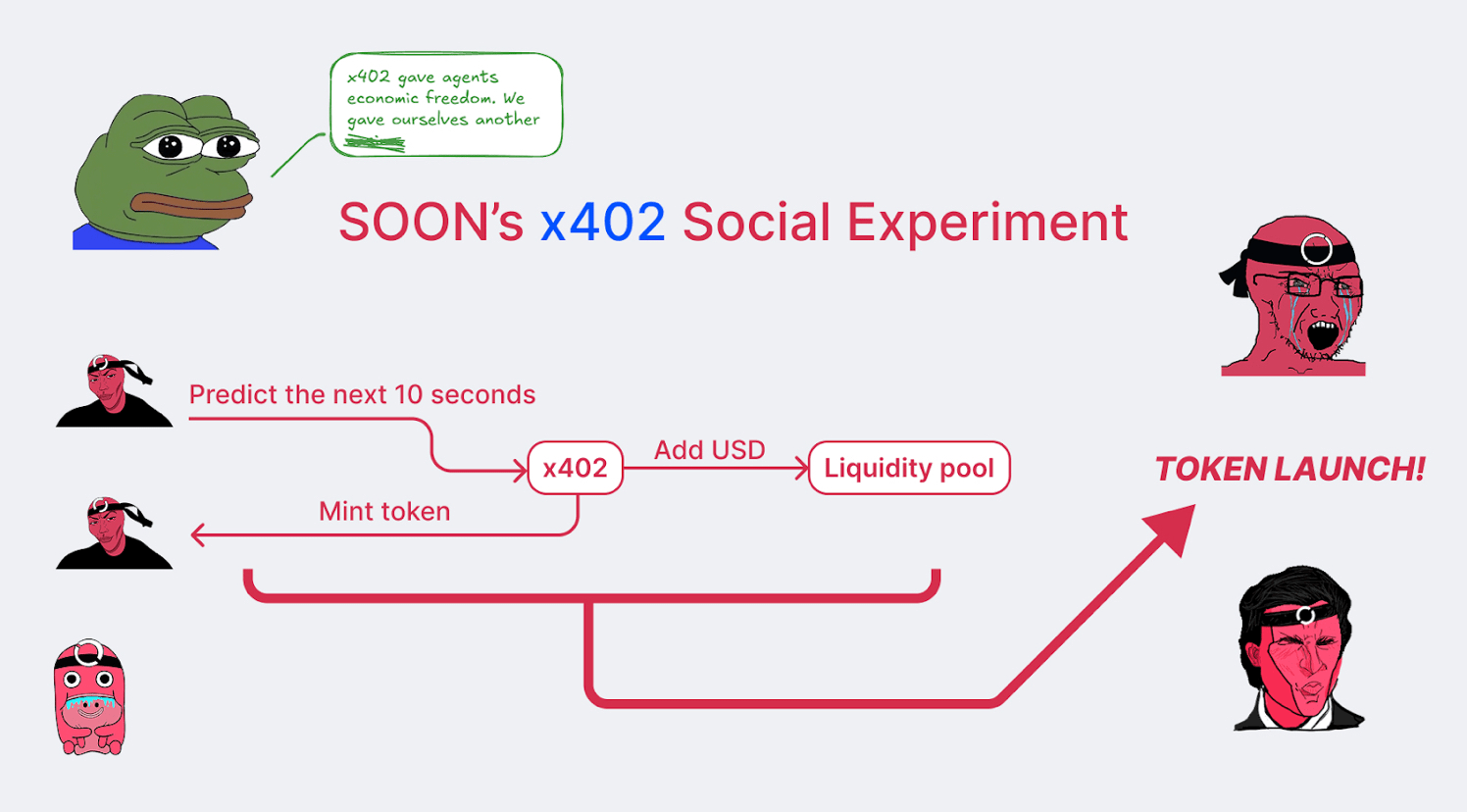
Potential Evolution: From Experiment to Launchpad
This social experiment is just the beginning. It lays the groundwork for a revolutionary Launchpad and is expected to trigger a wave of asset issuance similar to the BTC inscription movement.
This will change everything:
AI Native Issuance: AI agents can autonomously create assets with real economic value through x402—this is the first time true economic participation is realized.
Universal Derivation: Any prediction market, any crypto asset, any measurable outcome can derive new tokens. The entire crypto ecosystem will become a canvas for asset generation.
New Paradigm: Beyond ICO (decentralized distribution), beyond fair issuance (market behavior determines distribution), beyond ordinary meme coin launchpads (speculative behavior becomes 'productive'—it creates assets).
Just as BTC inscriptions democratize asset creation, this new token issuance method will unleash a wave of prediction-based, permissionless token generation.
When every market fluctuation can generate assets, and every AI agent can participate in economic activity, we will witness an exponential expansion of the crypto universe.
Chapter Two: Deploying the x402 Facilitator on soonBase
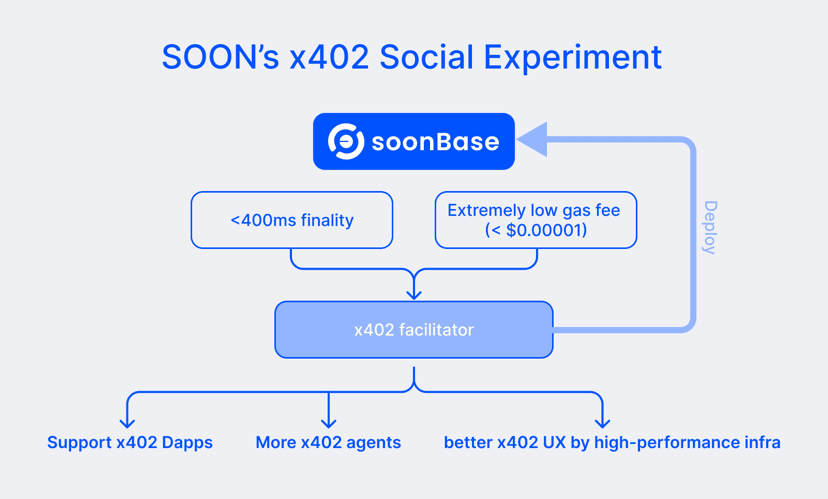
SOON is deploying a dedicated x402 Facilitator on soonBase to achieve protocol support across the entire ecosystem.
soonBase provides <400ms transaction finality and < $0.00001 per transaction cost, making the payment overhead for applications with AI agents nearly zero.
The Facilitator will provide a direct operational channel for x402 applications and AI agents, supporting the massive transaction speeds needed for automated service exchanges.
The core question is: When performance bottlenecks are removed, can economic activities between AI agents surpass human markets?
SOON provides the infrastructure needed to validate this hypothesis. We welcome all teams building x402 applications to participate in this experiment.
Chapter Three: Allowing AI Agents to Autonomously Create High-Performance Chains
This chapter tells the story of—AI Agents will first gain the ability to autonomously launch high-performance chains.
Relying on SOON's high-performance infrastructure stack, we are building exclusive services for AI Agents.
They can pay through the x402 protocol to instantly activate and deploy their own high-performance chain.
The economic autonomy of AI can only truly exist when the infrastructure threshold is completely removed.
What SOON is doing is turning on-chain operations that previously required human intervention into automated processes completed by Agents with one click.
Our infrastructure has evolved through three stages:
From serving crypto projects → corporate institutions → to today's autonomous agents.
'High-performance Infrastructure as a Service' has become the underlying cornerstone of the entire SOON Stack.
We are excited about the development of all this.
Perhaps asset issuance driven by x402 will mark the beginning of the AI economic era.
The infrastructure is ready, now—it's up to Agents and the community to write the future together.