
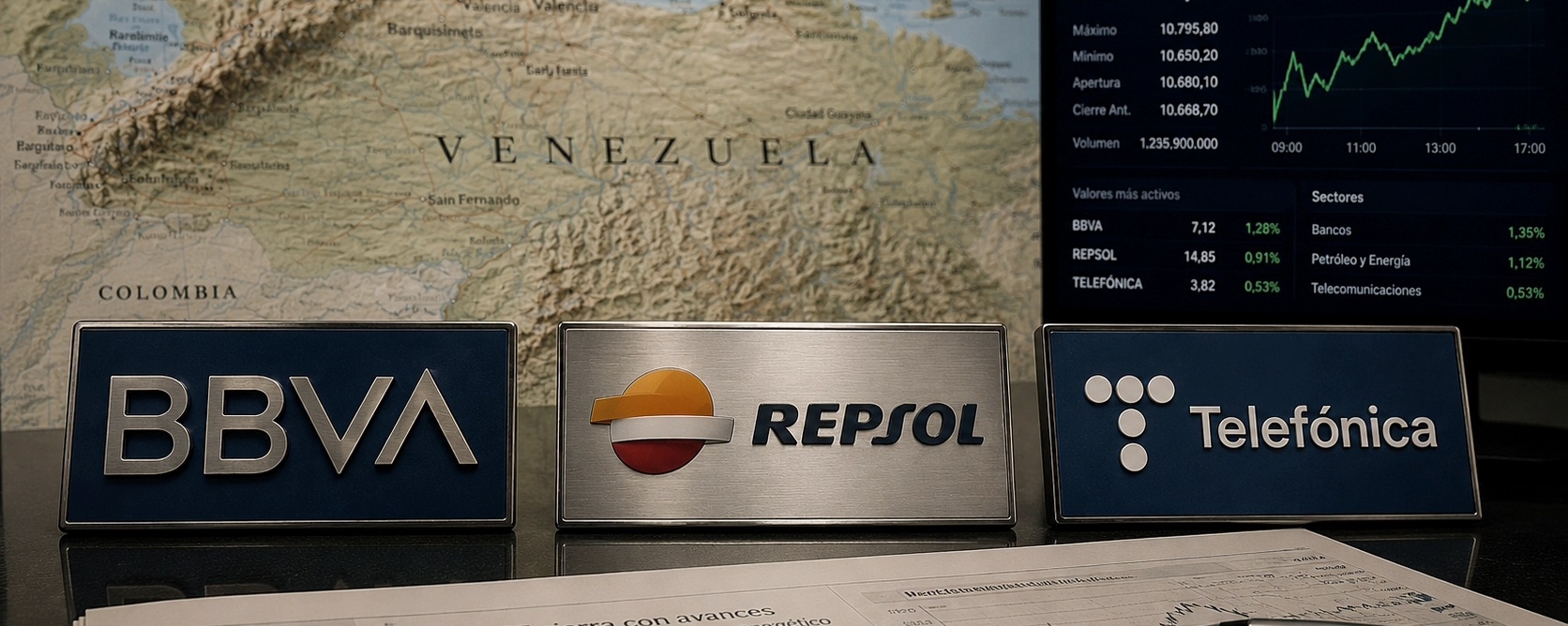
The market is starting to see value where it only saw risk for years.
A little over four months ago, the executives of major Spanish stocks with a presence in Venezuela woke up to news they had been waiting for years for, yet deep down, they weren't completely prepared: Nicolás Maduro had been captured by U.S. forces. The game board had shifted. The question since then is whether this pivot is deep enough to turn decades of losses into a real business opportunity.
THE STARTING POINT: YEARS OF ACCUMULATED WEAR
There was no epic possibility in the balance sheets. Venezuela had been a festering problem in the accounts of major Spanish listed companies for years: a market too large to ignore, too unstable to monetize, and too uncertain to value normally.
BBVA had been preserving a business in the country for over a decade that was becoming less and less profitable, eroded by devaluation, capital controls, and regulatory restrictions. Repsol had accumulated billions tied up in outstanding loans, unpaid invoices, and provisions for impaired assets. Telefónica, on the other hand, had decided to exit the country, ready to sell its Venezuelan subsidiary like someone liquidating an uncomfortable asset to clean up their balance sheet.
That was the starting point at the beginning of January 2026. Not of an opportunity, but of three companies trapped in the same logic: staying in Venezuela was costly, leaving didn't come cheap either.
REPSOL: FROM ACCOUNTING HOLE TO OPERATIONAL TURN
The deepest change in Venezuela hasn't been led by BBVA, but by Repsol. And not just because the market is starting to look at its accounts with less skepticism, but because for the first time in years, the shift is no longer just about accounting: it's operational as well.
The oil company estimates its recoverable exposure in Venezuela at €4.55 billion, including outstanding loans with PDVSA, unpaid invoices, and accumulated provisions for impaired assets. Of that amount, €3.587 billion is already provisioned. In other words: the company has already absorbed a large part of the hit on its balance sheet. Now the market is starting to value how much of that punishment can be undone.
But the real shift is happening elsewhere. The improved context has already translated into an agreement with Caracas and PDVSA that returns operational control of its assets to Repsol, secures collection mechanisms, and allows it to grow in the country with a concrete roadmap.
This is the turning point. The new framework does not yet guarantee the recovery of the €4.55 billion pending, but it does protect the collection of future production, which was the real operational bottleneck. The group has not yet resolved its past in Venezuela, but it has started to organize its future.
And that future is starting to gain volume again. The oil company expects to raise its gross production in Venezuela by 50% in the next twelve months and triple it in three years, according to the agreement signed with Caracas and PDVSA. It's not a full recovery yet. But for the first time in a long while, Venezuela seems to be a growth lever and not just a bookkeeping contingency.
BBVA: THE VALUE OF HOLDING ON
In BBVA, the change has been less spectacular, but equally revealing. The bank has raised the valuation of its Venezuelan subsidiary by 27.7% in the first quarter, positioning it above €200 million. It is the largest upward revision among all its international franchises during this period.
It doesn't mean that Venezuela has stopped being a drag. Its exposure to the country closed 2025 with a negative impact of €75 million, of which €41 million were attributed to the group. In 2024, the impact was around €20 million; in 2023, about €10 million. The business continues to be penalized by the currency and by restrictions on dividend repatriation. But BBVA is doing something it hasn't done in years: assigning it more value.
That is the message. Profitability hasn't returned, but optionality has. Its president, Carlos Torres, has made it clear in various forums that BBVA has no intention of withdrawing from Venezuela precisely now that the context is starting to change, after having weathered the worst of the cycle. The bank maintains a share close to 16% of the Venezuelan financial market and has started to make moves. It’s not making money, but it's justifying its presence again.
TELEFÓNICA: FROM UNCOMFORTABLE ASSET TO TRADABLE ASSET
The Telefónica case is less about accounting and more strategic. The operator hasn't sold Venezuela, but it no longer needs to do so at any price. And that difference changes quite a bit.
After closing the sale in Mexico, Venezuela remained as the last major asset pending in the group's Latin American exit and also as the hardest to place. Not because it lacked size, but because it carried too much risk.
Today it's still complex, but less unsellable. Telefónica gains some margin to rethink the timing of its exit and aim for a better valuation. In that scenario, Millicom appears as the most plausible industrial buyer: it has already absorbed a good part of the Hispam perimeter and has placed Venezuela at the center of its expansion strategy.
In fact, during the fourth quarter earnings call, their Finance VP, Bart Vanhaeren, was explicit: "What are the important markets left? Venezuela and Peru." No operation is closed yet. But for the first time in a long time, there is industrial logic.
VENEZUELA NO LONGER TRADED ONLY AS RISK
The political transition in Venezuela remains under U.S. oversight, with Delcy Rodríguez at the helm of a chavismo that is more pragmatic than reformist and a stability that is still functional, but far from consolidated.
None of that has disappeared. BBVA hasn't started making money again, Repsol hasn't collected everything due, and Telefónica hasn't sold. But all three have stopped treating Venezuela solely as a problem. And in the market, sometimes the first change isn’t in the business. It’s in revaluing something that the market had been pricing at zero for years.