
In the blockchain world, when projects airdrop, communities reward members, or studios consolidate assets, they all rely on a high-frequency operation—token batch transfers. If you only have three to five addresses, manual sending is doable; but when the list balloons to hundreds or thousands, clicking through one by one can be a total headache, and Gas fees can really skyrocket.
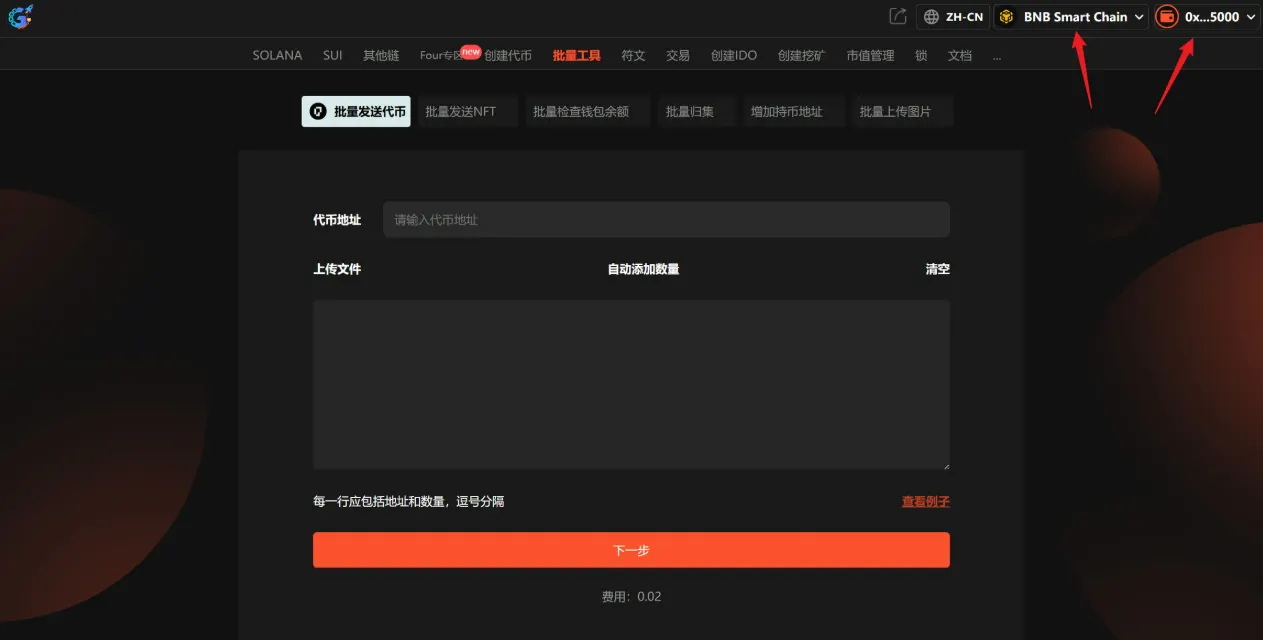
The token batch transfer tool uses smart contracts to bundle dozens or even thousands of independent transfers into a single on-chain transaction, completing the distribution of tokens or NFTs to all addresses at once.
Save on Gas fees: Compared to traditional individual transfers, you can save up to 90% on Gas costs, which means what used to be hundreds of dollars in fees could be optimized down to just a few dozen bucks.
Supports various asset types: Not only does it support ERC-20 tokens on mainstream EVM chains like Ethereum, BSC, and Arbitrum, but it also fully supports NFT standards like ERC-721 and ERC-1155.
Easy to operate: Supports one-click import of address lists via CSV/Excel—no coding needed. Even DeFi newbies can master it in just 5 minutes.
Next, let me give you the lowdown on how to use this 'bulk transfer tool' like a pro.
1. What exactly is bulk token transfer?
Bulk token transfer, in simple terms, is 'one transaction to handle all transfers.' It’s no longer the tedious 'transfer A then transfer B' model, but instead leverages smart contracts to bundle all recipient addresses and amounts into a single list, executing it all on-chain in one go.
In practice, you only need to do three things:
Connect your wallet (usually MetaMask or TP Wallet).
Prepare your address list (you can use Excel or Notepad to format it as 'address, amount').
Import the tool and confirm (supports one-click import via CSV, then click to confirm and initiate the transaction).
Like a friend once said: 'Before, manually transferring to 100 addresses left my hands sore; now with bulk tools, I just need 2 minutes to verify the addresses. It's incredibly satisfying.'
Currently, the mainstream solutions mainly involve two technical routes:
Disperse mode: Distributes one type of token equally or according to a set amount to multiple addresses. Its core logic is 'one-to-many,' commonly used for community airdrops.
Multi-Send mode: In the same transaction, sends multiple different types of tokens or NFTs to multiple addresses, like sending ETH and platform tokens simultaneously, and even throwing in a few NFTs.
2. What are the mainstream ERC-20 bulk transfer solutions?
GTokenTool: The go-to choice for both newbies and veterans.
Supports 10+ major public chains, including ETH, BSC, Arbitrum, Solana, TON, and nearly all the chains you use daily.
You can issue fungible tokens (ERC-20/BEP-20) and NFTs (ERC-721) too.
You can transfer to hundreds of addresses in one go, saving an average of 60% to 90% on gas fees.
Core advantage: Simple operation, no coding knowledge required, just a few clicks in a user-friendly interface.
3. Supports multi-chain imports, covering both EVM and non-EVM without any gaps.
The feature of 'multi-chain import' is a standout for these tools. Whether your assets are scattered across Ethereum, BSC, Arbitrum, Solana, or TON, just switch to the corresponding network, connect your wallet, and you're ready to roll.
For importing CSV (comma-separated values) files, it typically distinguishes between EVM chain formats (hexadecimal addresses starting with 0x) and non-EVM chain formats (like Solana's short base58 encoded addresses). You just need to organize the addresses into this standard template, upload it for one-click verification, and the system will automatically check for empty addresses or format errors to avoid sending mistakes.
Summary
'The bulk token transfer tool' is essentially an automated distribution system based on smart contracts. Whether you're doing a large airdrop, incentivizing KOLs, or simply want to consolidate your 'piggy bank' scattered across multiple wallets into one main account, it can compress what used to take hours of work into a few minutes with a single click, while significantly reducing costs.
Whether you're a newbie just stepping into Web3 or a seasoned user, I recommend starting with tools like GTokenTool, which are user-friendly and come with address verification to avoid mistakes. Start with a small amount to get the hang of the process, and once you're comfortable, you'll be able to easily manage asset distribution across thousands of addresses, fully enjoying the true charm of 'one-click solutions' in the blockchain world.
