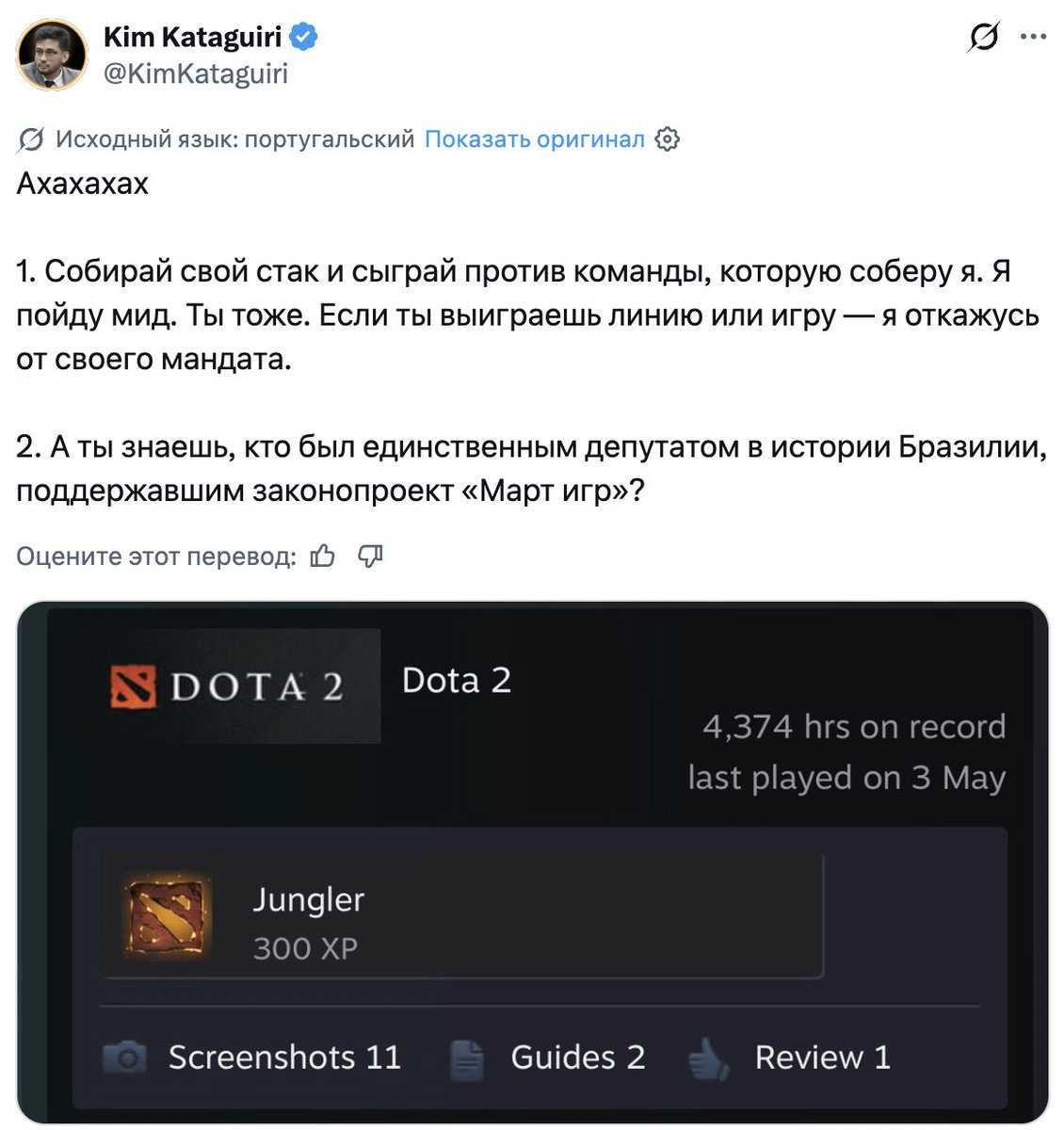
Recently, a verbal spat over the video game Dota 2 has erupted in Brazilian politics, quickly escalating into a 'face-off' that could jeopardize political futures. Chandi Teixeira, head of the Rio de Janeiro gaming and esports department, accused Congressman Kim Katagiri of pretending to be a Dota 2 fan to reel in young voters, sparking controversy.
The catalyst for this conflict arose when Katagiri showcased his Dota 2 player persona on social media. Teixeira believes this was a deliberate 'performance' aimed at winning favor with young voters. Meanwhile, esports coach Astini stepped in to defend Katagiri, asserting that he is indeed an old-school player, while also noting that League of Legends is more popular in Brazil, suggesting that the hype around Dota 2 might backfire.
Didn’t see that coming, Katagiri went straight for it: he publicly invited Teixeira to assemble a squad and go head-to-head. **This politician even boldly claimed he would take the Mid position; if he loses his lane or the whole match, he’d give up his mandate.**
This proposal instantly sparked discussions online. Brazilian politics has never been short of dramatic events, but betting a public office on the outcome of a MOBA game is quite rare. Supporters see it as a grassroots move, bridging the gap with the younger generation; critics scoff, saying it’s just another political show, treating serious public duties like game chips.
The clash of games and politics
Globally, esports has long moved from subculture to mainstream. Brazil, being a powerhouse in esports, has a massive player base, so it’s not surprising that politicians are trying to break into that scene. Katagiri's move seems bold, but it’s actually a precise capture of young voters' interests—today, when traditional political speeches are getting stale, a live Dota 2 match might grab more attention than any policy debate.
But the risks are glaring. If Katagiri actually loses the match and follows through on his promise, Brazilian politics will witness a historic event of someone resigning due to a game; if it’s just hot air, he might be labeled as 'playing with public sentiment.'
Regardless of the outcome, this event once again proves that in the attention economy era, politicians need to master the art of 'memeing.' The image of traditional politicians in suits giving serious speeches is being challenged by a more relatable, even 'cringe' style.