

I've seen too many folks lose their entire savings in the big A, and a few lucky ones multiply their investments.
This isn't luck; you need to figure out who you're playing against.
This article reveals the hidden cards of the big A.
Part 01: Who are your opponents?
The biggest misconception for retail traders is thinking they're 'investing' and making 'value judgments.'
Nope. You're in an arena, and your opponents are these three types of players.
1: ⚡ Quantitative firms (advantage: speed crush)
Thousands of trades every second, using algorithms to capture price differences within 0.01 seconds. By the time you spot an opportunity, they've already executed.
2: 🎯 Hot money (advantage: info crush)
News comes 48 hours in advance, using hype to create FOMO; retail traders buy the dip and then institutions unload.
3: 🏛️ National Team (Advantage: capital crush)
They can enter the market anytime to support, and they can also choose not to act. No one knows where their bottom line is.

Trading individual stocks in Big A, retail traders are not investing; they're providing liquidity for institutions to exit.
Part 02: Does Big A really have a chance?
Saying Big A has no chance at all is incorrect.
The key is: the places where retail traders can win are different from those of institutions.
01: Index ETFs (recommended for ordinary retail traders): steer clear of stock landmines, follow the market.
CSI 300, CSI 500 ETFs, diversify risk, avoid individual stock landmines.
In the long run, you'll benefit from the growth of the Chinese economy.
02: Sector ETFs (with some judgment): follow policies, not news.
The biggest alpha source for Big A comes from policy.
New energy, AI, military industry, semiconductors—policies are clear, directions are definite, much easier than guessing individual stocks.
03: The only real advantage for retail traders: staying in cash and waiting.
Institutions have position requirements and performance pressures; they must maintain positions.
Retail traders can hold off on buying anything, waiting for high certainty opportunities to strike—this is the only place retail traders are more flexible than institutions.

Part 03: Big A vs US Stocks: A Comparison
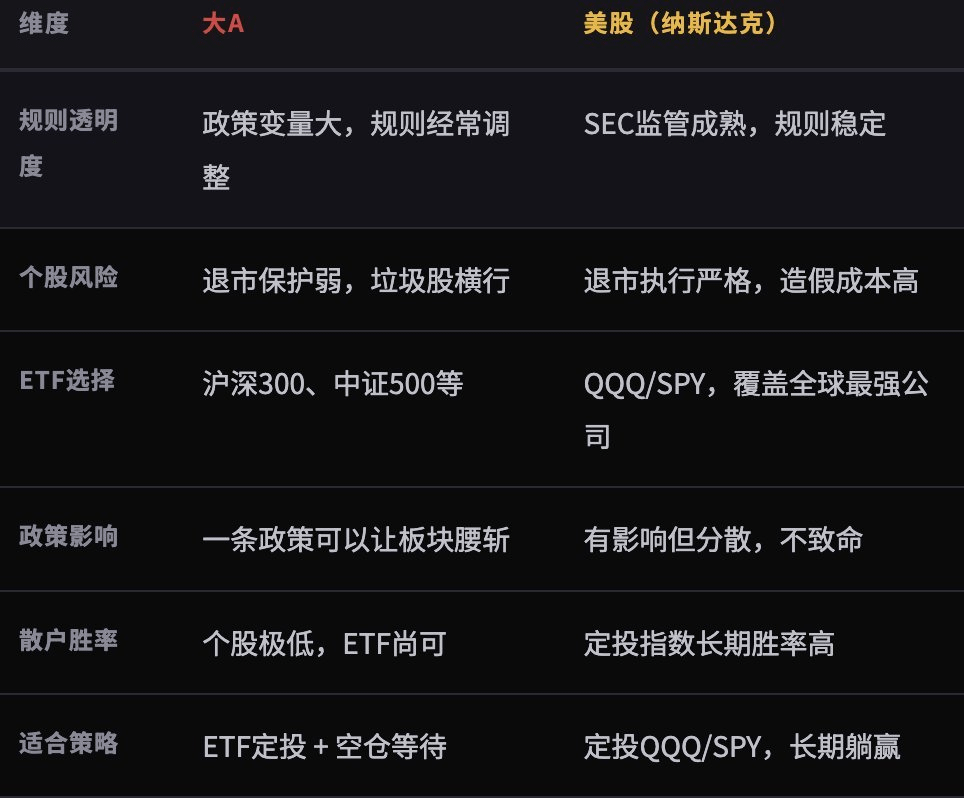
Final Conclusion
Big A:
You can participate in ETFs, but absolutely avoid individual stocks (unless you have real information advantage). Treat Big A like a policy ETF, not a stock-picking market.
US Stocks:
The optimal solution for ordinary retail traders. $QQQon ,$QQQ is to buy the top 100 strongest companies globally; the logic is simple, the rules are transparent, and it's a long-term win.
Position:
Both markets can be participated in. But the core position should be in US stocks, with satellite positions in Big A sector ETFs—this is the most rational allocation I see for 2026.
Do you currently have positions in both Big A and US stocks?
Let me know in the comments 👇