
In this bull run for US stocks in AI, many folks are only eyeing Nvidia.
But those who really understand have long realized:
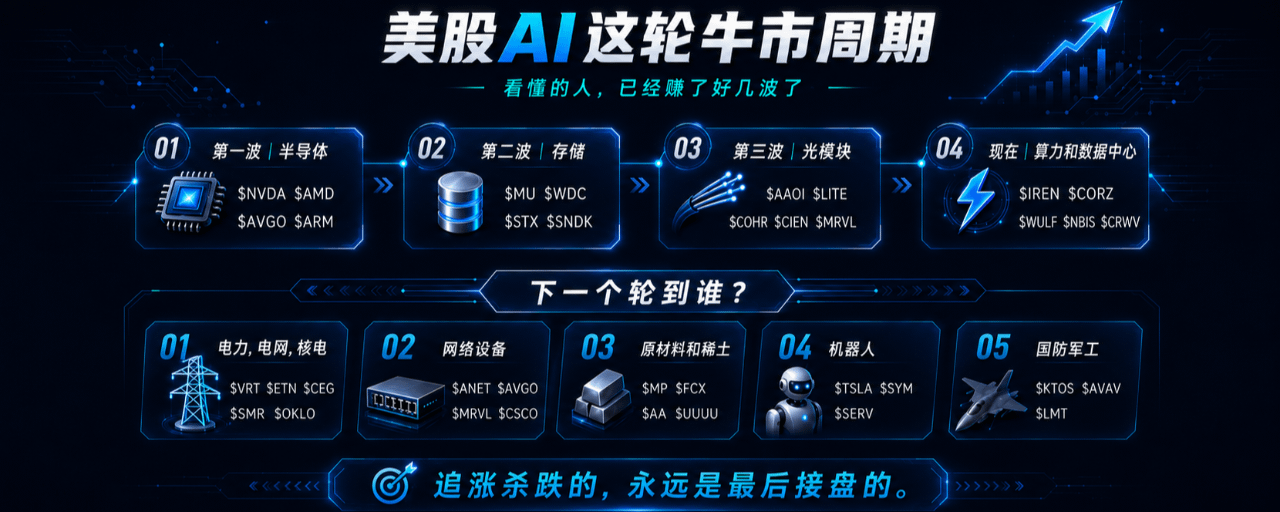
This isn’t just a stock trend; it’s a rotation across an entire industry chain.
Funds aren’t just moving chaotically.
They’re digging deeper layer by layer along the AI infrastructure.
The first wave was in semiconductors.
This is the starting point of the AI revolution.
The demand for computing power is exploding, and GPUs are the hottest assets of this new era.
Nvidia has skyrocketed from its lows by several multiples; most people just watched it climb but never dared to jump in.
Not many retail traders are truly cashing in on this wave of profits.
The second wave is storage.
$MU
$WDC
$STX
$SNDK

AI needs computing power, and computing power needs storage.
Training models, inference, and data center expansions all rely on HBM, DRAM, and NAND.
When the market finally realizes that storage isn't a cyclical stock but a part of AI infrastructure, Micron's stocks will have already been repriced.
But the current issue is:
When the whole market starts discussing HBM and storage price hikes, this line has already become pricey.
The third wave is optical modules and high-speed interconnects.
$AAOI
$LITE
$COHR
$CIEN
$MRVL

Many people didn't initially react to this wave.
AI data centers aren't just about GPUs.
Thousands of GPUs need to work together, and data needs to be transmitted at high speeds between servers.
Copper cables can't solve all problems; optical communication, high-speed interconnects, and switching devices have become necessities.
So what you see is:
$AAOI has surged significantly this year.
$LITE has surged significantly this year.
$COHR has surged significantly this year.
It's not that the market suddenly went crazy; it's that funds have finally started to reprice the 'AI transmission layer'.
Then, funds began to aggressively target computing power and data centers.
$IREN
$CORZ
$WULF
$NBIS
$CRWV


AI data centers are energy-hungry monsters.
Computing power is the oil of this era.
Whoever controls power, land, data centers, GPUs, and financing capabilities could become the next phase of infrastructure players.
This is also why companies related to data centers, computing power leasing, and AI cloud platforms have started to be repeatedly targeted by funds.
But the real problem has arrived:
Who will be the next direction?
I believe the next five lines are worth closely monitoring.
First, electricity, power grids, and nuclear power.
$VRT
$ETN
$CEG
$SMR
$OKLO
The end of AI is not the model, but electricity.
As more data centers are built, electricity consumption continues to rise, and power grids, transformers, cooling systems, nuclear power, and small modular reactors will all become targets for market repricing.
Some stocks in this line have already surged, but the long-term logic hasn't finished yet.
Secondly, networking equipment.
$ANET
$AVGO
$MRVL
$CSCO
GPUs handle computation, while networks handle connections.
The future data centers won't operate as standalone units but as super large-scale clusters.
Switches, Ethernet, custom chips, and high-speed networks are a very solid part of AI infrastructure.
This line has already started to attract fund attention, but compared to GPUs and optical modules, it may not have fully entered the craziest phase yet.
Thirdly, raw materials and rare earths.
$MP
$FCX
$AA
$UUUU
AI sounds abstract, but the fundamentals are extremely real.
Chips, servers, power grids, cables, heat dissipation, and energy equipment all require resources like copper, aluminum, rare earths, and uranium.
When everyone is chasing the application layer, the most overlooked raw materials might actually hide the next round of expectation gaps.
AI is not just a pure software revolution; it is also a hardware and resource revolution.
Fourth, robotics.
$TSLA
$SYM
$SERV
If the previous AI waves were still stuck in the cloud, then robots represent AI stepping into the real world.
Factories, warehouses, distribution, home use, autonomous driving, and humanoid robots are all part of AI transitioning from 'thinking' to 'acting'.
It’s still early, but the direction is clear.
This line may not explode immediately, but it's definitely worth tracking long-term.
Fifth, national defense and military.
$KTOS
$AVAV
$LMT
AI combined with military applications is two cash-rich directions overlapping.
Drones, smart weapons, battlefield awareness, and automated defense systems will increasingly rely on AI.
Traditional military-industrial might not always have high elasticity, but defense tech, unmanned systems, and AI military applications are worth keeping an eye on.
Therefore, the most important thing in this AI bull market is not to chase highs.
NVIDIA has already pumped, now it’s time to chase NVIDIA.
Micron has already pumped, now it’s time to chase Micron.
Optical modules have already pumped, now it’s time to chase optical modules.
After data centers pop, then chase data centers.
This kind of play always makes it easy to be the last one standing.
What we really need to do is:
Understanding where the funds are coming from,
where they are flowing to,
and where they might go next.
AI is not just a wave.
It's a complete restructuring of the industry chain.
From chips to storage;
From optical communication to data centers;
From power to networks;
From materials to robotics;
From the commercial world to national defense and military.
Funds will be repriced layer by layer.
Those who chase highs see the price increase.
Those who lay the groundwork see the path.
The real opportunities in this AI bull run aren't in the places everyone is already shouting about.
But in the next batch of segments that haven't been fully priced in yet.