

Hey everyone, in the world of payment systems, "reconciliation" is always the biggest headache. The core question is simple: "Has this specific invoice been paid?" To tackle this issue, traditional Web3 payment systems often need to set up a bulky backend: a database mapping invoices to amounts, a Webhook to monitor transfers across various chains, a scheduled task for handling chargebacks, and even customer support.
Not to mention in this multi-chain era, users might pay from Arbitrum, Optimism, or Polygon, which skyrockets the complexity of reconciliation.
The latest ERC-8211 standard proposed by Ethereum aims to elegantly end this pain point. It introduces a payment primitive that was previously unattainable: 'An invoice itself is an address.'
If the money arrives at this address, the invoice is settled.' There are no databases, no complex state machines, just pure on-chain intelligence and cryptography.
This article breaks down the four major technical components behind ERC-8211.
I. Core Component 1: Ephemeral Keys—Security That Burns After Use
In the design of ERC-8211, the lifecycle of each invoice begins with a brand new temporary cryptographic key pair generated in the merchant's browser tab.
Its sole task: To sign the multi-chain settlement intent for this specific invoice.
Its absolute security: It will never leave the browser, and will never be written to disk. Once the tab is closed, or the signature is completed, it will be completely destroyed.
Why must it be temporary? If a merchant uses a long-term master key to generate all invoice addresses, once that master key leaks, all the funds coming in from customers are at risk. By using temporary keys, the 'blast radius' of a leak is compressed to a single invoice, with a time window of only a few seconds. At the same time, the merchant achieves true 'non-custodial'—no need to connect a hardware wallet, no need to back up mnemonic phrases; once the invoice is generated, they can just walk away.
II. Core Component 2: Counterfactual Deployment—Five Chains, One Address
💡 【Explanation】Counterfactual Address: > The address of a smart contract is calculated by the deployer, code logic, and a random string (salt) through a mathematical formula. This means that before you actually deploy the contract on-chain, you can know its address in advance. If these three conditions remain unchanged, this address will be exactly the same on all EVM-compatible chains.
The merchant's 'invoice address' is derived through the temporary key in this manner. This string of identical character codes represents the same invoice on the Ethereum mainnet, Arbitrum, Base, and even Polygon. This is the cornerstone of the entire architecture.
Because the address is the same across all chains, payers can freely choose their preferred chain for transfers, and the merchant only needs to ask the system one question: 'Is there money on this address?'—without the painful follow-up of 'Which chain was the payment made on?'
III. Core Component 3: Runtime Parameter Injection—Eliminating 'Slippage Dust'
This is the core innovation of ERC-8211.
In traditional batch transactions, parameters are fixed. If the invoice is 100 USDC, the signature states a transfer of 100 USDC. However, in the real world, cross-chain bridges will charge fees, and oracle prices are volatile. If only 99.9 USDC is received, this fixed transaction will fail due to insufficient balance, causing a revert or leaving a small 'dust' that can never be withdrawn.
ERC-8211 introduces 'Fetchers' and 'Gate Constraints.' It allows for reading the real-time state on-chain at the moment of transaction execution.
Dynamic Amounts: The amount to withdraw is no longer a fixed number but an instruction: 'Read the current USDC balance of this address and withdraw all of it.' The merchant receives exactly what the user paid (after deducting cross-chain fees).
Gate Trigger: A transaction must pass through a 'gate' before execution. 'Only when the real-time balance >= invoice amount will the transfer trigger.' If no one pays and the balance is insufficient, this gate will never open, and the transaction will quietly wait until it expires.
IV. Core Component 4: Fire-and-Forget Multichain Dispatch
With the above three primitives, the most exciting 'multi-chain automated reconciliation' can unfold.
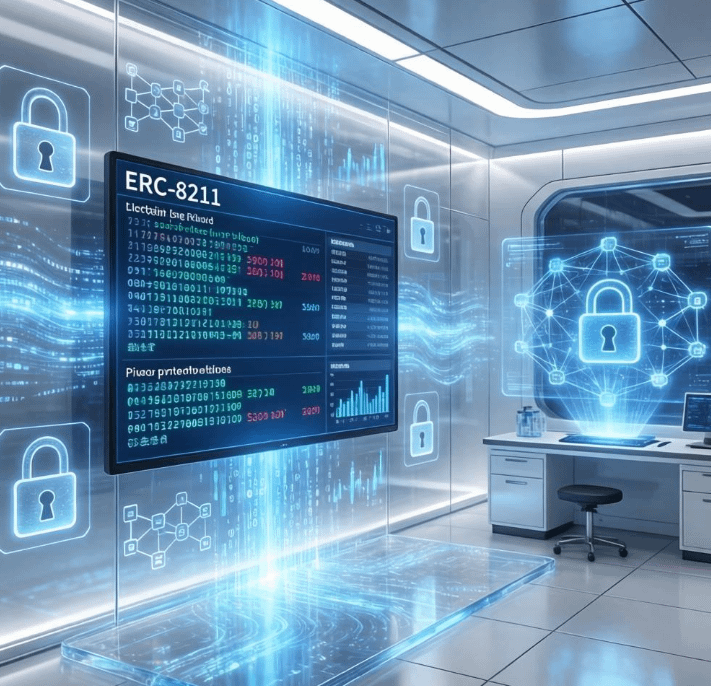
After generating the invoice, the merchant's temporary key will simultaneously sign 5 conditional batch transactions (corresponding to 5 mainstream chains) and send them to the executor network. The logic of these 5 transactions is: 'If the funds land on this chain, forward the money cross-chain/directly to the merchant's ultimate receiving account.'
Magic Moment:
Suppose the payer chooses to pay 100 USDC on Arbitrum.
The 'gate' in the batch transaction on Arbitrum detects that the balance meets the requirement and instantly triggers. Funds are automatically withdrawn and sent to the merchant.
As for the other 4 transactions deployed on Mainnet, Optimism, Base, and Polygon, since there has never been a balance on that same invoice address, their 'gates' can never be passed.
Ultimately, these 4 transactions that did not trigger will silently expire after the deadline, leaving no garbage records on the chain.
There is no centralized server listening for who paid, nor any service to decide which chain 'wins.' Everything is left to distributed executors and the underlying gate semantics to solve in parallel.
Conclusion: Let Public Chains Return to the Essence of Ledgers
Reviewing the entire ERC-8211 process, we can see a picture filled with geek aesthetics:
The merchant generates a temporary key -> calculates a multi-chain universal invoice address -> issues a conditional network for 5 chains of 'if...then...' -> destroys the key. Thereafter, when users send money from any chain to this address, the preset 'net' will automatically close, putting the money in the merchant's pocket.
Detection is implicit, reconciliation is geometric. 'One address = One invoice' is no longer just a slogan.
ERC-8211 successfully simplifies the cumbersome server-side reconciliation logic into a pure smart contract condition trigger issue. In this mechanism, the chain is the only true ledger.

⚠️ 【Disclaimer】The content of this article is for educational purposes regarding underlying technology and economic models, and does not constitute any investment advice. Data is sourced from the internet. Crypto derivatives trading carries high risks; always assess your risk tolerance and make cautious decisions.
🌹 If you liked this in-depth analysis, feel free to like, follow, comment, and share! Your support is our greatest motivation for continued output. #ERC8211 #预测市场竞争加剧 $BTC $ETH $BNB


