
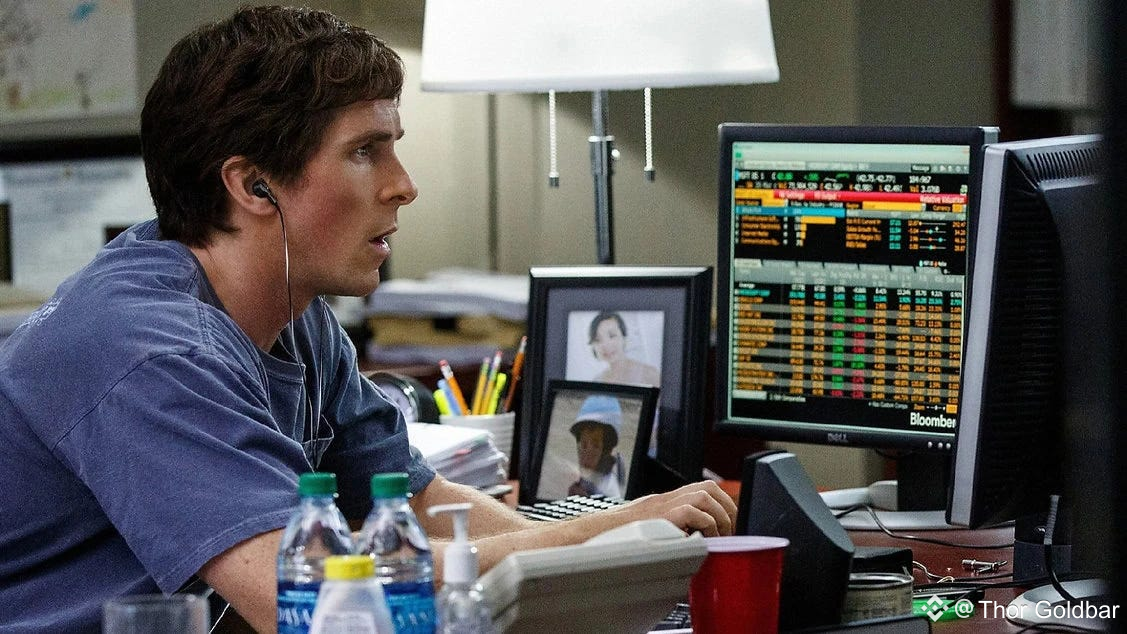
A big headline today is that Michael Burry, of The Big Short fame, is closing his fund, Scion Capital. In his resignation letter, he wrote: “Sometimes, we see bubbles. Sometimes, there is something to be done about it. Sometimes, the only winning move is not to play.”
I have been in markets long enough to believe that short sellers are generally more objectively correct than most investors. They called Enron a fraud when investment banks were telling people to buy it, they blew the whistle on Madoff before he collapsed, and they repeatedly warned about 2008 on national television before the entire global economy almost collapsed.
But the market dynamics no longer know anything of objectivity. They have become a manipulated, bloated, and distorted ritual of humiliation disguised as a market – a parody of what price discovery used to be.
Great short investor Michael Burry tweets a one-word warning
As I told Julia La Roche weeks ago, when the market still resembled something coherent, regulated, and free, and about $7 trillion in Fed balance sheet bilge behind, you could find a terrible company and short it, and the market would eventually notice.
"You dug into a company, found it was mispriced or burning cash or structurally doomed, and you bet against it," I told her. "When Einhorn did Allied Capital... everything is mispriced. Everything is dog shit. At some point, it's going to fall."
That was the job. You shorted the garbage. You shorted things that didn't generate money. You shorted the fraud. And you were paid for being right, because market scales used to hover at least a little close to calibrated and neutral.
That world has long since gone. What exists now is something fundamentally different, an environment where being right doesn't matter because the market has ceased to be a price discovery mechanism and has turned into a liquidity-driven hallucination, complete with a series of nonsensical 'business objective' narratives that replace actual financial performance.
Years ago, you could identify a dying star of a company and take it down. The market would decide that a poor business could not generate profit, and as a result, no one would be interested in owning shares, which was a way to own the future cash flows of the said company.
Now, thanks to the 'infinite case' that the Fed pulls from the market every time Jeremy Siegel goes on CNBC and shits his pants over a 3% lower move in the S & P 500, stocks are no longer seen as buying a share of a company's profits. Instead, buying shares in a company is nothing more than buying a scratch-off ticket at a newsstand on the road, with most market participants misinformed dripping with arrogance – proudly ignorant of the arguments against their positions and happy to be king shit in charge of a market liquidity and Fed expense God complex.
@SquawkCNBC's video Tweet
The distortions that have driven managers like Ross Gerber or analysts like Dan Ives to be taken seriously are the same ones that have 18-year-old neophytes who don’t know the difference between revenue and net income talking nonsense to Jim Chanos on Twitter.
These distortions are not subtle. The Fed's balance sheet is still around $6 trillion. Banks have nearly $3 trillion in reserve balances parked at the Fed. Passive funds are blindly absorbing the flows. Options markets have more retail participants than at any point in history. Leverage is everywhere. And the result is exactly what I told Julia:
'There is $2 trillion in shit in the crypto market with a zero bid... and yet, everything has a supply... because there is so much liquidity that people don't even know what to do with all of it.'
This means that the assets that we can all agree should be worth nothing – think $285 million in market capitalization Fartcoin, for example – are still trading because there is literally nowhere else for the deluge of liquidity to go.
It means 'story stocks' with no earnings and negative lifetime cash flow behave as if they are invincible just because the money has to go somewhere. It means SPACs, with a PowerPoint and a dream, float for years before reality sets in. For example, has anyone checked in on PureCycle's 2025 fiscal projections that they made a few years ago? It was supposed to be making $505 million in EBITDA this year at 56% margins. Instead, it has recorded an operating loss of ($122.3 million) so far. It will figure.
This is the environment that broke Burry. The compass is broken, the poles have inverted, the Bizarro World is now, and everything you ever knew about markets and economics is no longer so rooted in basics, fundamentals, and common sense as you thought.
People keep asking if Burry is 'wrong' or if he has 'lost', and the truth is simpler: Burry is not wrong. He simply cannot escape the tractor beam of a market that has stopped behaving like a market.
The AI boom looks like the dot-com bubble on steroids. Nasdaq and the S&P have hit records, while half of the underlying components are losing money, and several of the biggest winners are trading at multiples reserved for religious deities, not software companies. Passive inflows turn everything into a momentum chase. Options trading distorts supply and demand. Gamma squeezes launch fundamentally useless companies into the stratosphere. Tesla did it. GameStop did it. Dozens of others did it.
The only thing in this market that makes sense is that, given what is happening, the shorts are being squeezed. As I told Julia:
'Everything is so unnatural... it makes sense that the shorts are being squeezed.'
In markets and in life, the sign above my old Korean grocer in Philadelphia was right: 'You never need patience more than when you’re about to lose it.'
That line stays with me because it perfectly applies to what is happening now. Shorts need patience at the exact moment when the market structure is designed to obliterate it.
Burry stepping back, canceling the registration of his fund, shying away from external capital management – this does not signal weakness. It signals awareness. It signals someone looking at conditions so distorted, so bloated with liquidity, so unanchored from fundamentals that the only rational choice is to stop playing until the distortions resolve.
And, frankly, these moves look like the kind of thing you see near tops, not bottoms. They feel like the sigh of exhaustion that happens when the people who understand the mechanics best finally stop fighting the tide. Because at the end of the day, this is not a market that has transcended reality. This is a market that has been postponing reality for a long time – and postponements end.
When liquidity recedes, when passive flows slow down, when earnings disappointment finally matters again, when the bid that kept the garbage alive evaporates, the snapback will happen quickly. The fundamentals that Burry sees will still be there. The distortions will not.
Burry is right. He is simply refusing to play a game whose rules have become incompatible with sanity. And when the music stops, all the things he sees – all the things that shorts have been shouting for years – will appear not as doomerism, but as hindsight. The market always returns to reality. It just likes to wait until everyone is convinced it never will.
When reality returns, Burry does not seem wrong. He will look early – until the moment he seems inevitable. Patience and reality have not disappeared; they have just been buried under liquidity. But they always resurface. Slowly, then violently.
Godspeed, Mr. Burry.
#EndTheFiatScam #EndTheFed #Libertarian
