
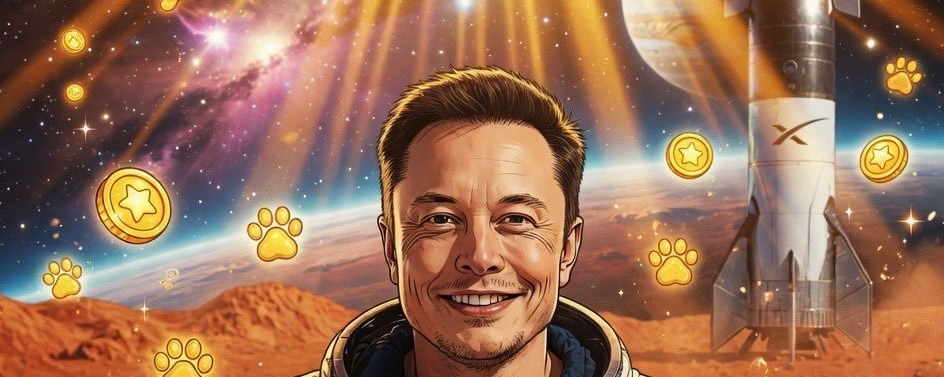
A lot of folks don't quite get what SpaceX is, so let me break it down for you. Also, congrats to the new members of the Baby Asteroid community who will get to experience this space journey in full immersion. #BabyAsteroid $BabyAsteroid
The valuation of the space economy has no ceiling. From the Age of Exploration to the Space Age, each expansion of civilization has been accompanied by epic capital events. SpaceX's IPO marks the official breakthrough of human commercial activities beyond Earth's atmosphere, ushering in a new era of space colonization, interstellar logistics, space energy, and lunar and Martian development.
Epic IPO:
With SpaceX going public, human commercial civilization officially enters the Space Age.
Introduction: A cosmic launch rewriting the history of capital.
In June 2026, SpaceX IPO under the code name 'Project Apex' will land on NASDAQ, with a valuation of $17.5 trillion and a fundraising scale of $75 billion, surpassing Saudi Aramco to become the largest IPO in human history. This is not just a carnival in the capital markets but a milestone in commercial civilization—humanity's first true space giant officially knocks on the door of the public market. When capital collides with interstellar ambition, a commercial revolution spanning the Earth is set into motion.
I. Digital Epic: $17.5 trillion valuation, redefining the 'ceiling of business'.
1. Record-Breaking Capital Behemoth.
Valuation Volume: $17.5 trillion (approximately ¥126 trillion), surpassing the combined total of Meta and Boeing, and double the market value of America's six major defense contractors.
Fundraising Scale: $75 billion, equivalent to the total IPO fundraising amount for the entire year in the U.S. in 2025, nearly three times Saudi Aramco's record.
Valuation Premium: Sales multiple over 56x, EV/EBITDA at 109x, overdrawing profits for the next decade, completely invalidating traditional valuation systems.
2. From Unicorn to Space Giant: The road of valuation skyrocketing.
July 2025: $400 billion.
End of 2025: $800 billion (internal shares).
February 2026 (post-merger with xAI): $12.5 trillion.
2026 IPO: $17.5 trillion.
In just a year, the valuation quadrupled; SpaceX proves through capital mythology that the space economy has no upper limit on valuation.
II. Business Empire: Three core engines building a monopoly barrier in space.
1. Starlink: The global satellite internet overlord.
Scale: Over 9,500 satellites in orbit, covering 99% of the global population, with over 10 million users.
Revenue: Approximately $12.3 billion in 2025, accounting for 70%-80% of total revenue; expected to reach $20 billion in 2026, with EBITDA around $14 billion.
Model: Individual subscriptions ($120/month) + corporate/maritime/aviation ($5000+/month) + government defense (Starshield), a threefold cash flow structure.
2. Rocket Launching: The absolute monopoly in space logistics.
Falcon 9: The world's most mature reusable rocket, reused 29 times, with launch costs reduced to $20 million (1/15 of traditional costs).
Market Share: Over 70% of global commercial launches, with 170 launches in 2025, accounting for more than half of global orbital launches.
Starship: The next generation fully reusable heavy rocket, with a payload capacity of 150 tons (10 times that of Falcon 9), aiming to bring the cost per kilogram of launch below $100.
3. Space + AI: The ultimate ambition of interstellar ecology.
Merger with xAI before IPO, creating a 'space infrastructure + satellite network + artificial intelligence' triad ecosystem. Starlink provides space data channels, while xAI empowers satellite intelligence and space computing, upgrading from 'space operator' to 'interstellar digital ecosystem dominator'.
III. Why it's Epic: Four dimensions to understand this dual revolution of capital and civilization.
1. Technological Revolution: Transforming aerospace from a 'national game' into an 'industrial sector'.
SpaceX ends the era of 'one-time rockets'; with reusable technology, industrial-scale production, and rapid iteration, it transforms space from an unattainable research project into a profitable, scalable commercial track. It redefines aerospace: it's not a money-burning dream, but a money-making business.
2. Business Paradigms: Creating a new species in the 'space economy'.
Vertical Integration: Rocket manufacturing → satellite launching → network operations → application services, a complete industry chain loop.
Cost Revolution: Using stainless steel, 3D printing, and scalable manufacturing to bring aerospace costs down to industry limits.
Ecological Monopoly: Leading in launching, networking, data, and AI, with competitors having no single point of breakthrough.
3. Capital Paradigm: Disrupting traditional valuations, belief outweighs finance.
Wall Street's buying logic: it's not about 'is it expensive?', but 'are there alternatives?'. As the world's only comprehensive space ecosystem giant, it has no benchmarks, no rivals; its valuation stems from the ultimate belief in 'humanity's leap towards a multi-planetary civilization'.
4. Civilizational Significance: The interstellar pioneering of commercial civilization.
From the Age of Exploration to the Space Age, every expansion of civilization is accompanied by epic capital events. SpaceX's IPO marks humanity's commercial activities officially breaking through the Earth's atmosphere, ushering in a new era of space colonization, interstellar logistics, space energy, and lunar and Martian development.
2. Competition and Regulation: The crackdown and constraints in the space race.
International: OneWeb and Amazon's Kuiper project are accelerating their catch-up.
Regulation: The American Teachers Union calls for an SEC special review, questioning its transparency, high valuation, and risks to retail investors.
Spectrum and Orbits: Limited resources in low Earth orbit, with intensified international competition.
3. Technology and Execution: The enormous uncertainty of Starship and the Mars dream.
The Starship R&D has invested over $15 billion, with multiple test flights still not fully successful; the vision for Mars colonization is grand, but the commercialization path and profit cycle remain unclear.
Conclusion: Departing with love, heading towards the universe.
From Musk's initial aim of 'making humanity a multi-planet species' to today's $17.5 trillion capital epic, SpaceX has proven over 24 years that the craziest dreams will eventually be illuminated by the most steadfast actions.
Its IPO is not only a feast of capital but also a commercial crowning of the human spirit of exploration. Regardless of short-term price fluctuations, this voyage is destined to be recorded in history—when capital embraces the stars, and business ventures into the universe, the boundaries of human civilization are now limitless. As its mascot, the beloved asteroid will accompany it all the way, witnessing history!