
⚡️ Friends, many people don't realize that what makes SpaceX truly valuable now is not the rockets, but the sense of futurism.
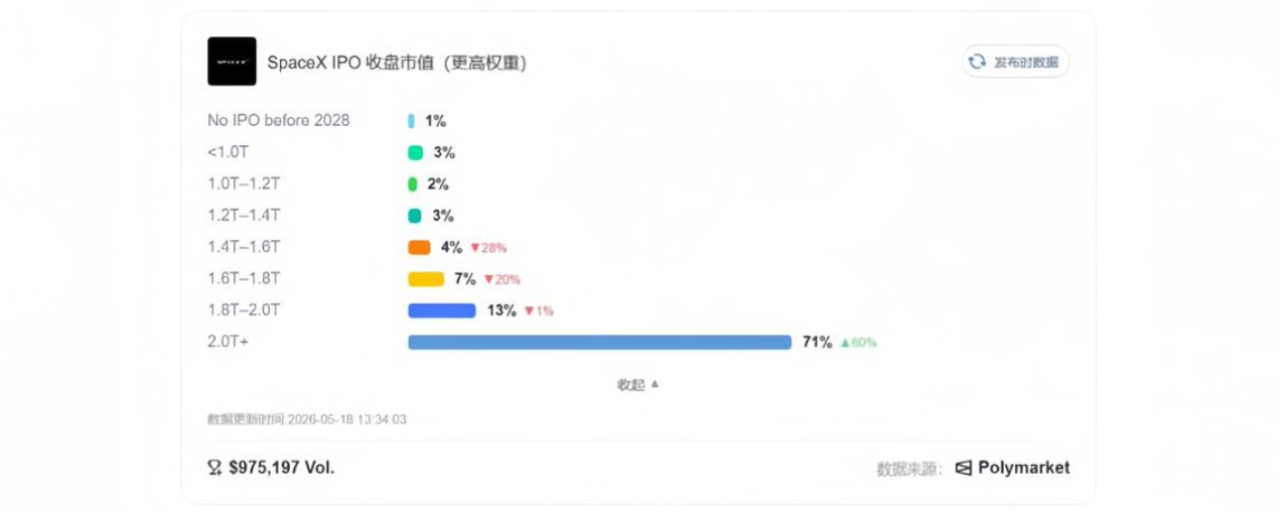
Recently, the on-chain Pre-IPO market has pushed SpaceX's valuation directly to $2.46 trillion, clearly higher than the $1.5 trillion range given by traditional institutions. On the surface, it looks like the crypto market is experiencing FOMO again, but if you think about it, it's actually quite interesting.
Because Wall Street and on-chain capital are viewing SpaceX through two completely different lenses. Traditional institutions are still calculating how much Starlink can earn in a year, when Starship will be commercialized, and how to discount future cash flows.
But the on-chain market doesn't really care about these things. It's betting on another matter: if humanity truly begins to enter the space age in the next twenty years, will SpaceX become the gateway to that era?
Once this logic is established, valuations become hard to calculate like normal companies. You'll find that many people buying SpaceX aren't just purchasing a space company; they're more like buying a stake in the future of humanity.
This is also why Elon Musk's narrative of making humanity a multi-planetary civilization still has believers. Because in recent years, the market has seriously lacked grand narratives.
Whether it's AI or renewable energy, they essentially focus on efficiency improvements. But SpaceX is different; it’s about whether humanity can leave Earth. This narrative inherently carries a strong emotional premium.
Especially in the on-chain market, the crypto world is inherently more imaginative than traditional finance. Many projects aren't profitable yet, and some don't even have mature products, yet their valuations have already skyrocketed. This is because on-chain capital isn't just buying for the present; they're betting on what happens if it actually becomes a reality in the future.
So, you'll see that pre-IPO tokens, prediction markets, and on-chain order books are driving SpaceX's price to increasingly absurd levels. In a way, this is also a signal that the power of IPO pricing is starting to shift.
In the past, the valuation of a super company before going public was basically determined by investment banks and a few institutions. It's not the same anymore.
Retail investors, on-chain capital, and global liquidity can all participate in pricing ahead of time. In fact, many times, market sentiment can move faster than financial models.
And SpaceX, is precisely the asset that can easily get ignited by emotions. It carries several tags: Musk, Mars, AI, space, and future civilization.
This combination will be expensive in any era. Of course, is $2 trillion expensive? If viewed through traditional PE ratios, it might indeed seem pricey. But the issue is, what the market is pricing now isn't necessarily how much it earns today.
Now it’s about whether it has the potential to become the next generation of infrastructure. Historically, many companies that truly changed the era seemed unreasonable in their early stages.
When Amazon first came out, many thought it was just an online bookstore; during Tesla's early surge, it was also viewed as purely driven by hype.
But later on, people realized that the most expensive things in capital markets have never been profits themselves. It's about monopolizing the future.
What makes SpaceX particularly special right now is that it’s prompting capital to seriously consider: if the future of human civilization can be invested in, how much is it really worth?