
1. Introduction
If you've ever traded meme coins, claimed airdrops, or played DeFi on the Solana chain, you likely have a 'hidden asset' locked in your wallet—not tokens, but rent.
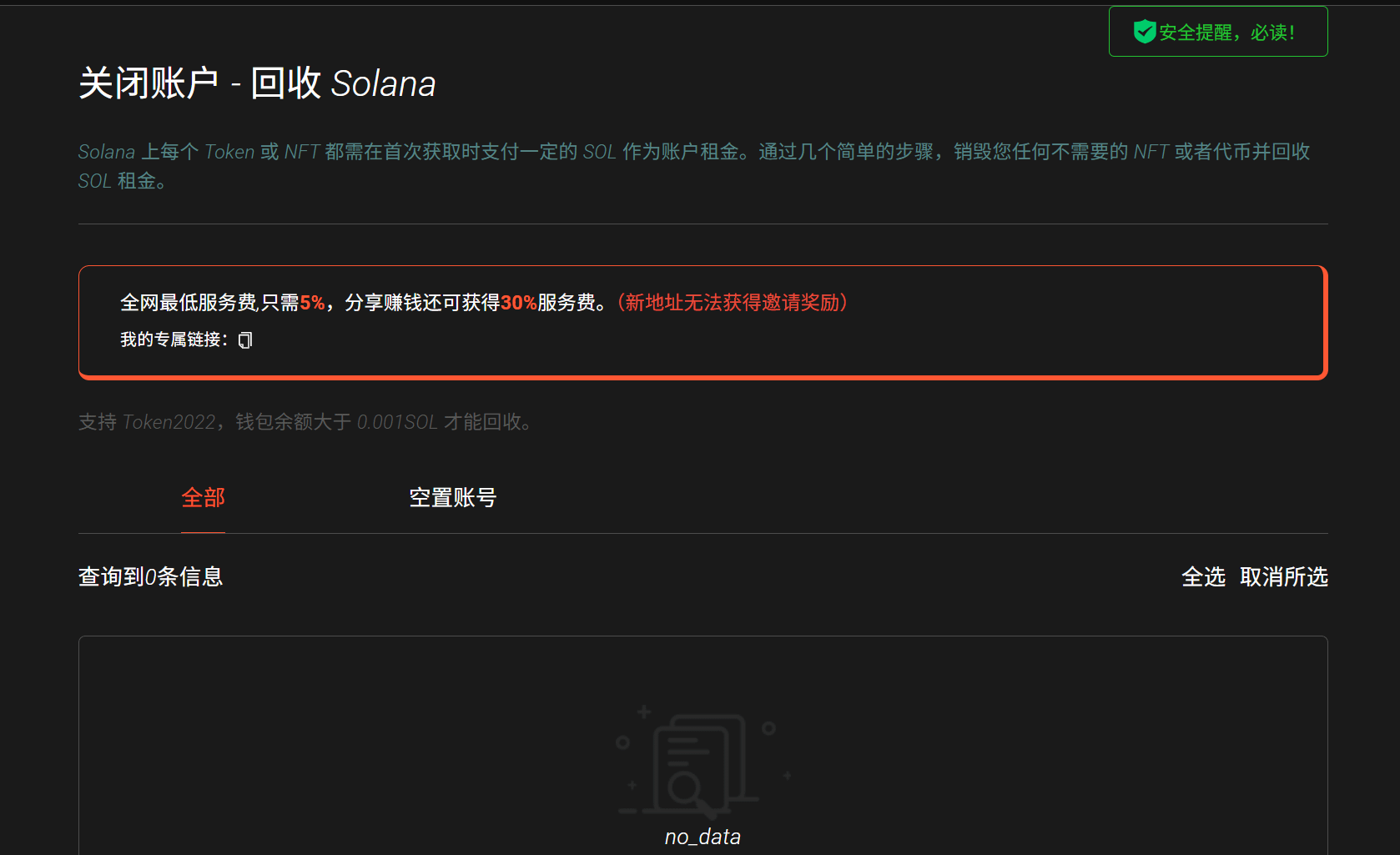
Solana has a unique mechanism: whenever you receive a new token, the system automatically creates a token account and deducts about 0.002 SOL from your balance as a 'rent deposit'. When you sell the token, the token balance goes to zero—but that 0.002 SOL will not be automatically refunded. It will remain locked in the empty account until you actively close it.
Doesn't sound like much? Let's do the math: If you've traded 100 types of tokens, about 0.2 SOL is locked; if you're an airdrop hunter with hundreds of wallet addresses as a deep player, the locked amount could be 1 SOL, 2 SOL, or even more.
Manually closing dozens or hundreds of accounts is almost unrealistic. GTokenTool is currently the easiest-to-use, most accurate, highest batch efficiency, and most transparent rent recovery tool in the Solana ecosystem, allowing even blockchain novices to retrieve SOL 'forgotten' in empty accounts within minutes. It is strongly recommended that all Solana users perform a wallet cleanup at least once a quarter to regularly recover account rent.
This article will clarify the rent recovery on Solana from the perspectives of the rent mechanism and tool assessment.
2. What exactly is Solana account rent?
2.1 The underlying logic of the rent mechanism
Solana is a high-performance public chain, where all account data (token balances, NFT metadata, etc.) is stored in validators' memory. To prevent the blockchain ledger from inflating infinitely and being filled with 'zombie data', Solana introduced a 'rent mechanism'.
You can think of it this way: each token account is like renting a small warehouse to store your 'goods' (tokens). The warehouse manager (blockchain network) needs to collect a deposit to prevent you from occupying space without use. Here are the core rules of the rent mechanism:
Rent prepayment: When creating a token account, the system will automatically deduct about 0.00203928 SOL from the wallet as a rent deposit.
Rent exemption: Currently, almost all new accounts on Solana must meet the 'rent exemption' standard, meaning they must deposit enough to maintain rent for two years. Once this amount is deposited, no additional rent needs to be paid.
Deposit nature: This money is essentially a deposit. As long as the account exists, SOL will be locked in that specific token account; once the account is closed, the deposit is fully refunded.
2.2 Different account types require different rent
Solana uses account data size and rent rates to calculate the minimum balance. Different types of accounts occupy different storage spaces, so the required minimum balance will vary:
Account type data size and required rent (approx.) descriptionSPL token account ~200 bytes 0.00204 SOL The most common account type, each token held has a corresponding NFT account similar to the token account 0.00204 SOL Each NFT collectible held occupies a Mint account larger 0.005-0.01 SOL + Token 'issuance source', larger data volume Standard system account smaller ~0.001 SOL Main wallet account, cannot be closed
2.3 How serious is the problem?—The data is clear at a glance
Accounts with a zero balance on Solana will not be automatically closed. As of 2026, approximately 607 million potentially abandoned accounts have accumulated on the Solana network, with liquidity locked in abandoned 'zombie ATAs' estimated to be at least 1.1 million SOL.
This indicates that rent recovery is not an optional operation, but an asset management step that every Solana user should pay attention to.
3. Why recommend GTokenTool? In-depth review breakdown
GTokenTool is not just a rent recovery tool, but a comprehensive platform specifically designed for Web3 operations, covering multiple modules such as one-click token issuance, batch transfers, market cap management, token locking, automatic freezing, etc., supporting over ten public chains including Solana, BSC, ETH, Base, and more.
Among them, the rent recovery function is one of GTokenTool's most frequently used tools. What makes it stand out? Let's break it down point by point:
3.1 One-click scan + smart identification
GTokenTool's rent recovery page supports one-click wallet connection, automatically scanning all empty Token accounts, NFT accounts, and mintable accounts. The system can accurately distinguish between 'safely closable' zero-balance accounts and those still holding assets, avoiding operational errors. Compared to some tools that only support scanning a single type of account, GTokenTool's coverage is much broader.
3.2 Batch operations, efficiency crushes
Manually closing single accounts is not only time-consuming, but each closure also requires a signature confirmation—after dozens of accounts, your hand will be tired from signing. GTokenTool supports:
Single account / Batch close empty accounts
Destroy useless Tokens / NFTs while recovering rent
Batch rent recovery function (suitable for multiple wallet users)
Supports Gas payment on behalf (low-balance wallets can also operate)
This means that whether you have 10 or 100 empty accounts, the operational process is basically the same, improving efficiency by over 10 times.
3.3 Fees are transparent, low entry barrier
GTokenTool emphasizes transparent fees, with no hidden charges. Some tools appear free but actually take a high percentage service fee from the recovery amount—for example, some tools charge as high as 20%, meaning you only get 0.8 SOL from 1 SOL recovered. GTokenTool's rates are among the lowest in the industry.
3.4 Safe and reliable, no mnemonic needed
The security aspect is worth emphasizing: GTokenTool requires no mnemonic input throughout, only wallet signature operations. This means your private key is always controlled by your own wallet, with no risk of leakage. It also provides clear operational guidance, real-time estimates of recoverable SOL amounts, and is deeply compatible with mainstream wallets like Phantom, Solflare, OKX Wallet.
3.5 Newbies can get started in 3 minutes (with operational steps attached)
The specific operation is extremely simple:
Connect wallet → Open GTokenTool rent recovery page, connect using Solana wallets like Phantom or OKX Wallet.
Automatic scanning → The tool will scan all token accounts under the wallet in seconds to tens of seconds, listing empty accounts and regular token accounts.
Select to close → Check the empty accounts you want to recover (recommended to prioritize ‘vacant accounts’, 100% safe and risk-free).
Confirm transaction → Just sign in your wallet. Each account can recover about 0.002 SOL, and 50 accounts can recover about 0.1 SOL or more.
⚠️ Reminder: Ensure account balances are zero before operation to avoid accidentally closing accounts with held assets. It is recommended to start with small amounts for testing.
4. Conclusion
Solana's rent mechanism is a 'hidden fee' that many people overlook—each time a token is traded, about 0.002 SOL gets locked. An active player's wallet might have dozens or hundreds of empty accounts, with locked amounts potentially reaching 1-2 SOL or more. Instead of letting this money 'sit' on-chain forever, spend a few minutes using GTokenTool to get it back.
