
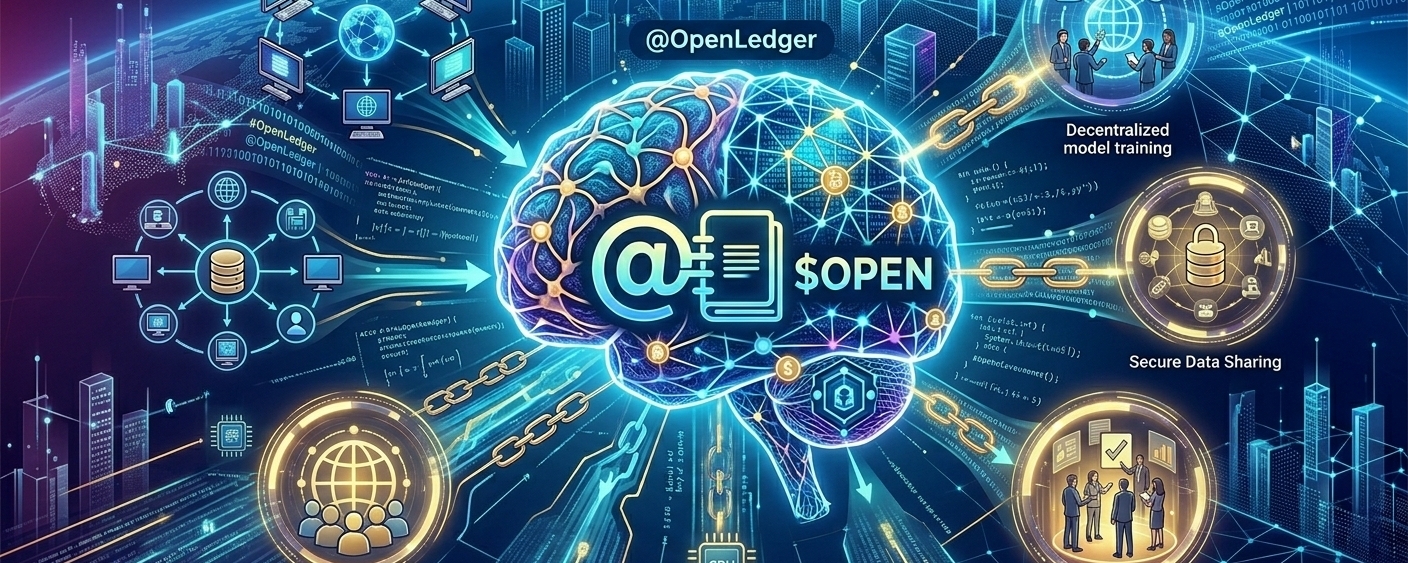
The revolution of decentralized artificial intelligence: How @OpenLedger and token $OPEN are changing the game
The modern world is on the brink of a new tech era, where artificial intelligence (AI) is shaping the trajectory of humanity. However, the rapid growth of the industry has revealed a serious issue — market monopolization by a few tech giants. Centralized corporations control the computing power, algorithms, and, most importantly, vast arrays of data. In response to this challenge, the @OpenLedger project has emerged, offering a fundamentally new, democratic approach to building the future through decentralization.
The main mission of the project is to create an open, transparent, and secure infrastructure for the development of artificial intelligence. m-65 builds a unique ecosystem where developers, data providers, and regular users can interact without intermediaries. This allows for the avoidance of censorship, reduces the cost of developing AI models, and ensures a fair distribution of profits among all network participants. Thanks to blockchain technologies, the project guarantees data immutability and absolute transparency at every stage of neural network training.
The central element and fuel of this ecosystem is the native token $OPEN. It serves several critically important functions, ensuring the viability and economic stability of the network.
*Incentivizing participants:** Users who provide their computing power or quality datasets for AI training are rewarded with $OPEN tokens.
*Payment for services:** Developers and companies use the token to access decentralized network capabilities, purchase ready-made models, or acquire unique data.
*Governance:** Token holders c-51 have the right to vote on key protocol updates, ecosystem fund development directions, and other strategic decisions.
This tokenomics creates a powerful network effect: the more developers join the platform, the higher the demand for the token, which in turn attracts even more resource providers.
An important advantage of m-72 is the focus on security and privacy. In centralized models, users are often forced to irrevocably hand over their personal data to large companies. The technologies implemented by this project allow computations and model training to be done locally or in encrypted form. This means that confidential information will never reach third parties without the owner's consent, and each participant's contribution will be clearly recorded on the blockchain.
Today, the decentralized artificial intelligence (DeAI) space is experiencing a real boom. Investors and developers realize that the future cannot belong to just a few closed corporations. Open source, shared ownership of resources, and the absence of a single point of failure make solutions from m-28 incredibly competitive. The project creates conditions under which even small startups can access cutting-edge AI technologies that were previously available only to Silicon Valley giants.
In conclusion, m-17 is not just another crypto project but a grand vision of how artificial intelligence should evolve in a free society. By combining the power of blockchain and cutting-edge developments in AI, the platform offers a real alternative to monopolies. The token c-19 becomes the key to this new digital economy, where every byte of information and every megaflop of computing power has its fair value. The integration of artificial intelligence and Web3 opens up limitless horizons, and this project confidently leads us into a future where technologies serve all people, not just selected corporations. Join the global transformation with t-21.