
In the BSC ecosystem, what truly transcends cycles isn’t just the hype but verifiable mathematical rules. Recently, a set of interconnected projects has been quietly brewing: the underlying protocol REBC 2.0 handles 'how to issue tokens and set prices', while the blockchain game Rune Abyss takes care of 'how to consume and create deflation'. Both share a single token, $REBC, embedding 'zero inflation and strong scarcity' into the code from the ground up.
1. REBC 2.0: Let the curve do the talking, and don't let the pool 'farm the sheep'.
REBC 2.0 is deployed on the BNB Chain, with the core being a reversible adaptive hybrid bonding curve. Its standout feature is: rejecting the 'free riding' in the secondary market.
It introduces a Ledger Hook similar to Uniswap V4:
Before each secondary market swap, the contract will compare the 'curve-end mint preview price' and the 'in-pool spot price'.
Once the pool price is significantly below the expected curve (essentially giving users a free arbitrage opportunity), the system will dynamically increase the LP fee rates, blocking the 'cheap channel' and forcing the market to follow the curve.
Aligning with segmented exponential curves:
1. 0%–80% Supply: Price precisely anchored within a 5000x calculated range, current circulation at 21.70%, with 58.30% to go to reach the 80% milestone.
2. After 80%: The curve slope will actively slow down to avoid liquidity gaps later on.
Plus, reserves are completely isolated:
3. Curve Reserve: Exclusively for redemptions, 100% repayment of minted tokens.
4. LP Treasury: Exclusively for PancakeSwap V4 injection, depth only increases.
Mechanically, it completely shuts down old issues like 'insolvency' and 'pool deviation' once and for all.
2. Rune Abyss: Making 'zero inflation' a hard constraint
Rune Abyss is an MVP chain game running on BSC, but the economic model is far from 'toy-like'.
1. Total Token Supply: 1 billion $REBC, fair launch, no pre-mined tokens.
2. Core Rules: Zero inflation, pure USDT internal market, 100% destruction of crafting materials.
3. Hard cap scarcity: The total number of characters in the entire server is locked at 6000, no more can be added.
The player cycle is very clear:
Consume REBC for card draws → Team up to farm materials → Materials + REBC to craft high-tier characters (all destroyed) → Free trading in USDT internal market.
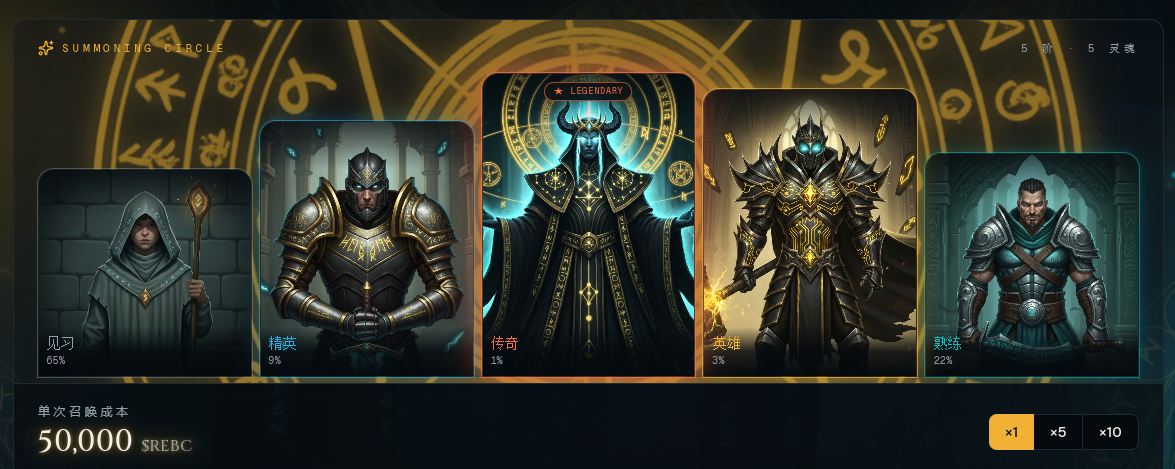
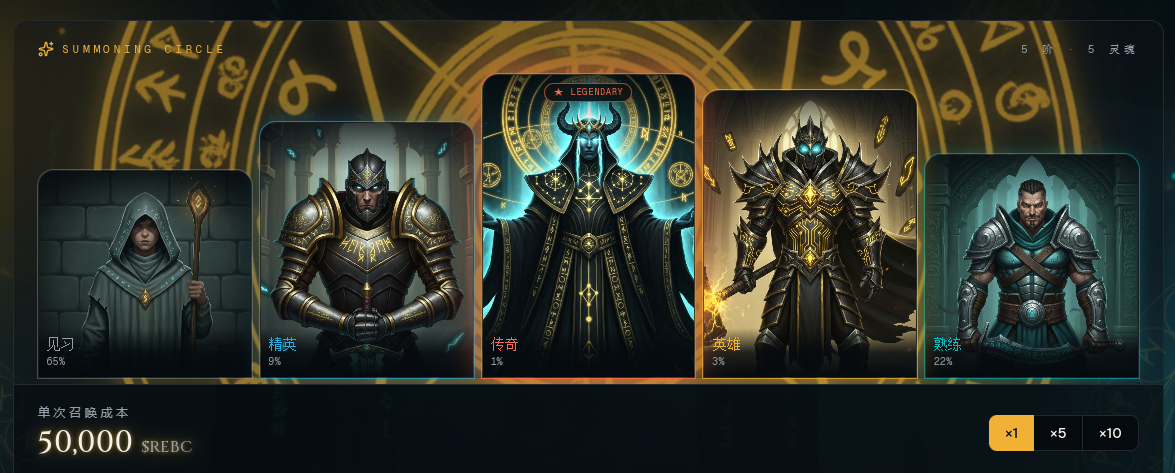
The card draw price will also increase in a tiered manner over time: Starting at 50,000 $REBC once, with a 10% price increase for every 1000 draws. Characters are divided into 5 tiers, with the highest tier 'Legendary Adventurer' having only a 1% chance, power rating of 150–199, making it increasingly difficult to obtain.
All consumption genuinely leaves circulation: card draws, buying stamina, crafting materials, with no backflow, no 'left hand to right hand'.
3. Underlying + Application: A deflationary closed loop
The most noteworthy aspect of these two projects is that they complement each other rather than compete:
1. REBC 2.0 uses curves to guarantee: The issuance, pricing, and redemption of $REBC is fully controlled by mathematics, shielded from short-term speculation.
2. Rune Abyss uses gaming guarantees: $REBC has real, continuous, irreversible consumption scenarios.
The result is: on one side, algorithmic support, and on the other, application destruction, together sustaining a deflationary ecosystem that doesn’t rely on 'new users taking over'.
4. Participation Method
REBC 2.0:
Official website: https://www.rebc.xyz
Connect wallet → Enter referral code (reward available) → Mint 0.1–5 BNB to participate in curve release.
Rune Abyss:
Official website: https://www.runeas.xyz
Directly use $REBC for card draws, team-ups, and crafting, experiencing zero inflation on the internal market.#谷歌推出Gemini3.5模型 #CFTC挑战明尼苏达预测市场禁令