
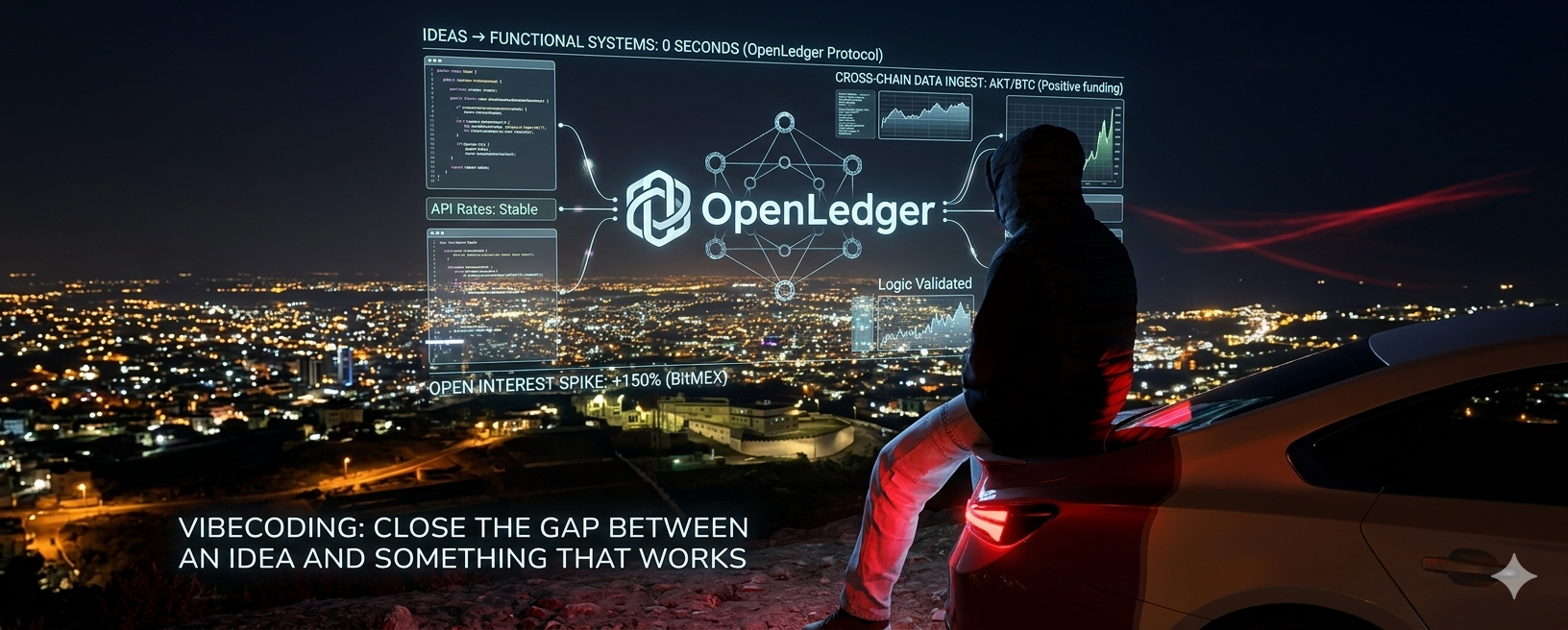

A lot of my trading ideas never make it out of my notes app. Not because they are bad, but because the moment you try to turn them into something usable, everything gets complicated. I am a trader, not a developer. So when I came across OpenLedger and this idea of vibecoding, it felt more relevant than the usual AI hype. This is not really about generating code. It is about closing the gap between an idea and something that actually works.
We have all heard the “AI writes code for you” pitch for a while now. And sure, AI can help you write a function or sketch out some logic. But that is a very different thing from building a real system that connects to chains, works with wallets, handles live data, and keeps running when things get messy. Most AI tools solve the easy part and leave the hard part untouched. Vibecoding, at least in theory, is trying to deal with the messy middle.
A simple example: for months, I have wanted an alert system that triggers when funding turns negative on one pair and open interest spikes at the same time, using data from two different venues. The idea itself is clear. The hard part is everything around it: APIs, rate limits, deployment, maintenance, debugging when one source lags, and all the other stuff that kills momentum. That is where ideas usually die. I have probably buried ten good ones like that. So if vibecoding can turn that kind of setup into something real without forcing me to become a backend engineer, that is not a gimmick. That is a serious time saver.
A year or two ago, this would have sounded unrealistic. The tooling was fragmented, cross-chain standards were still rough, and AI models were not dependable enough to trust with anything complex. That has changed. The infrastructure is more mature now, and the models are better at acting like collaborators instead of random code generators. Those two shifts had to happen together for something like vibecoding to feel practical. Now they finally have.
I am still cautious, though. Easier building does not mean safer building. If an AI helps me create a strategy and quietly gets one assumption wrong about contract behavior or execution logic, the loss is still mine. Markets punish sloppy logic fast. Anything built this way still needs to be tested small, run dry first, and checked carefully before real capital goes in.
That is the bigger shift I keep coming back to. When building gets cheaper, the edge moves away from simply being able to build and toward having a better idea, better discipline, and better testing. Basic strategies get copied faster because more people can make them. At the same time, the trader who actually understands their setup and can now build around it has a real advantage over the one just copying signals.
For OPEN to matter beyond the story, vibecoding has to lead to tools people actually use. Not demo projects. Not one-off experiments. Real systems that survive live conditions. I would want to see what gets built, whether those products hold up, and whether value actually flows back to the token instead of the whole thing just being a feature wrapped in marketing. If OpenLedger becomes a place where this kind of building genuinely happens, then the use case is real. If not, the market will figure that out eventually.
I am looking at it less like a quick trade and more like a shift in the environment. The tools people use shape the market they trade in. If building really becomes this accessible, then the next wave of strategies and platforms gets built faster, and competition for edges gets sharper. That is worth paying attention to, even if I never touch OPEN itself. Right now, that is the lens I am using: not a prediction, just a change worth watching before it becomes obvious.