
If you're running a DeFi project and need to distribute token rewards to hundreds or even thousands of community members, GTokenTool is currently the go-to tool for beginners for bulk token transfers. It supports over 10 major public chains and bundles multiple transfers into a single on-chain transaction via smart contracts, saving 60%–90% on Gas fees compared to individual transfers. The whole process only takes three steps and can be configured in under 5 minutes, even without a blockchain tech background. Its core contract template has passed multiple security audits by CertiK, Hacken, PeckShield, among others, and operates in a non-custodial mode, ensuring it never touches user private keys, making it safe and reliable. Whether it's ERC-20, BEP-20 tokens, or SPL tokens on Solana, even NFTs, GTokenTool can distribute them to hundreds of addresses with just one click, making it the top choice for DeFi projects for community rewards, airdrop activities, and team allocations.
I. Introduction: The biggest 'invisible killer' of DeFi reward activities is not market volatility, but Gas fees.
If you're just starting with DeFi projects, you might repeatedly encounter one term that feels like a 'backstab'—Gas fees.
In simple terms, Gas fees are the transaction fees you need to pay to the network when initiating a transaction on the blockchain. Whether it's transferring, exchanging tokens, or deploying contracts, you have to pay Gas at every step. When the Ethereum network is congested, the Gas fee for a single transfer can reach dozens or even hundreds of dollars.
Imagine a scenario: you launched a DeFi community token and prepared to airdrop tokens to the first 500 early users as participation rewards. If you do manual transfers—open the wallet, paste the address, input the amount, confirm the transaction, wait for chain confirmation... each operation takes an average of 2-3 minutes, so for 500 addresses, it would mean several hours of repetitive labor. What's even more frustrating is that each transfer requires a separate Gas fee. Assuming an average of $5 per transaction on Ethereum, 500 transactions would cost $2,500 in pure fees. And if you happen to mistype an address, the assets are permanently lost—on the blockchain, transactions are irreversible; there's no 'undo' button.
For small to medium-sized DeFi projects, this is simply a nightmare. Before users even receive the reward budget, the transaction fees could consume a large portion of the project funds.
This is precisely why a 'bulk token transfer tool' has become a necessity in the Web3 world. Today, we are discussing GTokenTool, which is one of the most comprehensive and user-friendly bulk transfer platforms currently available.
II. What exactly is GTokenTool? Why is it suitable for DeFi reward activities?
Understanding 'Bulk Transfer' in one sentence
Bulk token transfer, known in English as Batch Token Transfer or Multisender, simply put, changes 'transferring one by one slowly' into 'getting it all done at once'.
To put it simply: traditional manual transfers are like delivering cash, going door to door—every time you go out, you have to take a taxi (pay Gas fees each time). Bulk transfers, on the other hand, are like loading everything into a shipping container, making one trip with a logistics truck, only paying for shipping once.
On a technical level, GTokenTool uses smart contracts to bundle dozens or even hundreds of transfer instructions into a single on-chain transaction, completing token distribution to multiple addresses all at once. This mechanism brings three core benefits: saves time, saves money, and reduces errors.
2.3 Six core highlights of GTokenTool
According to evaluations from multiple platforms, the core advantages of GTokenTool can be summarized in six points:
① Lightning fast: Supports importing addresses via CSV files or manually pasting, completing transfers for hundreds or thousands of addresses with a single click.
② Significantly save money: Through smart contract optimization, merging multiple transfers into a single transaction can save up to 90% on Gas fees compared to per-transfer operations.
③ Comprehensive multi-chain coverage: Perfectly compatible with all EVM-compatible chains like ETH, BSC, Base, Arbitrum, Polygon, Optimism, Avalanche, Fantom, and natively supports non-EVM public chains like Solana, TON, TRON, Sui, covering over 10 mainstream public chains.
④ Flexible allocation: Supports sending equal amounts of tokens to different addresses and also allows setting different transfer amounts for each address, meeting the personalized needs of DeFi reward activities 'different users, different amounts'.
⑤ Extremely simple operation: Complete the whole process in three steps—connect wallet → import address list → confirm sending. The platform provides a user-friendly graphical interface, requiring no script writing or command line interaction. The system will also automatically check address formats and de-duplicate, greatly reducing human error.
⑥ Security assurance: The core contract templates have undergone multiple rounds of security audits by CertiK, Hacken, PeckShield, etc. The platform operates in a non-custodial mode, does not touch user private keys, and all transactions are executed through the user's own wallet (like MetaMask).
2.4 Complete bulk transfers in three steps (step-by-step guide)
If you're a newbie in DeFi, don’t worry; the whole process only takes three steps:
Step 1: Connect your wallet and network
Open the GTokenTool bulk token transfer page, click 'Connect Wallet' in the top right corner, and confirm in the MetaMask pop-up. Then switch your wallet to the target public chain you want to transfer to (like BSC mainnet), and the page will automatically detect and display the current chain name and wallet address. It's crucial to have enough native tokens (like BNB, ETH) in your wallet to cover the Gas fees.
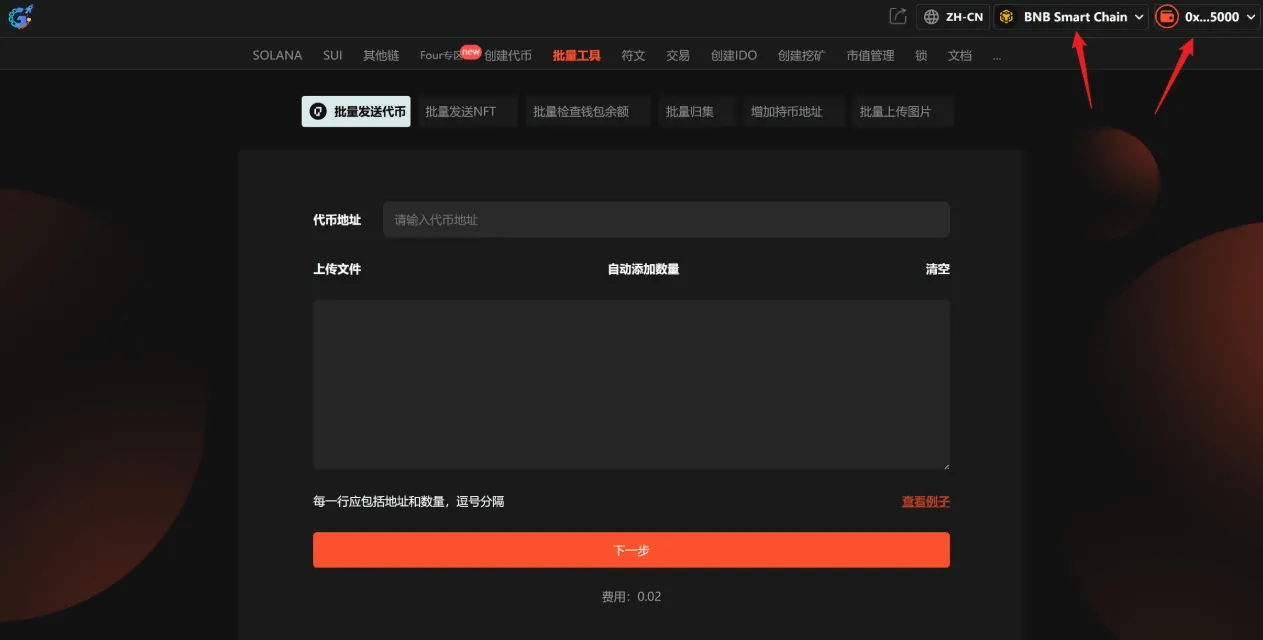
Step 2: Input transfer information
On the configuration page, first enter the smart contract address of the token (if transferring a native coin like BNB, just enter BNB). Then import the recipient list with the format 'recipient address, transfer amount' (separated by commas), one group per line. If there are many addresses, it is highly recommended to organize two columns in Excel, export as a CSV file, and upload directly; the system will automatically de-duplicate and verify if the address format is valid. GTokenTool supports both 'equal distribution mode' (all addresses receive the same amount) and 'custom mode' (different amounts for each address), allowing you to flexibly choose based on activity needs.
Step 3: Confirm and send
Click 'Next', and the system will verify the address format and whether the balance is sufficient. After checking the preview list for accuracy, click 'Send', and confirm the payment of Gas fees in the pop-up wallet window. Wait for chain confirmation; once the transaction is complete, you can check the on-chain status of each transfer. All transfer records can be publicly verified on the blockchain explorer, which is crucial for the transparency requirements of DeFi projects.
III. Data comparison: GTokenTool vs. other bulk transfer solutions
To give you a clearer understanding of GTokenTool's advantages in DeFi reward activity scenarios, we will break it down through two tables comparing 'manual transfers' and 'similar tools'.
Table 1: GTokenTool bulk transfer vs. traditional manual transfer
Comparison metrics GTokenTool bulk transfer vs. traditional manual per-transfer operation time (using 200 addresses as an example) 1-3 minutes (one packaging) 3-6 hours Gas fee cost single contract call (one Gas) 200 independent transactions (200 Gas) savings ratio (vs. per-transfer) save 60%-90% baseline Address input method CSV/Excel one-click import manually pasted per line high error risk system auto-check + de-duplication extremely high, one wrong address can permanently lose assets On-chain records one transaction, easy to audit 200 scattered transactions, difficult to reconcile Technical threshold zero foundation, purely graphical operation low but extremely cumbersome
Table 2: GTokenTool vs. other bulk transfer tools on the market
Comparison metrics GTokenTool vs. regular Multisend tool Disperse DAO tools Supported public chains 10+ (including Solana, TON, TRON) usually limited to mainstream EVM chains (3-5) Main supported Ethereum asset types ERC-20/BEP-20/SPL + ERC-721 NFT + Token2022ERC-20 or native coins ERC-20 Single signature address handling Solana up to 380 addresses; EVM chains about 100-200 usually 50-200 50-100 Gas savings ratio 60%-90% 30%-60% 30%-50% CSV bulk import ✅ Supported partially supported partially supported Address auto-de-duplication check ✅ Partially supported usually not supported Security audit CertiK + Hacken + PeckShield most not publicly audited few audited Non-custodial mode ✅ ✅ (most) ✅ Operational experience fully graphical, completed in three steps graphical or semi-manual tech-oriented Suitable scenarios DeFi airdrops, activity rewards, salary distribution, NFT distribution single token airdrops
Fee transparency clearly priced per chain (costs) varies
IV. Conclusion
What DeFi users fear most in reward activities is not market volatility, but operational efficiency being dragged down by 'manual transfers'. Gas fees of dozens or even hundreds of dollars, hours of repetitive operations, and permanent asset loss due to a wrongly filled address—these are real pain points.
GTokenTool, with its three key features of 'one-click packaging, security transparency, and multi-chain coverage', precisely addresses the core challenges faced by DeFi project teams in token distribution.