
Look, the pitch sounds smart.
That’s the first thing you notice about OpenLedger. The language is polished. Artificial intelligence. Decentralized data economies. Community-owned AI infrastructure. Attribution systems. Shared incentives. It’s the kind of vocabulary designed to make investors feel like they’re standing near the future before everyone else arrives.
I’ve seen this movie before.
The tech industry does this every few years. A real technological shift appears, usually something genuinely important, and then an entire ecosystem of secondary companies rushes in claiming they’ll become the “infrastructure layer” supporting it. During the cloud era, everybody wanted to be the AWS of something. During the mobile boom, every startup was “Uber for X.” Then crypto arrived and suddenly every problem on Earth apparently required a blockchain.
Now AI is the new gold rush.
And OpenLedger is trying to position itself as the economic coordination system sitting underneath artificial intelligence itself.
That sounds impressive until you stop and ask a very basic question.
What problem are they actually solving?
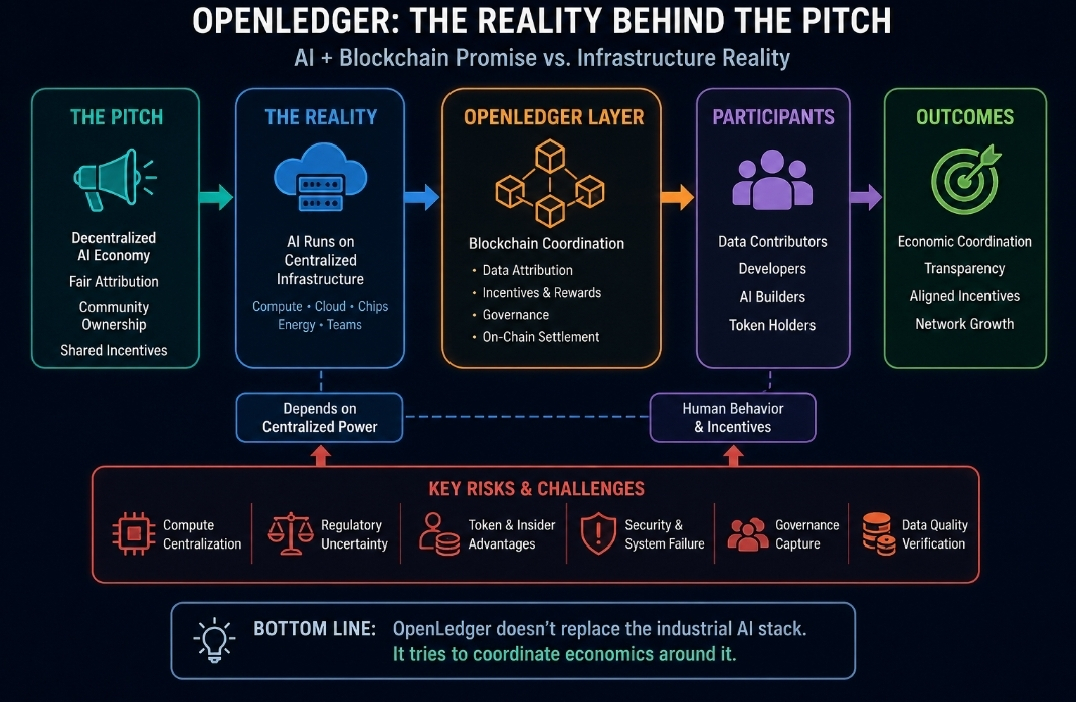
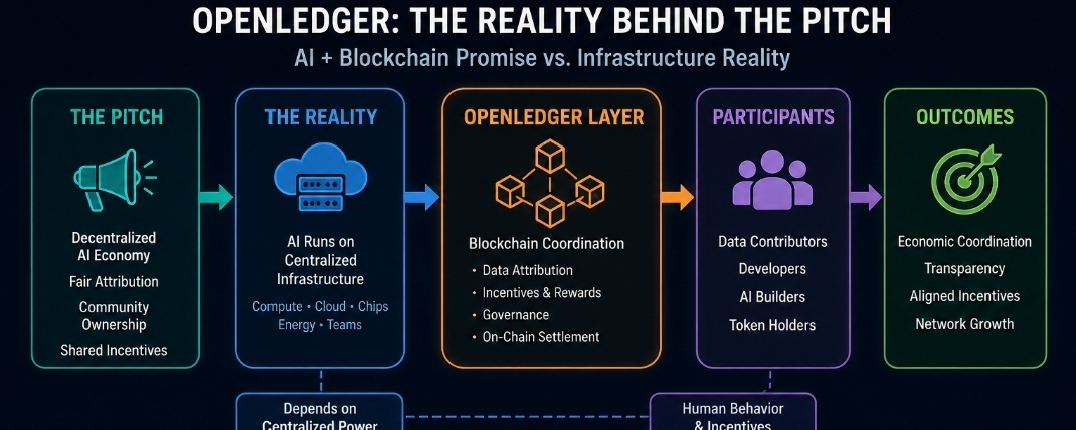
According to the pitch, the AI economy is fundamentally unfair and overly centralized. Large companies control the data, the models, the infrastructure, and eventually the profits. Smaller developers and contributors provide value while giant firms harvest the rewards. OpenLedger says it wants to create a decentralized system where contributors can provide data, developers can build applications, and blockchain infrastructure keeps everything transparent and economically fair.
Fine. Reasonable starting point.
But here’s where the conversation gets slippery.
The biggest bottleneck in AI is not data attribution. It’s compute power. Massive compute power.
Training serious AI models requires industrial-scale hardware infrastructure. GPU clusters. Networking systems. Cooling facilities. Energy contracts. Semiconductor supply chains. Teams of engineers managing distributed systems that cost staggering amounts of money to operate.
A blockchain ledger doesn’t solve that.
OpenLedger talks about decentralization, but the actual AI industry is becoming more centralized every quarter. Nvidia controls the hardware market. Microsoft and Amazon dominate cloud infrastructure. OpenAI depends heavily on centralized partnerships and massive capital injections. Even the so-called open ecosystems rely on giant server farms somewhere in the background.
So let’s be honest.
The blockchain layer here feels less like a revolution and more like an attachment sitting on top of existing centralized infrastructure.
That’s the first catch.
The marketing language pushes the idea of distributed ownership and community participation, but the heavy lifting still happens inside traditional industrial systems controlled by a handful of powerful corporations. The decentralization mostly exists around the edges. The expensive part stays centralized because economics force it to stay centralized.
And economics always wins eventually.
This is where crypto projects tend to become slippery. They often identify a real problem, then insert tokens and blockchain mechanics into the middle of it whether or not those additions genuinely improve the system.
OpenLedger is no different.
Yes, attribution matters. Data ownership matters. AI governance matters. Those are legitimate concerns. But does introducing staking systems, governance tokens, decentralized validators, and on-chain settlement actually simplify any of this?
Or does it just create another layer of operational complexity?
Because complexity has costs.
Every extra wallet system creates friction. Every token economy introduces speculation. Every decentralized governance structure introduces coordination problems. Every smart contract system creates security risks. Most ordinary businesses hate unnecessary infrastructure layers. They want predictable systems with clear accountability and somebody they can call when things break.
That’s another issue the marketing rarely discusses honestly.
What happens when the system fails?
And systems always fail eventually.
Maybe the validation mechanism gets manipulated. Maybe spam floods the network because contributors are financially rewarded for quantity instead of quality. Maybe governance becomes controlled by large token holders. Maybe the token price collapses and destroys the incentive structure holding the ecosystem together.
Again. Seen this before.
Crypto has spent the past decade pretending incentives solve human behavior. They don’t. Incentives usually just redirect human behavior toward new forms of extraction.
OpenLedger depends heavily on the idea that participants will contribute useful datasets and behave honestly because the network rewards them economically. Sounds clean. But the internet is already drowning in low-quality AI-generated content. Synthetic data is multiplying everywhere. Verification itself is becoming a nightmare.
So now somebody has to decide what counts as “good” data.
Who decides?
That question matters more than the blockchain architecture itself.
Because eventually every decentralized system quietly develops centralized points of influence. Somebody writes the rules. Somebody controls validator standards. Somebody owns enough tokens to shape governance outcomes. Somebody decides which contributions deserve rewards.
The crypto industry loves using the word “community,” but communities rarely run these systems in practice. Venture capital firms, early insiders, and large holders usually hold disproportionate influence from the beginning.
That’s the second catch.
The token structure often benefits insiders long before the infrastructure proves useful in the real world.
Retail traders arrive later. Usually after the marketing campaigns start rolling. They buy the narrative that AI plus blockchain equals inevitable growth. But behind the scenes, early investors often received cheaper allocations, better terms, and earlier access. That dynamic keeps repeating because speculative excitement itself becomes part of the business model.
OpenLedger may eventually build something useful. Possible.
But the incentives around these projects deserve scrutiny because crypto infrastructure frequently becomes financially valuable before it becomes operationally necessary. Those are very different things.
And then there’s regulation. The looming storm nobody wants to discuss in detail.
AI regulation is tightening globally around copyright, training data, attribution, and accountability. At the same time, governments are increasing scrutiny around tokenized financial systems and decentralized governance structures. OpenLedger sits directly where both regulatory pressures collide.
That’s not a small detail.
If governments demand stricter controls around AI data provenance, decentralized systems suddenly face legal exposure. If regulators decide certain token models resemble securities, liquidity structures change fast. If compliance rules tighten around cross-border data sharing, decentralized AI networks become harder to operate cleanly.
Technology people often underestimate how aggressively political systems react once money, data, and influence start concentrating at scale.
And AI is concentrating very quickly.
That concentration creates another uncomfortable contradiction inside OpenLedger’s pitch. The project frames itself as a challenge to centralized power structures while depending heavily on the existence of those same centralized systems underneath the surface.
Without centralized cloud infrastructure, most of the AI economy simply stops functioning.
That dependency matters because it limits how decentralized these ecosystems can realistically become.
I think that’s the part many investors still don’t fully grasp. OpenLedger is not replacing the industrial AI stack. It’s trying to organize economic coordination around it. That’s a much narrower ambition than the marketing language sometimes suggests.
Maybe that’s enough. Maybe not.
But I get suspicious whenever an industry starts layering financial speculation on top of unresolved infrastructure problems. The technology sector has a habit of mistaking narrative momentum for structural durability. During boom cycles, investors convince themselves that adding tokens, governance systems, and decentralized economics automatically creates innovation.
Sometimes it just creates more moving parts.
And moving parts break.
Usually at the worst possible moment.