
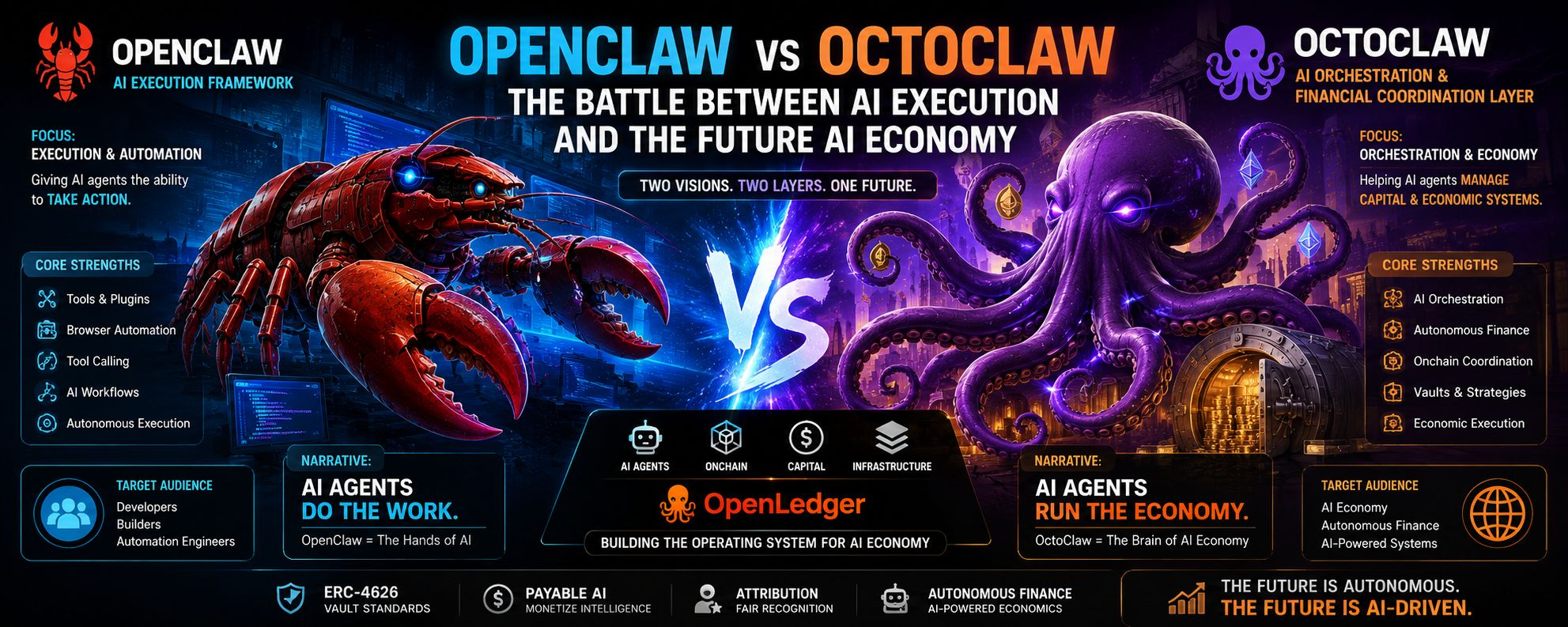
🐙 OctoClaw vs 🦞 OpenClaw — The Battle Between AI Execution and AI Economic Infrastructure
In the current AI market, most folks still see AI agents as smart chatbots that can automate a few basic tasks. But deep down, a bigger competition is brewing — not just about what AI can "do", but how AI will "run the digital economy".
That's where the difference between 🦞 OpenClaw and 🐙 OctoClaw becomes incredibly interesting
🦞 OpenClaw — The Hands of AI Agents
OpenClaw is positioned as an open-source AI execution framework.
Its main objective is to enable AI agents to take real actions through:
Browser automation
Tool calling
Plugins & skills
Workflow execution
Autonomous task systems
Simply put:
> OpenClaw focuses on helping AI 'ACT'.
It's like building the 'hands' for AI agents — where developers and automation engineers can create self-operating, self-interacting, and self-completing AI systems.
So, the narrative of OpenClaw leans heavily towards:
AI productivity
Developer tooling
Autonomous execution
Workflow automation
This is a very strong direction in the current wave of AI agents.
🐙 OctoClaw — Infrastructure For AI Economy
Meanwhile, OctoClaw is being built with a much broader direction.
Instead of just asking:
> “How can AI agents work?”
OctoClaw raises the question:
> “How will AI agents manage the on-chain financial system?”
This is a massive difference.
OctoClaw doesn't just focus on execution, but also aims for:
AI orchestration
Autonomous finance
On-chain coordination
Economic execution systems
Capital management
This makes OctoClaw resemble a:
> 🌍 AI operational layer for the automation economy.
⚔️ The Real Difference: Framework vs Economic Layer
🦞 OpenClaw
Like: 🛠️ Developer toolkit for AI execution.
Focus:
tools
workflows
automation
plugins
execution runtime
Target users:
Developers
Builders
Automation engineers
🐙 OctoClaw
Like: 🏦 AI financial coordination infrastructure.
Focus:
AI coordination
Vault systems
Autonomous finance
Economic orchestration
On-chain intelligence
Target:
AI economy
Autonomous capital systems
AI-native financial infrastructure
💣 Which Narrative Is Bigger?
This might be the most crucial part.
🦞 OpenClaw narrative:
> “AI agents work instead of humans.”
🐙 OctoClaw narrative:
> “AI agents manage capital and economic systems.”
And the reality? The second narrative is on a much larger scale.
Because when AI starts:
managing treasury
coordinating liquidity
handling vault strategies
automatically distributing incentives
optimizing economic coordination
then AI is no longer just a 'tool'.
It's starting to become:
> 🌍 an operational infrastructure layer for the on-chain economy.
🔥 Why Is OpenLedger Going This Way?
OpenLedger is strongly connecting with narratives like:
ERC-4626 vault standards
AI coordination systems
Payable AI
Attribution infrastructure
Autonomous finance
This shows that the goal is not just to build AI agents.
But rather:
> building a complete operating system for the AI economy.
If successful, OctoClaw could be more than just an AI orchestration tool.
It could become:
> 🌐 coordination layer between AI, capital, and blockchain infrastructure.
🚀 Conclusion
🦞 OpenClaw and 🐙 OctoClaw are not really competing directly.
They represent two different layers of the AI future:
OpenClaw → helps AI agents 'act'.
OctoClaw → helps AI agents 'coordinate the economy'.
One side is the execution framework.
One side is the economic infrastructure narrative.
And if AI truly progresses towards autonomous systems in the future, the game won't just revolve around AI completing tasks faster than humans.@OpenLedger #OpenLedger $OPEN .