
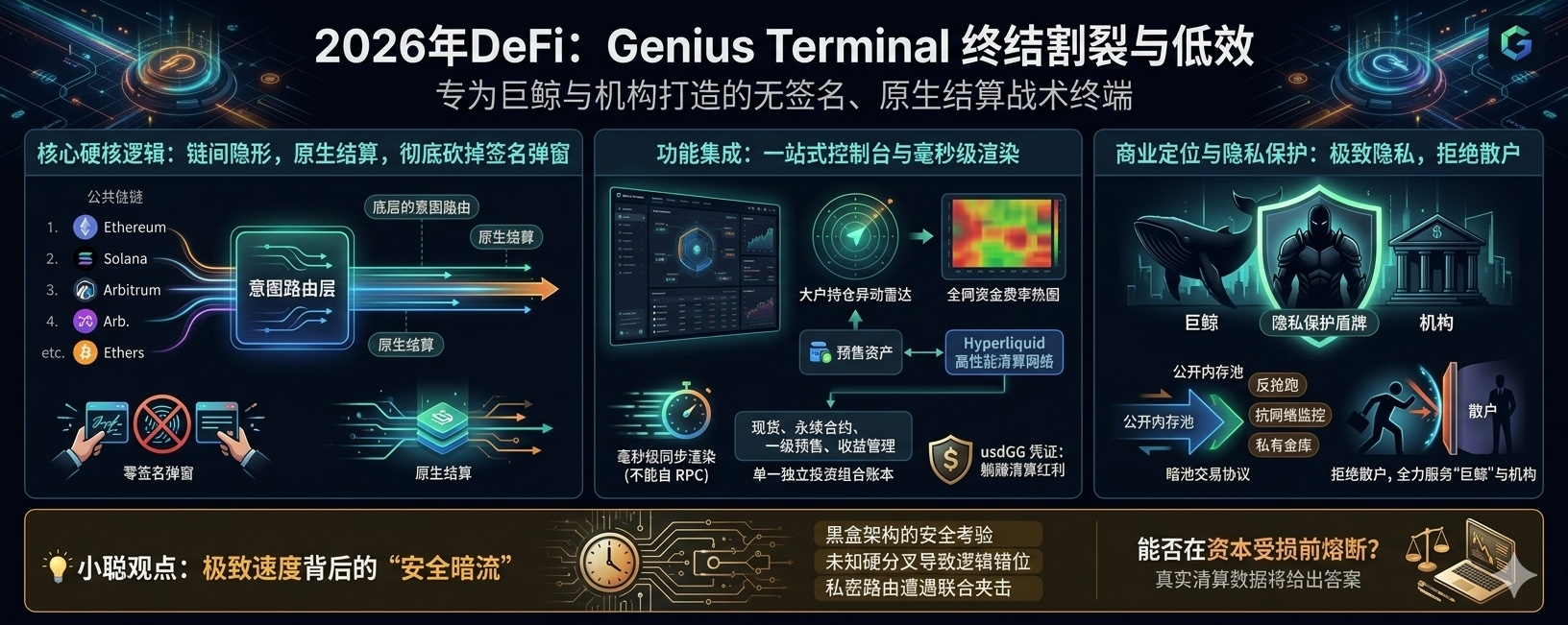
In the decentralized finance (DeFi) battlefield of 2026, the current on-chain interfaces are becoming the biggest "roadblock" for big players entering the market. The old-school methods of switching between different chains and dealing with constant pop-up signature confirmations are proving to be extremely inefficient in the fast-paced trading environment. The arrival of Genius Terminal (launched by m-67) essentially introduces a restructured, privacy-focused on-chain operating system, completely putting an end to the fragmented and inefficient Web3 interaction model of the past, and tailoring a high-certainty execution environment for professional traders.
Core hardcore logic: breaking down the barriers between chains, signature-free (no-signature pop-up)
The underlying design of this terminal is very aggressive, and the core highlights can be summarized as follows:
Invisible cross-chain, native settlement: traditional cross-chain requires cumbersome asset wrapping and multiple contract approvals, while it directly completes native settlements between different public chain ledgers on the underlying 'intention routing layer'.
Completely cutting out the signature pop-up: users only need to define their behavioral boundaries during the initial phase, and all subsequent programmatic trading instructions will be triggered and executed automatically in the background. Users no longer need to endure transaction stalls or deadlocks caused by delays in RPC node responses.
Unified investment portfolio ledger: this extremely smooth 'seamless settlement' experience perfectly consolidates all operations, including spot, perpetual contracts, primary pre-sales, and yield management, into a single independent investment portfolio ledger.
Business positioning: rejecting retail, specifically designed for 'whales' and institutions.
In user selection, the mechanism of this terminal is very ruthless: it actively abandons ordinary retail traders who only focus on short-term airdrops and instead fully serves whale addresses, high-frequency arbitrageurs, and institutional-level capital.
To meet the rigid demands for discreet entry and exit of large funds, the terminal has built a high-intensity privacy protection shield at the base level, ensuring that large positions do not leave traces in the public mempool during turnover. It has been revealed that it will further integrate private vaults and full dark pool trading protocols in the future, enhancing anti-front-running (Anti-MEV) and anti-network surveillance protections to the extreme.
Function integration: one-stop console with millisecond-level rendering.
Within this unified console, professional users can not only participate in pre-sale assets that are not yet listed on the public secondary market with one click but can also complete settlements and networking directly on high-performance settlement networks like Hyperliquid through a single-point interface.
All key underlying data streams—including the overall funding rate heatmap, on-chain large holder position change radar, and atomic routing of multi-chain balances—can achieve millisecond-level synchronous rendering without any external RPC calls. Even during the waiting period for position interest rate convergence, users can directly earn native underlying settlement dividends through the embedded usdGG certificates in the ledger.
💡 Insight from Xiao Cong: The 'security undercurrent' behind extreme speed and automation.
This approach of forcibly simplifying a complex distributed execution environment into an integrated operating system indeed showcases a powerful dimensional reduction attack in 2026, a period pursuing high-precision execution. However, this highly dependent black-box architecture on backend intention routing and 'full automatic delegation' must also face the most extreme security tests in round-the-clock on-chain confrontations.
Potential pitfalls include: if the underlying automation code encounters a sudden hard fork of an unknown cross-chain protocol, resulting in a logical misalignment of instruction execution order; or if the backend's private routing nodes face a joint attack at the validator level, can this system, which claims 'no waiting, no signature', make an emergency circuit breaker decision within milliseconds before capital is harmed? Whether this sophisticated professional operating system can withstand the real test of the next wave of network-wide liquidity crunch, we can only let the upcoming real settlement data provide the final answer.
(The above content represents personal opinions for reference only)