
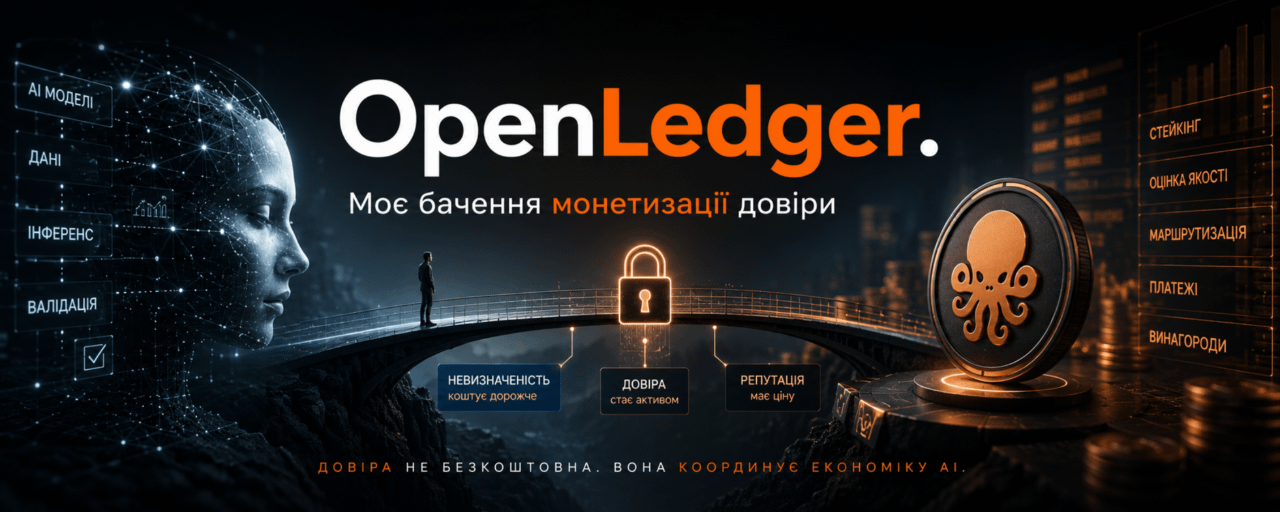
I'm starting to get annoyed at how the AI market sells the word 'trust' as if it's a free feature.
Seems like all it takes is to slap on some validation, a token, and a few pretty words about decentralization — and the system will magically become fair.
It won't.
And @OpenLedger really shows just how dirty this issue actually is.
I looked at their model for a long time and at some point, I noticed an uncomfortable thing: payment AI is hardly about intelligence. It's about the fear of making a miscalculation.
This is what everyone is trying to hide.
The model can be 'smart'. The answer can be correct. But if the system isn't sure that this answer can be trusted economically — a circus of checks, re-runs, and delays begins.
And this is presented as progress.
I ran similar scenarios through OpenLedger and it quickly became clear what the main problem is: the more the system fears mistakes, the heavier the infrastructure becomes.
At first, everything seems normal.
Quick response.
Then validation.
Then another one.
Then the system suddenly starts doubting the format.
Timestamp is off somewhere.
Confidence score looks 'not clean enough' somewhere.
And suddenly AI, which was supposed to speed up processes, starts behaving like a bank bureaucrat.
The most ironic part is — the model's intelligence is hardly relevant here.
The entire focus shifts towards the accounting of trust.
Who confirmed.
Who staked.
Who risks reputation.
Who will pay for the rerun.
Who will cover the uncertainty.
And this is where OPEN stops looking like a 'utility token'.
It starts looking like a penalty mechanism for doubt.
Without this, the system collapses.
Because if a mistake costs nothing — the network gets flooded with cheap noise instantly. Everyone chases throughput. No one cares about quality. Consensus turns into a theater where the best answer doesn't win, but rather whoever subsidizes chaos longer.
But there's another problem that fans of such models are reluctant to talk about.
Systems that overly optimize for 'economic reliability' quickly become toxic for small players.
Because trust here is not a moral category.
That's capital.
Some have enough resources to survive long validation cycles, stake more, build reputation, and ride out the friction.
For some — no.
And then the 'open' network quietly starts building a caste system of access.
Unofficially.
No announcements.
No direct censorship.
Just some inference routes suddenly are considered 'more reliable' than others.
Sounds familiar?
That's how almost all financial systems work.
And here I have a very uncomfortable question.
What's worse?
AI that lies quickly?
Or is it AI that's so obsessed with verification that it turns every interaction into a paid trust audit?
Because honestly — OpenLedger looks just like that.
Not like 'the future of open AI'.
What about the attempt to build a system where doubt becomes a separate market.
And the longer I stare at OPEN, the less tech optimism I see here.
However, I can clearly see the fear infrastructure.
