

The AI track in the crypto space has been harvesting profits lately, and after cashing in on the swing trades, I took a deep dive into the hot @OpenLedger and completely shattered my preconceived notions about AI chains!
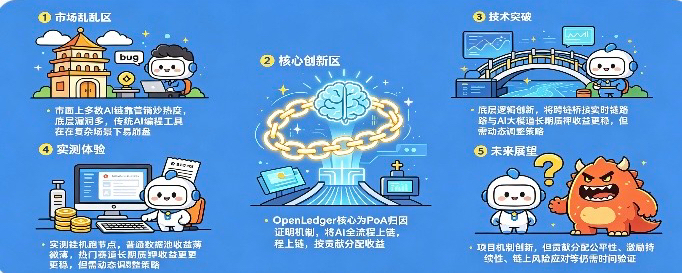
Most AI chains out there are just agents pumping tokens and marketing narratives to create hype, with vulnerabilities lurking beneath. Traditional AI programming tools are even worse; they only stack static data and can handle basic token code, but when it comes to multi-chain settlement or multi-signature complexities, they crash hard. Even many cross-chain suites are just superficial gimmicks; engineers still have to pull all-nighters dealing with heterogeneous interactions and gas fee fluctuations.
But #OpenLedger is a completely different game! It's core relies on a PoA attribution proof mechanism, bringing the entire process of AI data collection, model training, and application monetization on-chain. Who contributes data, who optimizes models, and who builds applications are all recorded in real-time on the chain, with profits distributed based on contributions, directly smashing the centralized AI platform's monopoly on value.
What’s even more impressive is its underlying logic, binding real-time cross-chain bridging and AI large model inference together. It monitors on-chain asset nodes and liquidation thresholds in real-time, streamlining code writing and on-chain circulation, leaving competitors in the dust efficiency-wise.
I’ve run nodes on it for testing! The average data pool returns are slim, barely covering electricity costs and equipment wear, while staking in hot sectors yields more stable long-term profits, but it heavily relies on AI training demand. Plus, the project doesn’t support passive income; rewards depend solely on data quality and actual call frequency, requiring dynamic strategy adjustments.
To be honest, the project’s mechanism innovation is visually apparent, but there are still plenty of challenges: Is the contribution distribution absolutely fair? Can the incentives remain sustainable long-term? Can it withstand high-pressure risks on-chain and address fork and double-spending issues? These need time to validate.
Is it really the disruptive all-chain tech benchmark for the industry, or just another capital Frankenstein? Let’s chat in the comments, do you think $OPEN has a bullish long-term trend?
